Summary
- Work in phases: baseline, schedule, front desk, billing, people and reporting.
- Fix the schedule and the front desk before you buy software or hire.
- Run two or three priorities at a time, and write down every routine you change.
- Review the numbers monthly so the improvements outlast the person who started them.
Most practices do not fail because of one big mistake. They drift: a few workarounds at the front desk, a schedule that grew by habit, a billing backlog that nobody owns. Every practice management consulting project I run starts by turning that drift into an ordered plan.
This playbook follows the same order I use with clients. Each phase has a goal, a few priorities and a point where you decide whether to move on. You can run it yourself, or use it to brief a manager or consultant.
Six Phases, Summarized
| Phase | Goal | Move on when | Typical time |
|---|---|---|---|
| 1. Baseline | Know where you stand | Six numbers recorded for one month | 2 to 4 weeks |
| 2. Schedule | Fill capacity, cut no-shows | No-show rate has dropped for two months | 1 to 2 months |
| 3. Front desk | Shorter check-in, fewer errors | Routines written and used by all | 1 to 2 months |
| 4. Billing | Faster, cleaner payment | Days in A/R falling for two months | 2 to 3 months |
| 5. People | Clear roles, steady team | Every role has a written description and a cover | 1 to 3 months |
| 6. Reporting | Steer with a monthly report | Three reports delivered on time | Ongoing |
Choosing Your Priorities Before You Start
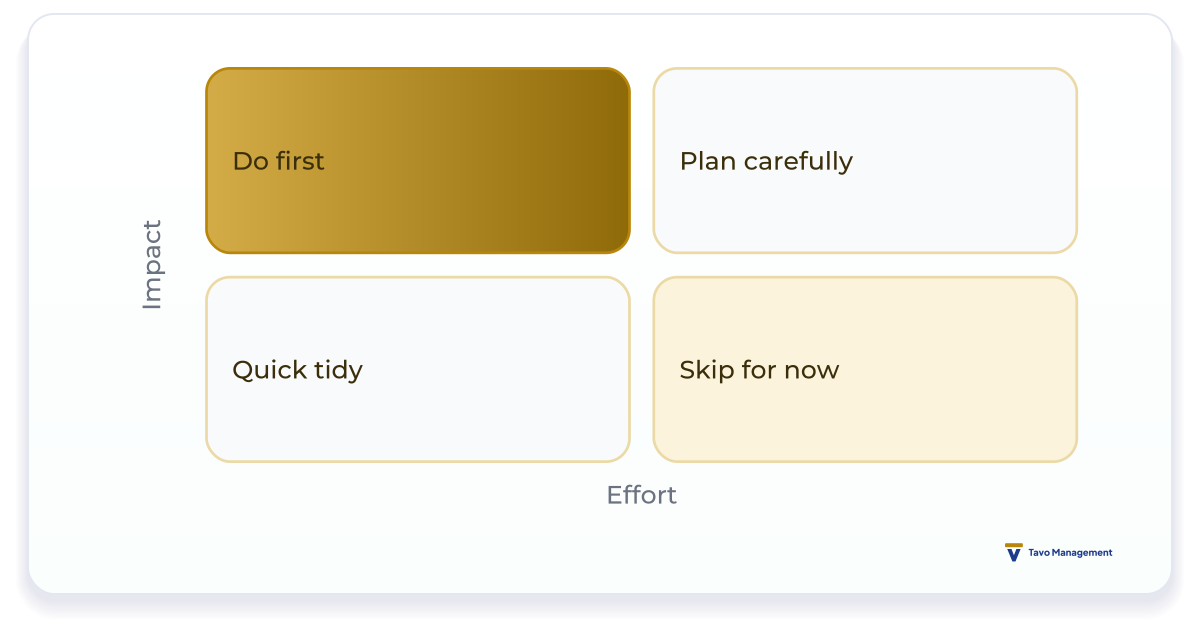
Resist the urge to fix everything. A practice with two administrators and four providers has little spare time, so every change competes with patient care. I rank candidate changes by two questions: how much money or time does it save, and how hard is it to put in place? Start in the top left, high payoff and low effort.
Reminders, appointment buffers and a written check-in routine are usually there. A new software migration is almost always the opposite: high effort, uncertain payoff. If you are considering one, read my comparison of practice management software after you finish phases two and three, not before.
Phase 1: Take a Baseline in Four Weeks
Before you change anything, measure. Record no-show rate, schedule utilization, days in accounts receivable, net collection rate, denial rate and cost per visit for one month. Each takes minutes to pull from most systems, and my guide to practice management metrics shows the formulas.
Walk the patient path yourself at the same time. Call the practice as a new patient, book online, arrive and check in. Write down every point where you waited, repeated yourself or filled in something twice. Those notes are worth more than a report, because they show what patients actually feel.
Do not skip this because you think you know the answer. In the practices I review, the owner's guess about the biggest problem is wrong about half the time, and the baseline is what keeps you from spending three months on the wrong fix.
Phase 2: Fill the Schedule and Cut No-Shows
The schedule is the biggest lever you have. Check how your appointment types match reality: if a follow-up visit is booked for 30 minutes and takes 20, you lose ten minutes every time, and if a new-patient visit takes 50 and is booked for 40, the whole afternoon runs late.
Then address no-shows in this order: automatic reminders by text and email, a clear cancellation message and a waitlist that fills gaps within the day. A deposit or a fee helps for high-cost visit types, though it needs a clear and polite policy. Match the length of each visit type to what really happens, and keep a small buffer at midday.
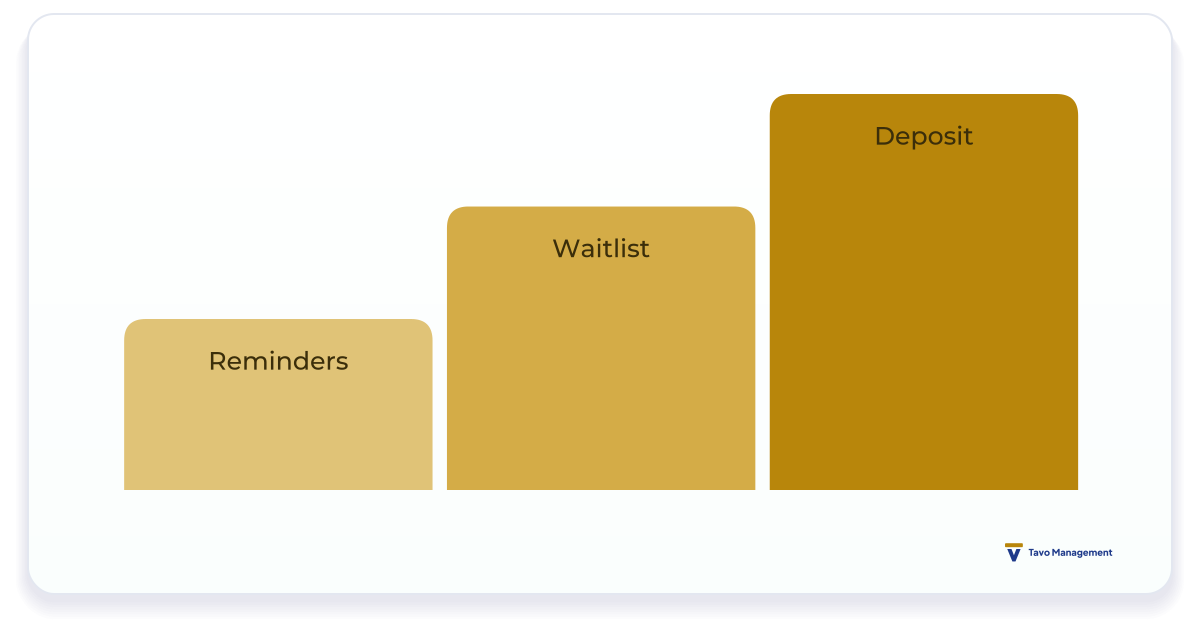
Expect a first improvement within a month. Track no-show rate and utilization weekly, and stay in this phase until the no-show rate has fallen for two months in a row.
Phase 3: Streamline the Front Desk
Front desk errors travel downstream. A missing insurance detail at check-in becomes a denied claim six weeks later. The goal of this phase is to move work earlier: forms and insurance checks before the visit, payment at the visit and a handover note for anything unusual.
Write one-page routines for the five tasks that eat the most time, such as new patient intake, check-in, checkout, cancellations and insurance verification. Ask your most experienced person to write the first draft and a new colleague to follow it. Wherever the new colleague gets stuck, the routine is wrong.
Do not turn the front desk into a call center that answers everything. Separate the phone work from the in-person work during busy hours if you can, even for two hours a day. It cuts errors more than any script.
Phase 4: Get Paid Faster and Cleaner
Billing improves when you treat it as a weekly rhythm, not a monthly cleanup. Check eligibility before the visit, capture charges the same day, submit claims within two days and review the aging report every week. Assign every open claim over 60 days to a named person.
Denials need their own routine. Group them by reason each month and fix the top one at its source. In my client work, the top reason is usually something the front desk can fix, such as incomplete patient details, which is why this phase follows the front desk and not the other way around.
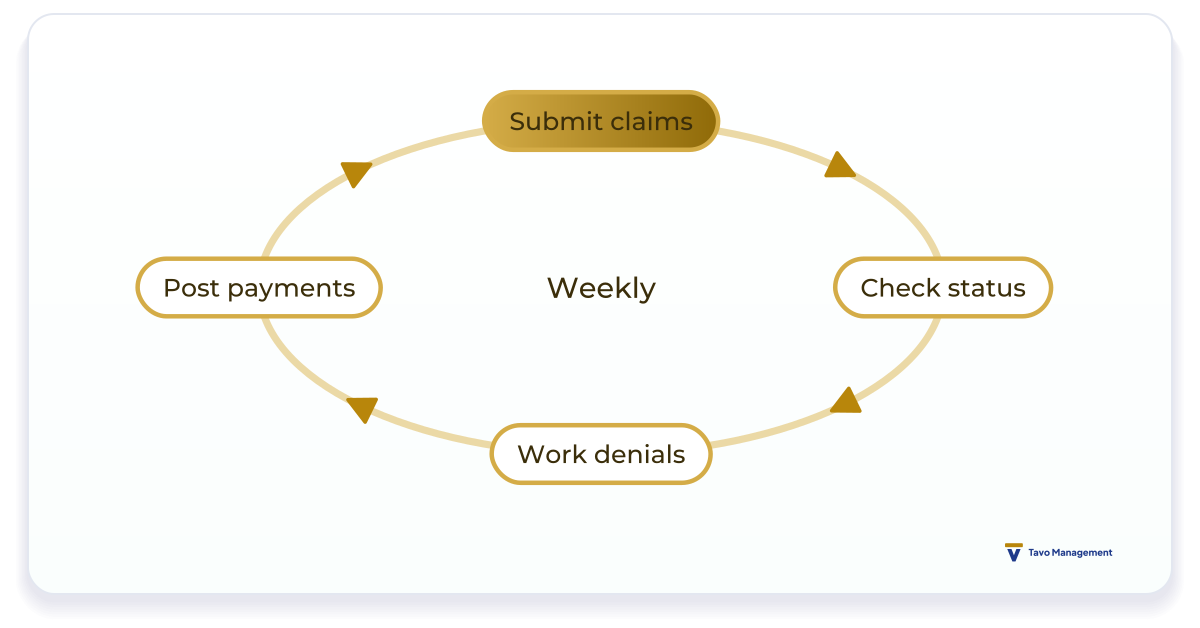
If billing is your biggest problem and the routines are in place, a deeper revenue cycle management consulting review may find what a weekly rhythm cannot. Otherwise, stay in this phase until days in accounts receivable have fallen for two consecutive months.
Phase 5: Define Roles and Keep Your Team
Unclear roles cause more friction than low pay. Write a half-page for every role: what the person owns, what they hand off and who covers when they are away. Then name an owner for every number in your monthly report.
Hold a short one-to-one every month with each staff member, with the same three questions: what is slowing you down, what would you change and what do you need from me? You will hear problems months before they would reach you otherwise. Turnover is expensive for a small practice, because each departure takes routines with it.
Hire only after you have fixed the schedule and the front desk. A new person added to a broken workflow inherits the workaround, and the problem stays hidden for another year.
Phase 6: Build a Monthly Reporting Rhythm
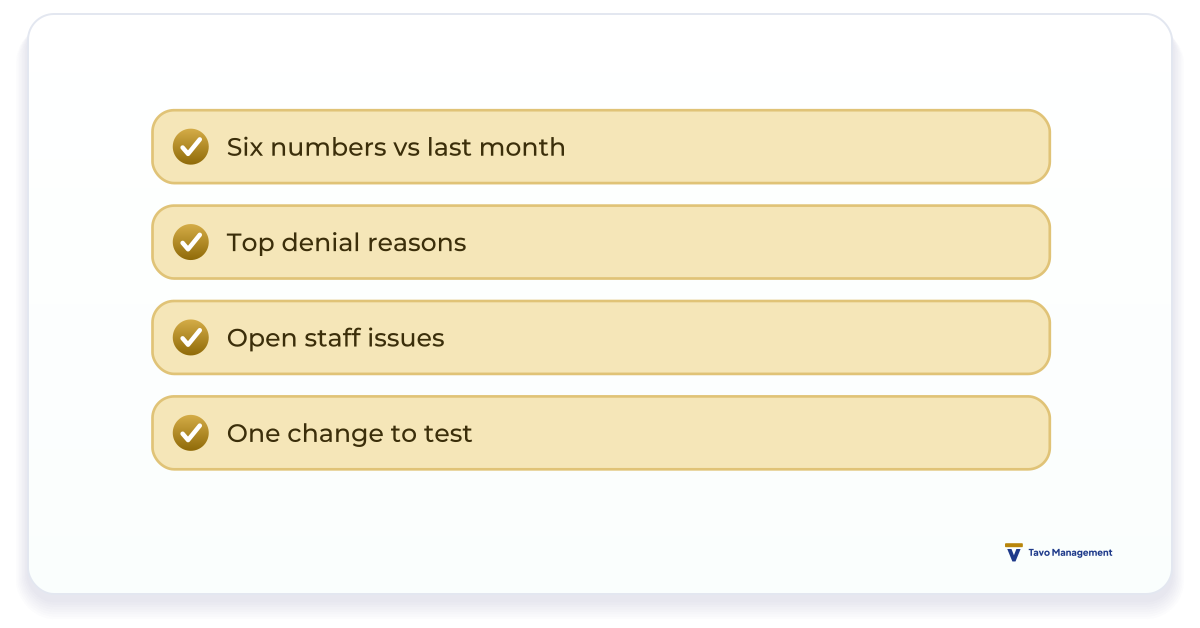
The last phase makes the others last. A one-page monthly report with six numbers, a target and a sentence of explanation for each is enough. Hold a 30-minute review with the people who own the numbers, and write down one action per number that moved the wrong way.
After three months you have trends, and trends are where strategy begins. You can now see whether a change worked, set realistic targets and decide, with facts, whether to add a provider, extend hours or open a second location.
What the First 90 Days Can Look Like
Here is a realistic sequence for a practice with four providers and two administrators, based on how projects of this size tend to run in my client work. It will not match yours exactly, but it shows the pace to expect.
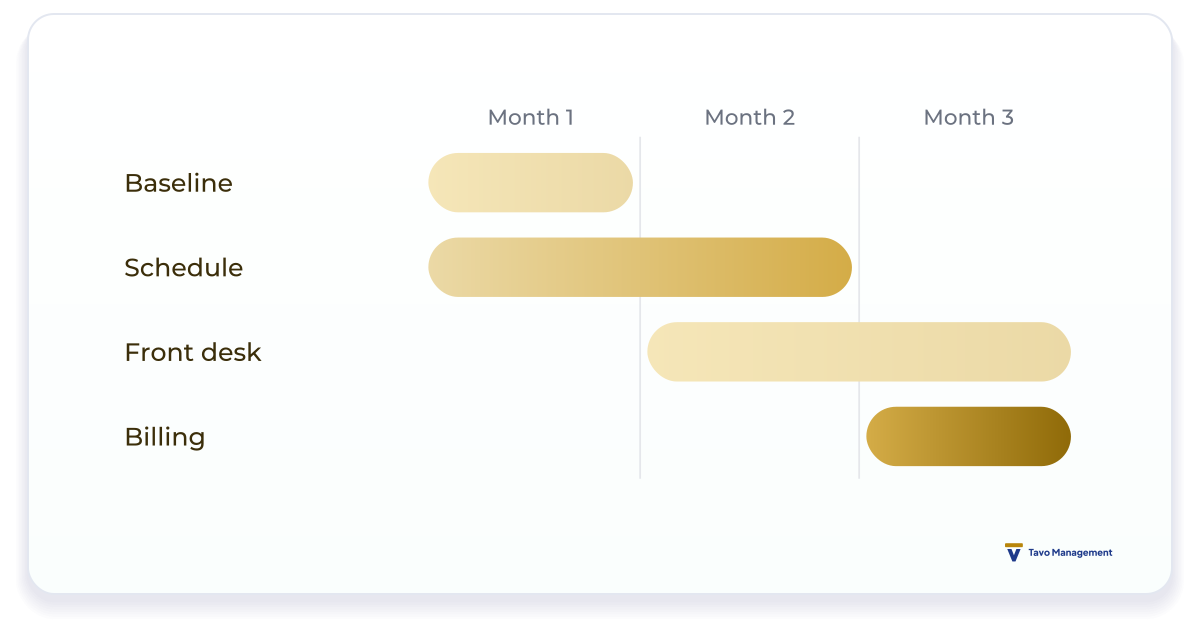
In month one you take the baseline, walk the patient path and choose two priorities. In month two you adjust appointment lengths, switch on reminders and write the first three front desk routines. In month three you start the weekly billing review and hold your first monthly meeting around the report. Some of it slips: a vacation, a system update or a sick day will move a date, and that is normal. Keep the monthly review fixed, even when other things move, because it is the habit that carries the plan.
At day 90, compare your six numbers with the baseline and write down what moved, what did not and why. Choose the next two priorities from the list you built in the beginning. Most practices find the second round easier, because the team has seen that changes can work and that the routines save them effort.
Where Practice Strategies Usually Stall
| Stall point | How it looks in practice | What to do instead |
|---|---|---|
| Buying tools first | New software goes live, same problems remain | Fix workflows, then pick the tool |
| Too many priorities | Ten half-finished projects | Two or three at a time |
| No owner | Everyone agrees, nothing changes | One named person per routine |
| Skipping the baseline | You cannot say if it worked | Measure for a month first |
These are all about management, not medicine or law. That is good news, because management habits can be learned, written down and handed on.
Deciding Where to Begin
If you can only start one thing this month, choose by your main pain:
- Empty slots and late starts: begin with phase 2.
- Errors and rework at the desk: begin with phase 3.
- Slow payment: take the baseline, then go to phase 4.
- Staff leaving or confused: begin with phase 5.
If you are unsure, take the baseline first. It costs little and it points to the right phase. For help with the diagnosis or the rollout, the team behind practice management consulting offers a free discovery call.
Questions About Practice Management Strategies
What Is the First Practice Management Strategy I Should Work On?
Start with the schedule. It is the part of the practice every patient touches, and it is where lost revenue is easiest to see. Measure your no-show rate and utilization for four weeks, fix the biggest gap, then move on to the front desk and billing. Strategy work that begins in the schedule shows results fast and earns your team's trust.
When Will We See Results?
Reminder and scheduling changes can show up within a month. Billing and collection improvements take one to three months, because claims take time to pay. Staffing and culture changes take longer, often two quarters. Plan a first review at 90 days, with numbers you agreed on at the start.
Do I Need New Software to Improve My Practice?
Often not. Many practices use a third of what their current system can do, so switching tools solves less than owners expect. Review your settings and workflows first. If the system still blocks you, compare options in a ranking of practice management software and run a small pilot.
How Do I Get My Staff on Board?
Involve the people who do the work before you design the change. Ask the front desk what slows them down, test the new routine with one person for a week and fix what breaks. People support changes they helped shape, and they ignore ones announced in a meeting.
How Many Priorities Can a Small Practice Handle at Once?
Two or three at a time. A practice has very little spare capacity, so a long list ends in half-finished changes. Pick the biggest one in scheduling, one in billing and one in people, and finish them before adding more.
Should I Hire a Practice Manager or Use a Consultant?
If you need ongoing daily management, hire a manager. If you need a diagnosis, a plan and a set of routines in a few months, a consultant is faster and cheaper. Many practices use a consultant to build the system, then hand it to a manager or lead who runs it.
How Do I Keep the Improvements from Fading?
Write down the routines, give each one an owner and review the numbers monthly. Fading usually happens when the person who drove the change leaves or gets busy. Documentation and a standing monthly review are the two cheapest protections.
General information only: this is not legal, financial or tax advice. Examples and numbers reflect typical projects; check the specifics with your advisers before deciding.
Did you find this helpful?
Thank you for your feedback.
Delaney Brisco
Delaney leads the Tavo editorial team and works with our consultants to turn real client projects into practical guides on project delivery, process design and organizational change. Before joining Tavo, she spent 12 years in operations and program management roles. She has since edited more than 300 articles on management practice and reviewed PMO setups and process redesigns from over 100 client projects. She is based in Minneapolis, Minnesota.