Summary
- A practical framework has six phases: define, assess, align leaders, plan people work, launch and reinforce.
- Prosci found that 88% of projects with excellent change management met or exceeded objectives, against 13% with poor change management.
- ADKAR, Kotter and Lewin describe the same journey from different angles, so borrow from all three.
- Every phase needs one owner and one output you can check, or the framework turns into slideware.
A change management framework is a repeatable sequence of steps for helping people adopt a new way of working. Most projects I see do not fail on the technical side. They fail because the people who had to use the result were told late, trained once and left to cope. That gap is the reason people hire a change management consultant, and it is also something you can close yourself with a simple framework.
Below is the six-phase model I use as a starting point, with the question each phase answers and what it should produce. I also show how it maps to the three models you will hear about most often.
Six Phases, Summarized
Read the table first. It gives you the whole path on one screen, and the sections after it explain each phase in turn.
| Phase | What it tells you | Output you can check | Starts |
|---|---|---|---|
| 1. Define the change | What is changing, and why now? | One-page case for change and success measures | Before the solution is chosen |
| 2. Assess impact and readiness | Who is affected, and how ready are they? | Impact map per team and a readiness rating | Right after phase 1 |
| 3. Align sponsors and managers | Who must lead, and are they ready? | Sponsor roles, manager briefing guide | Before any announcement |
| 4. Plan communication and training | What does each group need to hear and learn, and when? | Communication calendar, training plan | Parallel to the build |
| 5. Launch with support | Where will people get stuck on day one? | Go-live support plan, named contacts | A few weeks before go-live |
| 6. Reinforce and measure | Is the change holding? | Adoption report and fixes | At go-live, runs for months |
Phase 1: Define the Change and the Reason Behind It
Start with a plain sentence that finishes "From now on, people will…". If you cannot write it, nobody else can explain it. Then write the reason in terms of the business, such as longer lead times, audit findings or a system reaching the end of its support. People accept a change they understand far more readily than one that was handed to them.
Add two or three success measures at this point. They should describe what people do, such as the share of orders entered in the new system, and not only what the project delivers. Those measures come back in phase 6, and I describe good candidates in my guide to change management metrics.
Phase 2: Assess Who Is Affected and How Ready They Are
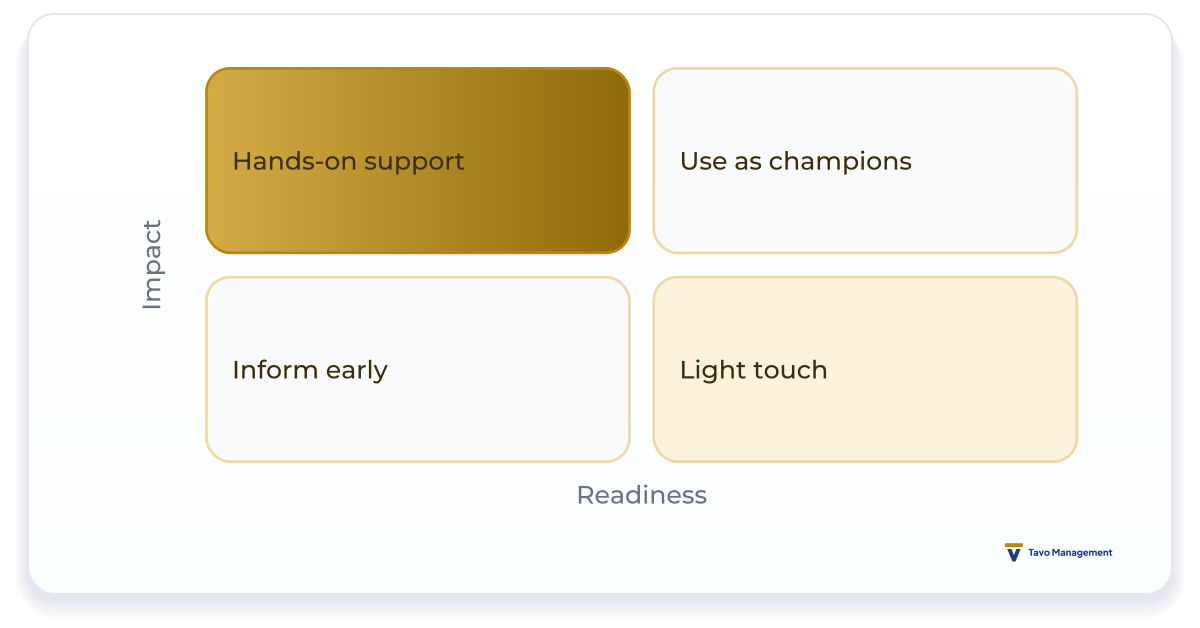
List every group that touches the change, then describe what each one will do differently. Be concrete: "Warehouse staff scan a barcode instead of ticking a paper list" is useful, "Warehouse staff adopt new tooling" is not. Rate each group for impact (how much changes) and readiness (how willing and able they are today).
Readiness comes from conversation. Ten short interviews across levels and sites tell you more than a long survey, and a five-question survey afterwards tells you whether the interviews were typical. In one three-site rollout I worked on, the head office was enthusiastic and the smallest site was quietly afraid of losing two roles. It surfaced in week two, not at go-live, and the client could answer it honestly.
Phase 3: Line Up Your Sponsor and Your Managers
Prosci's research shows how much sponsorship matters. Projects with extremely effective sponsors met their objectives 79% of the time, against 27% for extremely ineffective ones. Sit down with your sponsor and agree on three visible actions: explain the reason in their own words, remove blockers quickly and show up where the work happens.
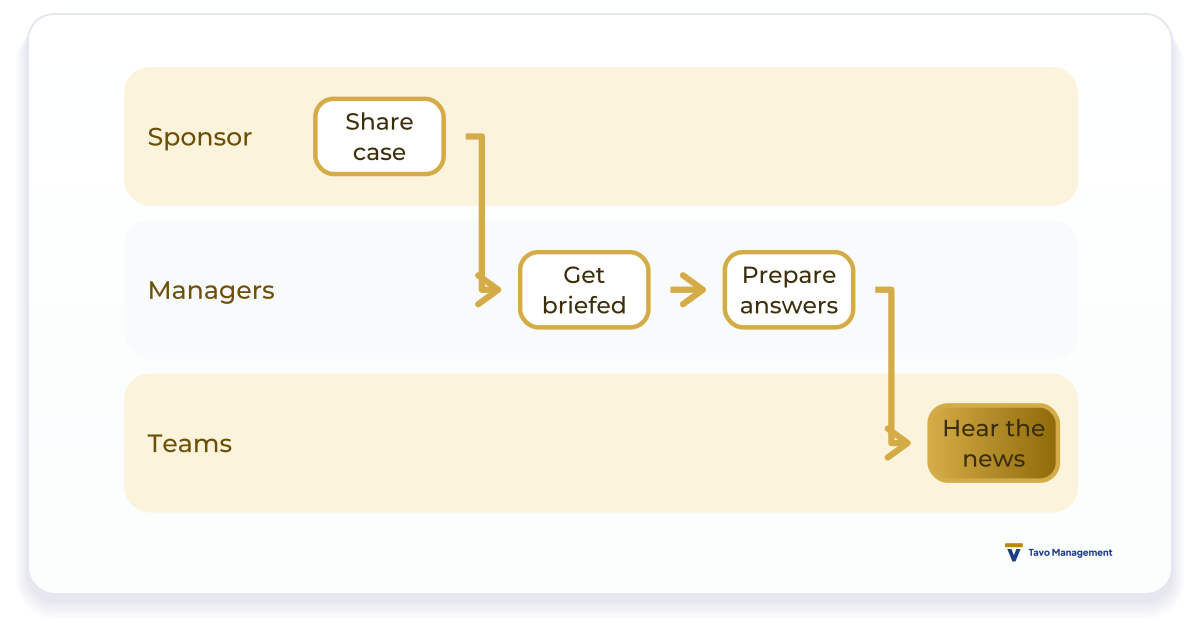
Then brief the managers before their teams hear anything. Employees prefer to hear about personal impacts from their direct supervisor, according to Prosci, so a manager who is surprised by an announcement damages trust twice. Give each manager a one-page guide with the key messages, the likely questions and what to do when they do not know the answer.
Phase 4: Plan Communication and Training Around Each Group
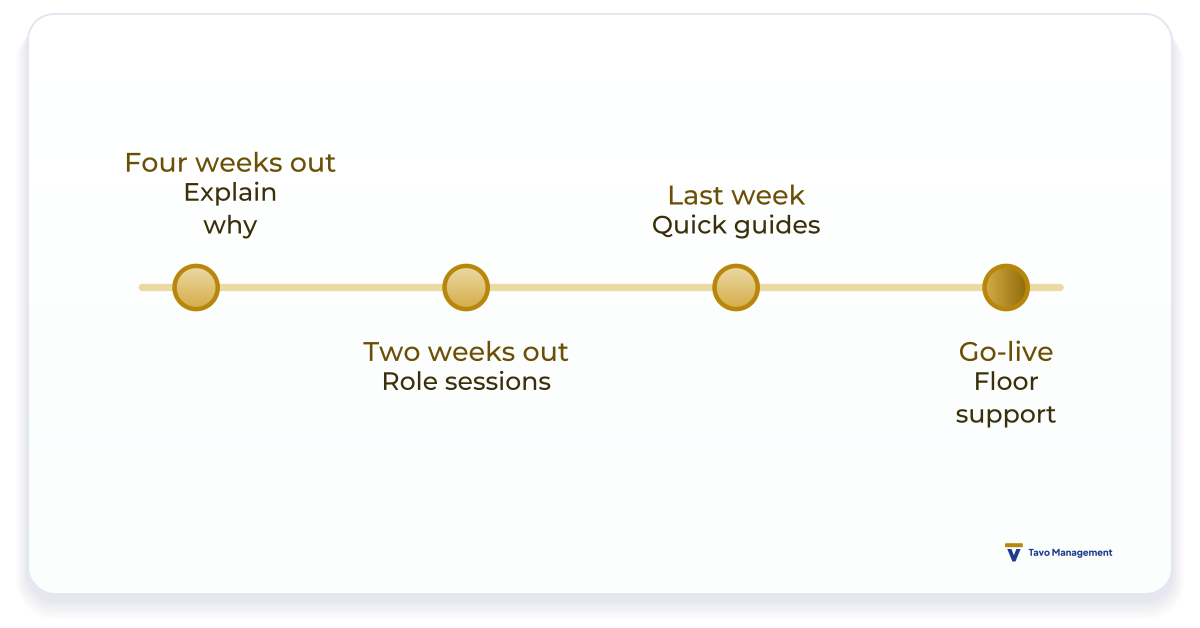
Build one calendar that shows, week by week, who hears what from whom. Early messages explain why. Middle messages explain what changes for each role and when. Late messages cover practical details such as where to get help. Repeat key points, because most people need to hear a message several times before it sticks.
Plan training for timing, not for coverage. A session three weeks before go-live is forgotten by go-live. I prefer short sessions in the week before launch, a quick-reference page people can keep open on their screen and a second round two weeks after, when real questions have appeared. Tools can help here, and my ranking of change management tools covers options for tracking, messaging and in-app guidance.
Phase 5: Launch With People Close By
Go-live is the moment when the plan meets daily work. Put help physically or virtually close to people: floor walkers in the first days, a named channel for questions and an escalation route that gets a real answer within a few hours. Make the first week boring by removing the surprises you could see in advance.
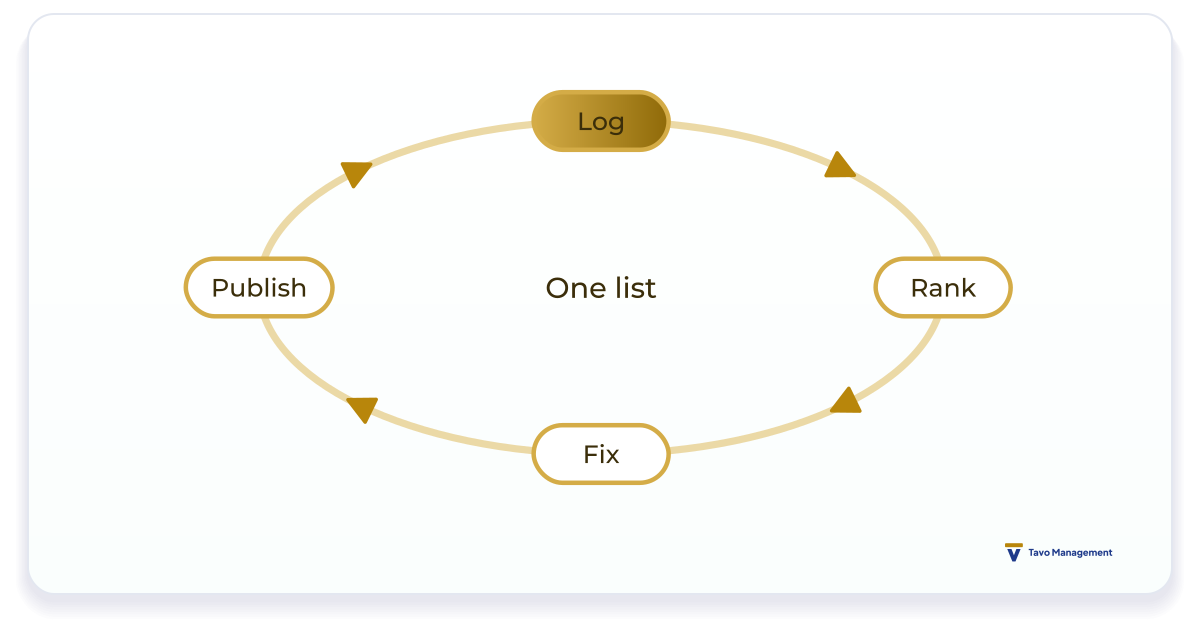
Collect issues in one list, and publish the fixes. When people see that a complaint on Monday leads to a change on Wednesday, they stop inventing workarounds. This is also the best moment to find champions, the people in each team who quietly help their colleagues, and give them a little time and recognition.
Phase 6: Reinforce the New Way and Measure It
Most changes slip back in the first three months. Reinforcement means making the new way easier than the old one: remove the old spreadsheet, change the report managers use, update targets and job descriptions. Prosci found that 81% of participants who planned for reinforcement met or exceeded objectives, against 15% of those who did not.
Measure against the success measures from phase 1. Track usage, how quickly people become proficient and whether the business result has appeared. The change management KPIs I use for monthly reports are a good shortlist, and the closing steps are covered in my change management checklist.
How the Framework Compares With ADKAR, Kotter and Lewin
You do not need to pick one named model. They describe the same journey from different angles, and each one is strongest at a particular task.
| Model | Shape | Best used for | Maps to phases |
|---|---|---|---|
| Lewin | Unfreeze, change, refreeze | Explaining the idea of change simply to a sponsor | 1 to 3, then 4 to 5, then 6 |
| Kotter | Eight steps, from urgency to anchoring the change | Aligning leaders on a large, organization-wide change | 1, 3, 4, 5 and 6 |
| ADKAR | Awareness, Desire, Knowledge, Ability, Reinforcement | Finding where individual people or groups are stuck | 2, 4, 5 and 6 |
Kotter's steps are: create a sense of urgency, build a guiding coalition, form a strategic vision, enlist a volunteer army, enable action by removing barriers, generate short-term wins, sustain acceleration and institute change. They fit phases 1, 3, 5 and 6 well. ADKAR, from Prosci, is the model I reach for when adoption stalls, because it tells you which element is missing for a given group. If people know why but cannot do the task, you have an Ability gap and need practice, not another announcement.
A Realistic Timeline for the Six Phases
Phases overlap, and that is normal. For a change that affects around 300 people across two sites, I plan roughly two weeks for phases 1 and 2, another two weeks for phase 3 and a six-to-eight-week stretch for phase 4 that runs next to the build. Phase 5 covers the two weeks before and the four weeks after go-live. Phase 6 then runs for at least three months.
The delays I see most often sit in phase 3. Sponsors are busy, and managers are pulled into day-to-day work, so the briefing slips. Book those dates early and treat them like a project milestone. A late manager briefing pushes the announcement back, and that is a better outcome than an announcement that leaves managers surprised.
Adapting the Framework to Your Size
For a one-team change, compress it to a single page: the sentence, the reason, the list of what changes, a manager briefing and a check-in a month after launch. For a multi-site program, add a change lead per site and a shared dashboard. What matters is that every phase still has an owner and an output, even if the output is a paragraph.
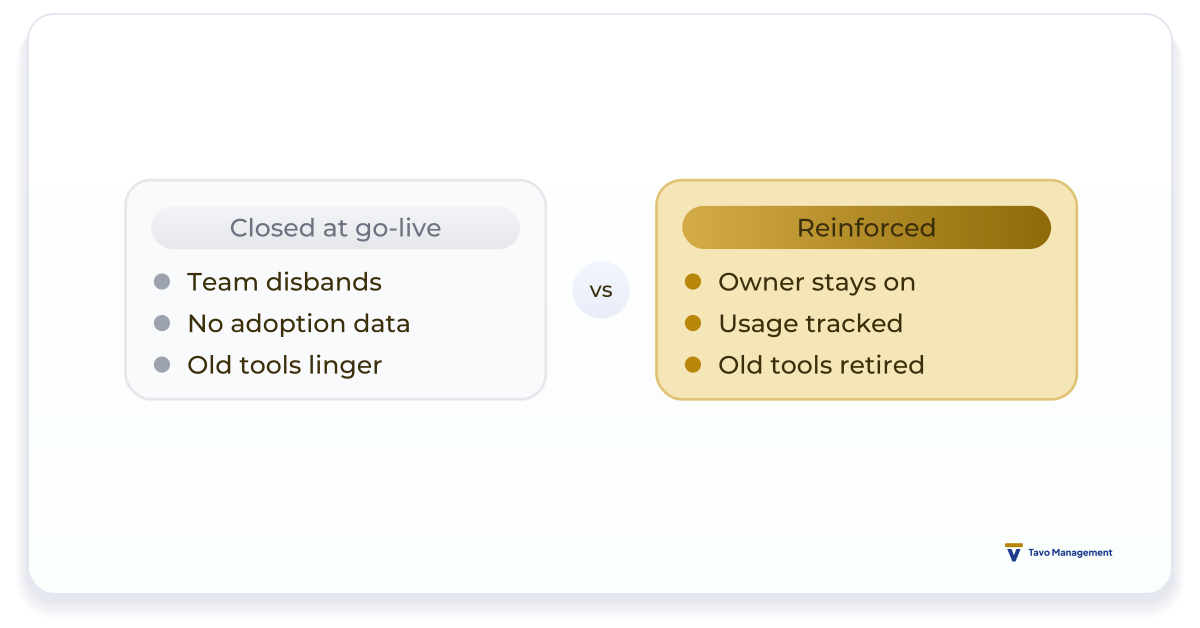
The part most teams skip is phase 6. Budget time for it at the start. A project that is closed the day the system goes live has already given up on adoption.
How to Choose and Start Your Framework
I suggest you begin with these four checks before you write a single message:
- Is the change described in one sentence that a new colleague would understand?
- Does every affected group appear in your impact list, including the quiet ones?
- Has your sponsor agreed to three visible actions?
- Does the project plan include time and budget for reinforcement after go-live?
If any answer is no, fix that first. A framework only helps when the basics are real. If you want a second opinion on your plan, a short call is usually enough to tell you where the biggest gap is.
Questions About the Change Management Framework
What Is the Difference Between ADKAR, Kotter and Lewin?
Lewin describes the shape of a change: unfreeze, change, refreeze. Kotter gives eight steps for leading a large change from the top. ADKAR looks at one person at a time and asks where that person is stuck. I use Kotter for leadership alignment, ADKAR for diagnosing adoption problems and Lewin as a simple way to explain the idea to a sponsor.
How Many Phases Should a Change Management Framework Have?
Five to seven is enough for most organizations. More phases mean more paperwork and fewer conversations. The six phases in this article cover the full path, and you can merge two of them for a small change, as long as every phase still has an owner and an output.
Can I Use a Framework for a Small Change?
Yes, in a lighter form. For a change that touches one team, a one-page impact summary, a manager briefing and a short check-in after go-live is a complete framework. Keep the same order of thinking and drop the formal documents.
When Should Change Management Start in a Project?
As early as there is a budget and a rough scope, which is usually before the solution is chosen. Starting at that point lets you shape the project around the people it affects. Starting at the training stage means you can only explain decisions that are already made.
Who Owns Change Management, the Project Manager or HR?
The sponsor owns the outcome, the project manager owns the plan and the people managers own the conversations with their teams. A change lead coordinates the work and supports all three. HR is a partner, especially for roles, training and communication rules, but it rarely owns the change itself.
How Do I Deal with Resistance Inside the Framework?
Treat resistance as a signal in the readiness and reinforcement phases. Ask what the person stands to lose, check whether the concern is fair and adjust the plan where it is. Prosci's research identifies mid-level managers as the group most often seen as resistant, so brief them first and listen closely.
Do I Need a Certified Practitioner to Use a Framework?
No. Certification helps when you run large programs or want a shared vocabulary across projects, but the core steps are simple enough for a capable project lead to follow. If your change is big, a consultant can coach your team through the first cycle.
Sources
- Prosci: Why Change Management Is Important
- Prosci: Best Practices in Change Management
- Prosci: The ADKAR Model
- Kotter: The 8 Steps for Leading Change
General information only: this is not legal, financial or tax advice. Examples and numbers reflect typical projects; check the specifics with your advisers before deciding.
Did you find this helpful?
Thank you for your feedback.
Delaney Brisco
Delaney leads the Tavo editorial team and works with our consultants to turn real client projects into practical guides on project delivery, process design and organizational change. Before joining Tavo, she spent 12 years in operations and program management roles. She has since edited more than 300 articles on management practice and reviewed PMO setups and process redesigns from over 100 client projects. She is based in Minneapolis, Minnesota.