Summary
- An assessment turns a supplier list into a ranked risk register, based on likelihood, impact and recovery time.
- Screen every supplier quickly, then go deep on the ones behind your critical parts.
- Dependencies below the first tier, such as shared sub-suppliers and ports, are where surprises hide.
- The result is only useful if every top risk gets an owner and a date.
A supply chain risk assessment answers a plain question: if one thing in my supply chain stopped tomorrow, what would it cost, and how likely is it? Most companies can guess at the answer for their largest suppliers. Very few can answer it for the small supplier of a single part that sits in every one of their products.
I run these assessments as part of the supply chain risk management consulting work at Tavo, and the method below is the one I trust for mid-sized operations. It works with a spreadsheet, and you can add software later if the volume demands it.
What a Supply Chain Risk Assessment Covers
An assessment has four parts. You identify what you depend on, you collect facts about each dependency, you score the risk and you rank the results. It looks at more than supplier finances. It covers where a part is made, how it travels, who else makes it and how long it takes to switch.
It also separates risk types, because each one needs a different fix. The table below shows the six I use.
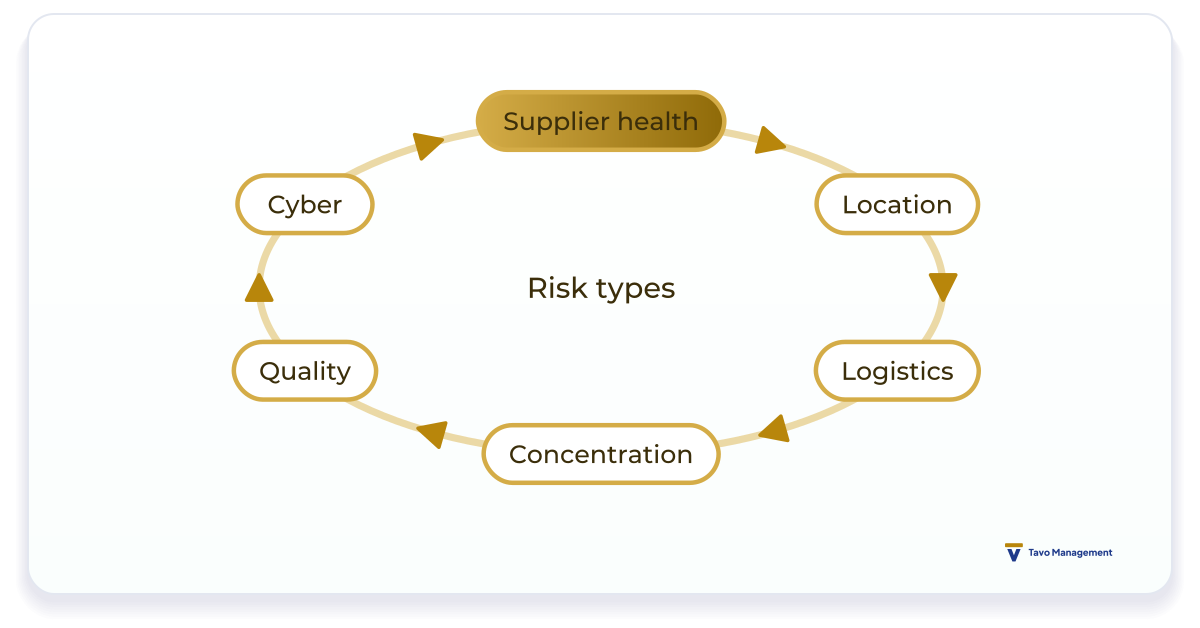
| Risk type | Example | What you check |
|---|---|---|
| Supplier health | A key vendor runs out of cash | Financial trends, payment behavior, ownership changes |
| Location | A factory sits in a flood zone | Site, region, natural hazards, political stability |
| Logistics | A port closes for weeks | Routes, ports, carriers, transit times |
| Concentration | Three vendors rely on one mill | Shared sub-suppliers and single points of failure |
| Quality and compliance | A supplier fails an audit | Audit history, certifications, defect rates |
| Cyber and data | A supplier is hit by ransomware | Security practices and access to your systems |
Not every type matters equally to every business. A food producer cares most about location and quality. An electronics maker cares most about concentration, since one chip can stop a line.
Collecting the Data You Need
Start with what you already own. Your ERP holds the supplier list, spend and part numbers. Planning knows lead times. Finance knows the margin on each product. Put them in one sheet with one row per part and supplier.
Then add the facts that rarely sit in a system: the production site, the country, the transport route and the sub-supplier for the main input. This is the slow step, because buyers have to ask. A short questionnaire of six questions gets better answers than a forty-question survey, and I always follow up by phone for the top ten suppliers.
For long supplier lists, outside data can fill the gaps. My overview of supply chain risk management software lists tools that score suppliers without a questionnaire, though none replaces a direct conversation about your top names.
Step One: Screen Every Supplier Quickly
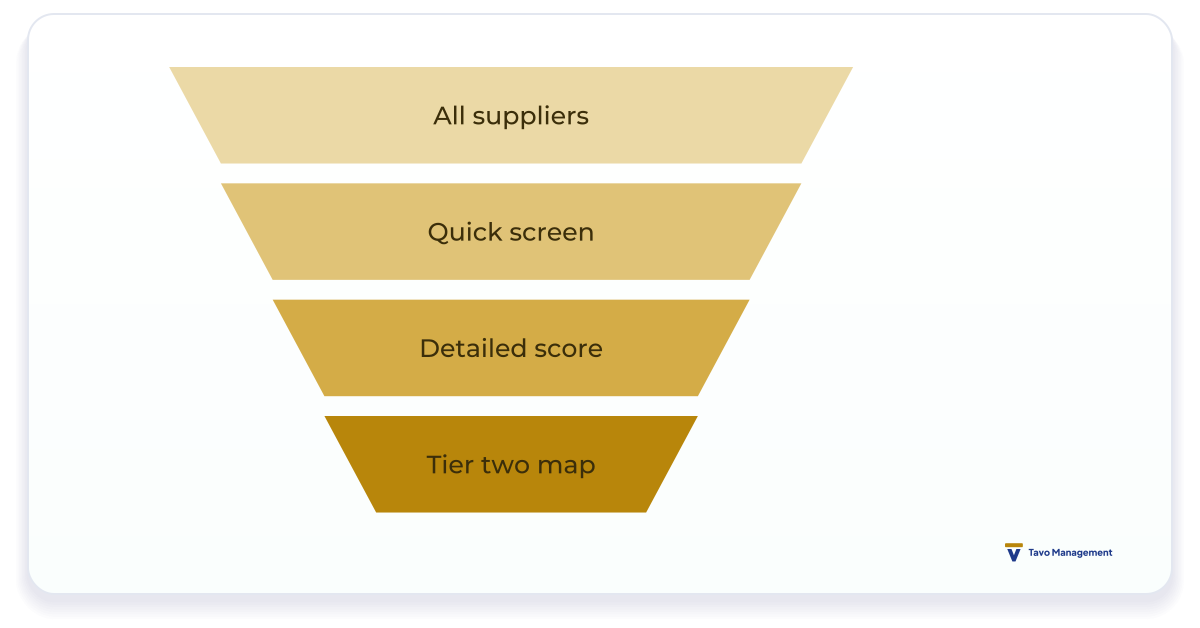
Give each supplier a fast pass using three questions. How much of your spend or output depends on them? How hard are they to replace? Do they supply anything that touches a customer commitment? Anyone who scores high on any of the three goes forward to a deep review. Everyone else gets a light check once a year.
A good screen takes minutes per supplier. If it takes an hour, it is too detailed for this stage.
Step Two: Score the Risk
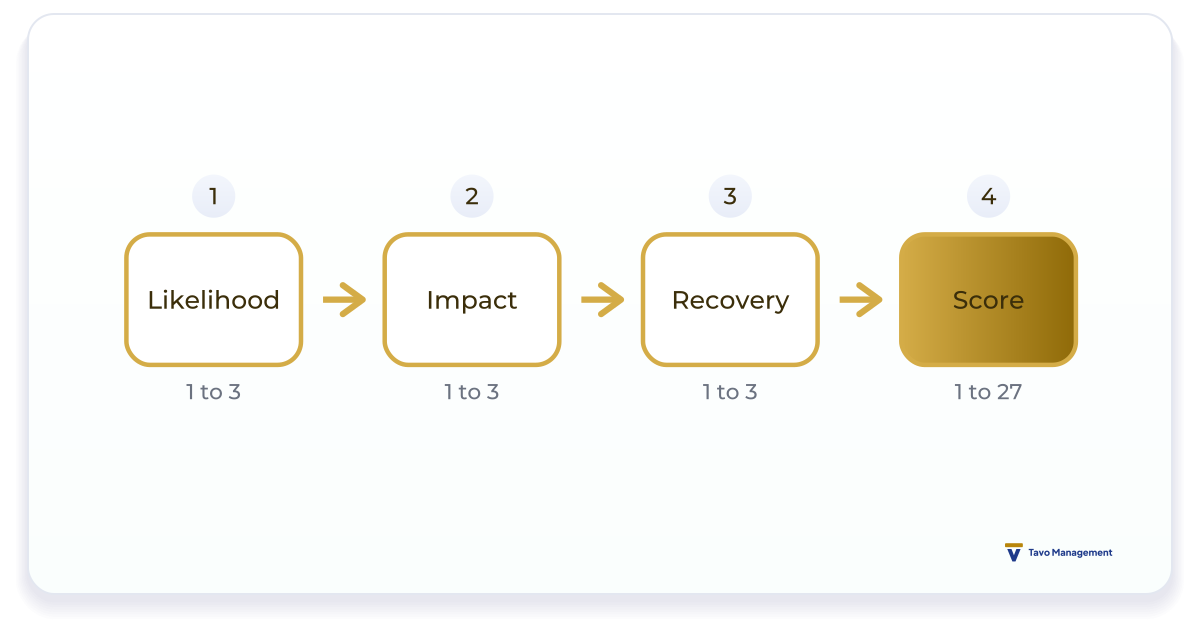
For each supplier in the deep review, give three scores from one to three.
- Likelihood: how probable is a failure in the next twelve months?
- Impact: how much would a failure cost in lost sales, penalties and recovery?
- Recovery time: how long would it take to replace the supply or restore it?
Multiply the three for a score from 1 to 27, and rank. A supplier with a likelihood of 2, an impact of 3 and a recovery time of 3 scores 18 and beats a vendor with a higher likelihood but an easy replacement.
Write one sentence for every score level, so a buyer in Texas and a planner in Ohio score the same way. Without definitions, scores drift and the ranking loses its meaning.
| Supplier | Likelihood | Impact | Recovery | Score |
|---|---|---|---|---|
| Sole-source resin plant | 2 | 3 | 3 | 18 |
| Packaging vendor, two alternatives | 3 | 2 | 1 | 6 |
| Contract machinist, one site | 2 | 2 | 2 | 8 |
This is a made-up example, but the pattern is real: the supplier you worry about most is rarely the one at the top of the list.
Step Three: Look Below the First Tier
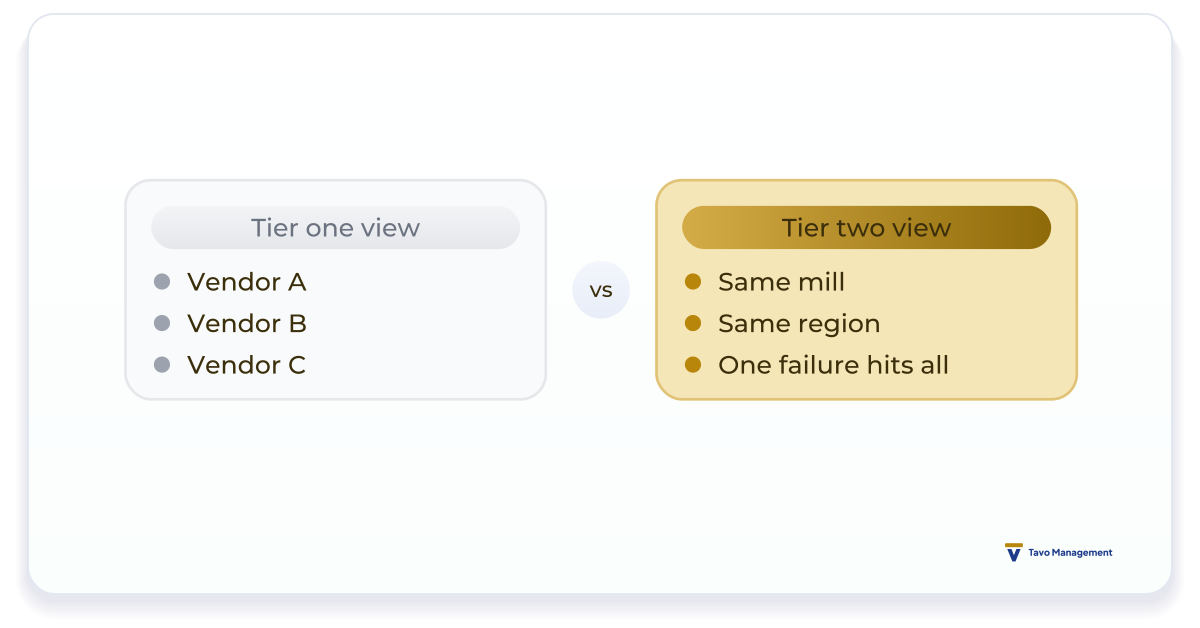
For the top-ranked parts, ask who supplies your supplier. You are looking for overlaps: one sub-supplier, one port or one region that appears behind several of your vendors. These concentrations do not show up in any contract, yet they decide whether your backup works.
Do not map every part this way. Limit tier-two mapping to the dozen parts at the top of your ranking, and note unknowns as open risks.
Reading the Results and Deciding What Next
Plot your ranked suppliers into three groups: act now, plan and watch. Act-now risks need an owner and a first step within the month. Planned risks go into the strategy with a budget. Watched risks get an alert and a review date.
This is where the assessment hands over to the supply chain risk management strategy, which chooses the response for each top risk. Do not let the register become a report. If a risk has no owner after the readout, it will still be there at the next disruption.
How the Assessment Differs by Industry
The method stays the same, but the weight of each risk type shifts with what you make. In manufacturing, concentration and recovery time dominate, since one tooled part from one plant can stop a line for months. In healthcare, availability and quality come first: a hospital or clinic network cares about sterile supplies, drugs and devices that have no quick substitute, and about recalls that remove stock overnight.
In food and hospitality supply, shelf life changes everything. Safety stock is not an option for fresh goods, so location, transport and supplier health carry more weight and the fix is usually a second regional source. Distributors and retailers should pay attention to carriers and ports, because their risk lives in the routes more than in the factories. Adjust your definitions of impact to match, and keep the list of risk types short enough that your group can actually discuss each one.
Spreadsheet or Software for the Assessment
A spreadsheet is enough for your first assessment of up to a few hundred suppliers. You need one tab for the supplier and part list, one for the scores and one for the open actions. The benefit is that everyone understands it and nobody waits for a vendor demo.
Software starts to pay off when you have thousands of suppliers, many sites or a need for constant alerts. Dedicated platforms bring outside data on supplier finances, location hazards and news, which saves your buyers from hunting for it. The trade-off is cost and setup time, and a tool cannot decide what counts as critical for you. I suggest you finish one manual assessment first, so you know what you want the software to do.
What Happens After the First Assessment
The first assessment gives you a baseline. The second one, a year later, tells you whether you are getting better. Compare the share of critical parts with a backup, the number of single points of failure and the time it takes to learn about a supplier problem. If those numbers have not moved, the plan is not being run.
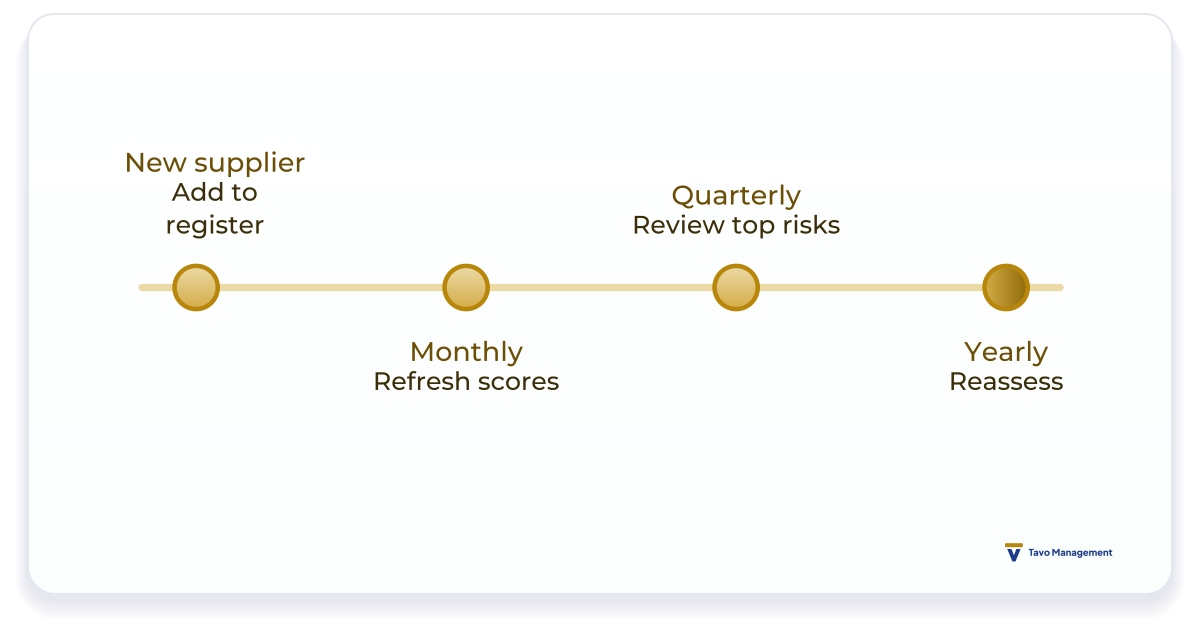
Keep the register alive between assessments. Add every new supplier at onboarding, update scores after any incident and drop suppliers you no longer use. A register that is touched a few minutes each week stays accurate, while one that is rebuilt once a year is always out of date by spring.
One more habit helps: record how you reached each score, in a short note beside the number. Six months later, when someone asks why a supplier moved from a 6 to an 18, the note answers the question and keeps the debate short. It also makes handover easy when a buyer changes roles.
Mistakes That Weaken an Assessment
Looking only at spend is the most common one. A low-spend supplier of a unique part can be a bigger risk than your largest vendor. Next comes treating the assessment as a one-time project, when supplier conditions change every quarter. The third is leaving purchasing out of the working group, which means the findings never reach buying decisions.
Also avoid starting with software. A tool that scores two thousand suppliers does not help if you have not agreed what a critical part is.
A Checklist Before You Start
Before you begin, confirm that the basics are in place:
- You have a supplier list with spend, part numbers and the products they feed.
- You know the cost of one day without each critical product.
- A working group includes purchasing, planning, quality, logistics and finance.
- You have written definitions for each score level.
- A date is set for the readout, with decision makers present.
If you want an outside team to run the review with you, a free first call is enough to agree on scope.
Questions About Supply Chain Risk Assessments
What Is a Supply Chain Risk Assessment?
It is a structured review that identifies the suppliers, sites and routes your business depends on, scores the risks in each and ranks them by how much they could cost you. The output is a risk register you can act on, not a general report.
How Often Should I Run a Supply Chain Risk Assessment?
Run a full assessment once a year and refresh the scores every quarter for critical suppliers. Repeat it sooner after a major change, such as a new plant, a supplier merger or a disruption that exposed a gap.
What Data Do I Need to Start?
You need a supplier list with spend, the parts each one supplies, the production site and country, and the products those parts go into. Lead times and the cost of a day without each part make the scores far more useful.
Should I Assess Every Supplier?
No. Screen all of them with a quick check, then assess in depth the ones that supply critical parts or are hard to replace. A small number of suppliers usually carries most of the exposure.
How Do I Score Risk Without Software?
Use a spreadsheet with three-level scales for likelihood, impact and recovery time. Multiply or add them to get a priority score. What matters is that everyone scores the same way, so write a short definition for each level.
Who Should Be Involved in the Assessment?
Bring purchasing, planning, quality, logistics and finance into one working group. Buyers know the suppliers, planners know the demand and finance knows what a shortage costs. An assessment run by one department misses half the picture.
What Do I Do with the Results?
Turn the top risks into a plan with owners, responses and dates. My supply chain risk management strategy guide covers the choices for each risk. Anything that is accepted should be written down, with a date to look at it again.
General information only: this is not legal, financial or tax advice. Examples and numbers reflect typical projects; check the specifics with your advisers before deciding.
Did you find this helpful?
Thank you for your feedback.
Delaney Brisco
Delaney leads the Tavo editorial team and works with our consultants to turn real client projects into practical guides on project delivery, process design and organizational change. Before joining Tavo, she spent 12 years in operations and program management roles. She has since edited more than 300 articles on management practice and reviewed PMO setups and process redesigns from over 100 client projects. She is based in Minneapolis, Minnesota.