Summary
- A BPM framework is a repeatable order of work: scope, discover, analyze, design, implement and monitor.
- Every phase needs an exit rule, or projects drift in mapping for months.
- One named owner and two or three measures per process keep gains from fading.
- Run the loop on one process first, then repeat it across the others.
Frameworks have a bad reputation because most of them arrive as a 40-page diagram. A framework that works fits on one page: a short list of phases, what you must have at the end of each and who decides. That is the version I give clients.
The model below comes from my work on business process management consulting projects, where it has to fit into a manager's calendar. It is a six-phase loop, and the last phase feeds the first one again.
Six Phases, Summarized
The table gives you the whole model. Read the exit rule column first, because it is the part teams skip, and the reason they get stuck.
| Phase | Main question | Exit rule | Owner | Typical time |
|---|---|---|---|---|
| 1. Scope | Which process, and why now? | One-page charter signed by the sponsor | Sponsor | 1 week |
| 2. Discover | How does it really run? | Map confirmed by the people who do the work | Process owner | 1 to 2 weeks |
| 3. Analyze | Where do time and quality leak? | Baseline measures and a ranked cause list | Analyst | 1 week |
| 4. Design | What should it look like? | Future-state map, rules and roles approved | Process owner | 1 to 2 weeks |
| 5. Implement | How do we switch safely? | Staff trained and the new process live | Team leads | 2 to 3 weeks |
| 6. Monitor | Is it holding and improving? | Monthly review held, next change chosen | Process owner | Ongoing |
Phase 1: Scope the Process and the Prize
Pick one process and write down why it matters in one sentence, for example "Orders take 12 days to invoice and customers are noticing." Then name the start and end of the process. Most teams skip the boundaries, and then argue for weeks about whether quoting belongs in the project.
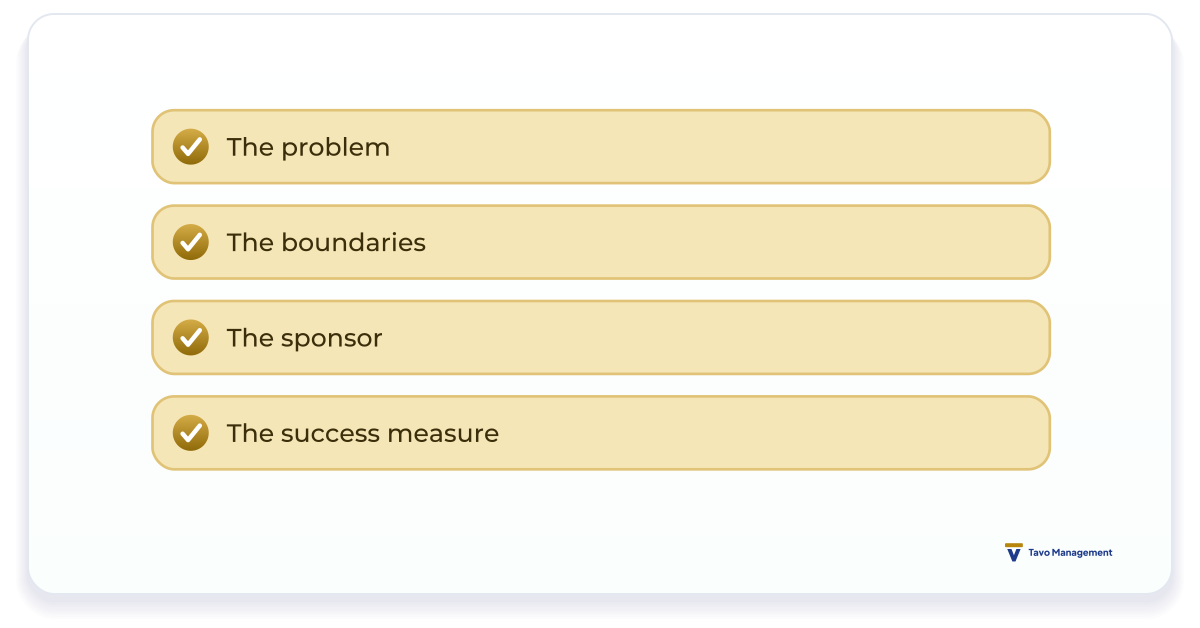
The charter has four lines: the problem, the boundaries, the sponsor and the measure that will show success. If you cannot agree on one measure, the process is not ready. You can see what a well-chosen scope looks like in my business process management examples.
Phase 2: Discover How the Work Really Runs
Gather the people who do the work in a room for 90 minutes and map the process on a wall with sticky notes. Ask them what really happens, not what the procedure says. Workarounds are the most useful finding of the whole project.
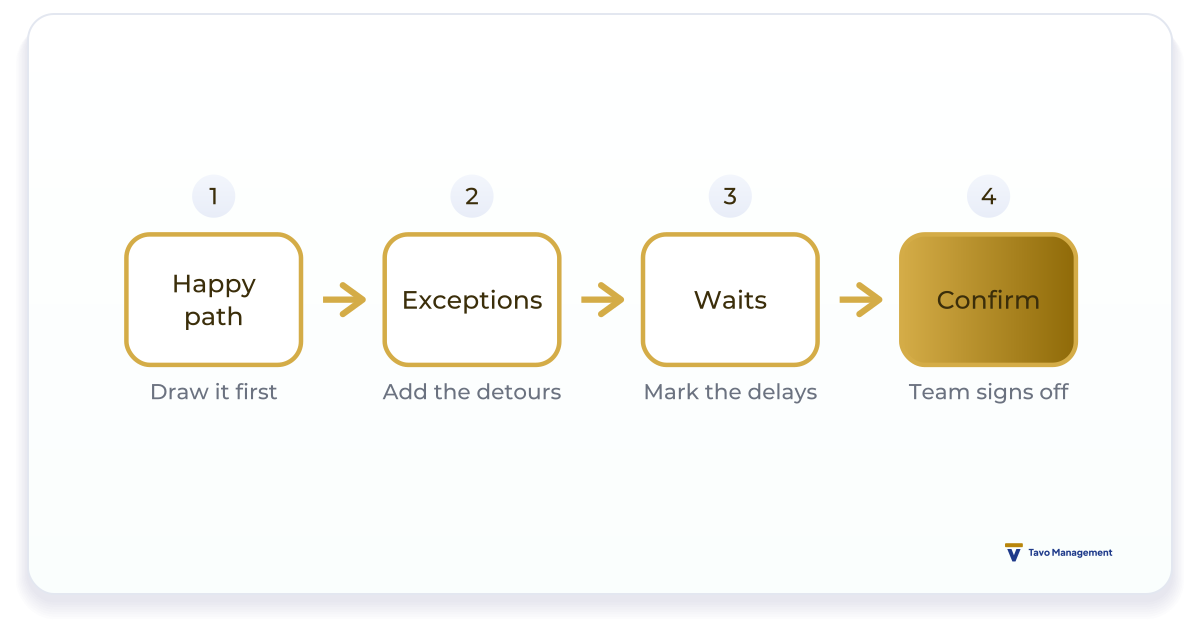
Use swimlanes, one row per team or role, and draw the happy path first. Then add exceptions and ask how often each one occurs. Do not leave the room until the people who do the work say "yes, that is how it goes."
Phase 3: Analyze Where Time and Quality Leak
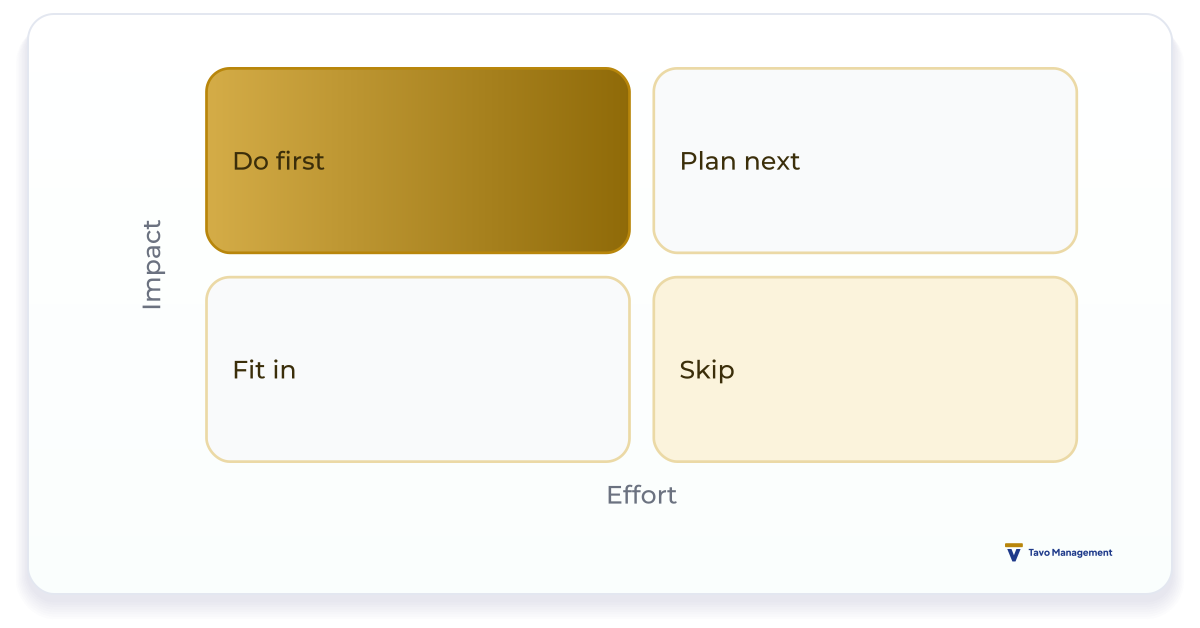
Measure before you opine. For a sample of 30 to 50 recent cases, record the elapsed time, the working time and the number of times each case was sent back. The gap between elapsed and working time is waiting, and in most processes I measure, waiting accounts for the large majority of the elapsed time.
Then ask why for each long wait and each rework loop. Group the causes into a short list, for example missing information at entry, unclear approval rights or duplicate data entry. Rank them by how many cases they affect. Your design phase will attack the top two or three.
Measures worth recording
| Measure | How to calculate it | What it tells you |
|---|---|---|
| Cycle time | End date minus start date per case | What the customer experiences |
| Touch time | Hours of real work per case | How much of the cycle is actual work |
| First-pass yield | Cases completed without rework divided by all cases | Quality at the source |
| Handoffs per case | Count of times ownership changes | Hidden delay and error risk |
| Cost per case | Staff hours times hourly cost, plus tool cost | The value of any improvement |
Phase 4: Design the Future State
Design in the same room, with the same people, in two sessions. In session one, go through the top causes and remove, merge or reorder steps. In session two, define the rules: who approves what, within which deadline and what happens when the deadline is missed.
Resist the urge to automate everything in this phase. Decide first what the process should do, and only then which steps a system should handle. When you reach that point, my guide to BPM tools shows how the main platforms differ.
- Every step has one owner and one deadline.
- Every decision has a rule, for example a value limit.
- Every exception has a named person to handle it.
- Every handoff passes complete information, enforced at entry.
Phase 5: Implement Without Disrupting the Business
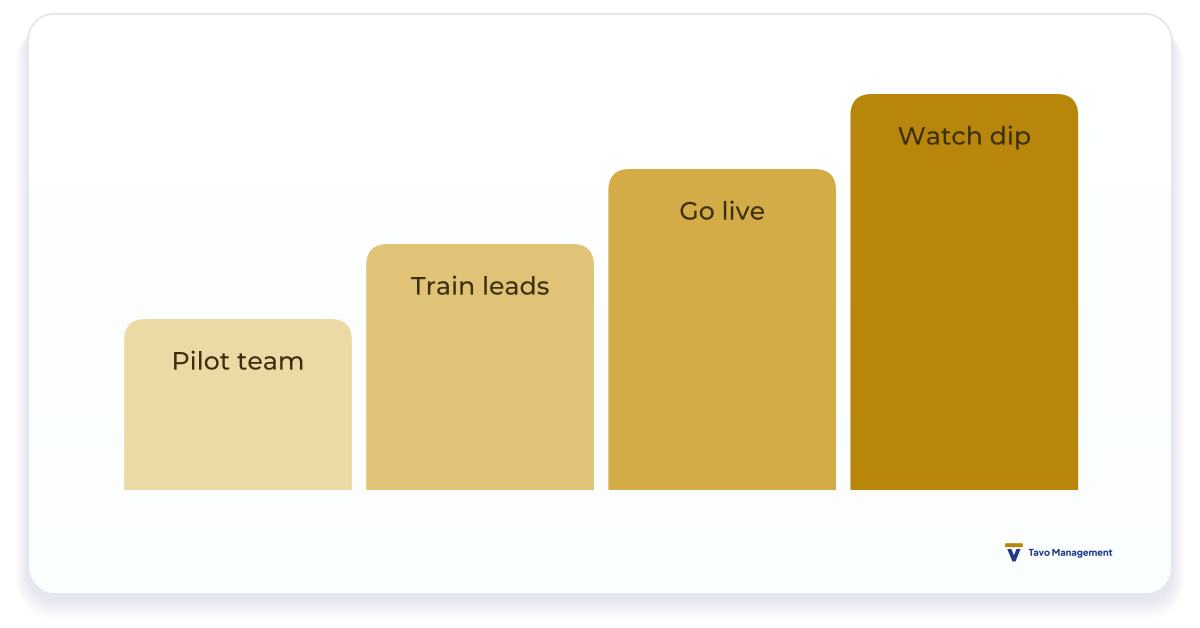
Test the new process on a small slice, such as one team or one customer group, for two weeks. Compare the results against your baseline. Fix what breaks, then roll out to the rest.
Write a one-page procedure and a short checklist, and train people in groups of five to eight at their own workplace. Plan for a dip in the first week. Productivity often falls before it rises, and a manager who expects that will not abandon the change.
Phase 6: Monitor and Optimize on a Schedule
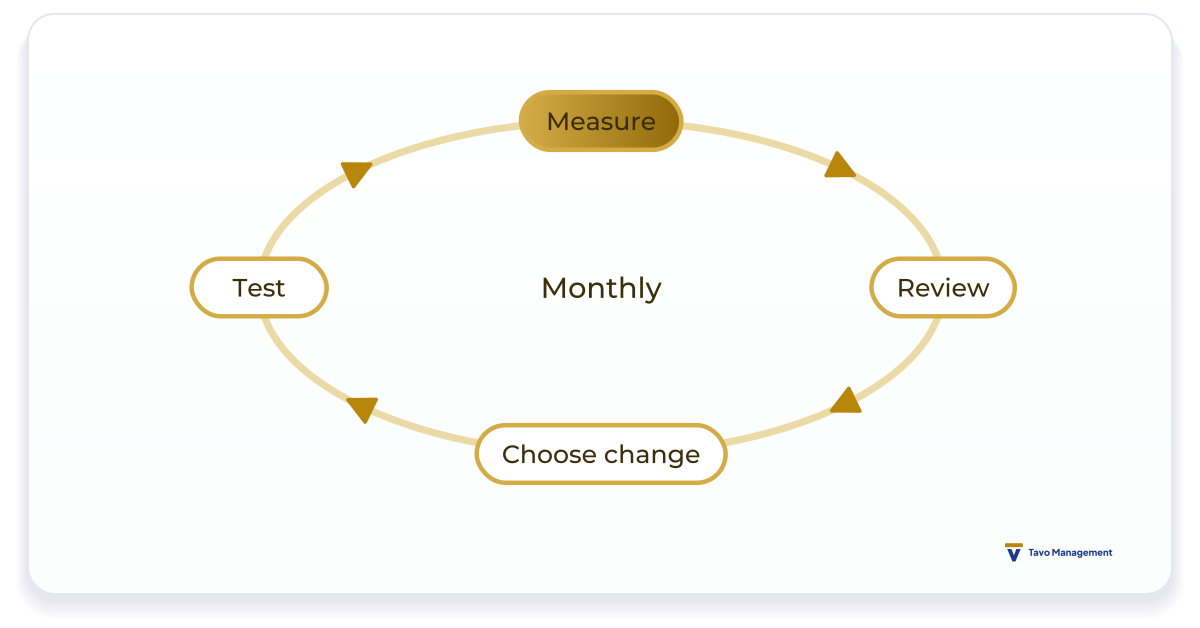
Hold a 30-minute review every month. The process owner brings three numbers, usually cycle time, first-pass yield and volume, and the group decides on one change to try. Then the loop starts again at analysis.
Monitoring is where most programs quietly die, so protect it. Put the review in the calendar for the next six months before the project closes. When the numbers are good for two quarters in a row, move the owner's attention to the next process.
Where Lean, Six Sigma and BPMN Fit Inside the Model
People often ask me which method to pick. The honest answer is that they sit inside different phases. Lean thinking helps in analysis, because it gives you a vocabulary for waste: waiting, rework, extra movement and unused approvals. Six Sigma tools help when variation is the problem, for example when one site closes orders in two days and another takes nine. BPMN helps in design when you plan to hand a process to a workflow engine.
For most mid-sized companies I would use none of the formal certifications at the start. A swimlane map, a sample of 40 cases and a stopwatch teach you more than a six-week methodology course. Add specialist methods once you meet a problem the simple approach cannot explain.
A Worked Example: Quote Approval in 6 Weeks
A manufacturing client took an average of 11 days to approve a custom quote. Scope took a week: the process ran from the customer request to the signed quote, with the sales director as sponsor and the sales operations manager as owner. In discovery, a 90-minute workshop showed that each quote passed through five people and that three of them only checked the same margin number.
The analysis of 40 recent quotes showed 2.5 days of touch time inside the 11-day cycle. The rest was waiting. The design removed two approvers, set a margin band that needed no sign-off and gave the one remaining approver a one-day deadline. Rollout started with one product line. After 30 days the average fell to four days, with no rise in margin errors. The owner now reviews the numbers monthly, and the next process on the list is order entry.
The details will differ in your business, but the sequence holds: scope, map with the team, measure, remove, pilot and review. Notice also what the team did not do. They did not buy software, they did not redraw the whole sales process and they did not wait for a perfect map. Each phase ended with a small, visible output, and that pace kept the sponsor engaged until the numbers arrived.
Who Does What
Frameworks fail on roles more often than on method. The table shows the minimum cast.
| Role | Responsibility | Time needed |
|---|---|---|
| Sponsor | Signs the charter, settles cross-team disputes | 1 hour a week |
| Process owner | Owns design, rules and measures | 3 to 4 hours a week during the project |
| Analyst or consultant | Facilitates workshops, collects data | Part or full time |
| Team leads | Train staff, report problems | 2 hours a week during rollout |
If you have no time for these roles, the process is not a priority yet. That is a useful answer, and it is better to hear it in week one than in week ten. The most common reasons programs stall are described in my article on business process management challenges, and my overview of business process management use cases shows where companies apply the framework first.
How to Choose Which Parts of the Framework You Need
You do not need every phase at full weight every time. For a small process with two teams, a one-hour scope, one mapping workshop and a simple review rhythm are enough. For a process that crosses five teams and a regulator, spend more time in discovery and design.
Use this checklist before you start:
- One sentence explains why this process matters now.
- A sponsor and an owner have agreed to spend the time.
- At least one measure exists today, even if it is rough.
- The people who do the work can attend two workshops.
- You have booked the first monthly review.
Questions About the Business Process Management Framework
What Is a Business Process Management Framework?
It is a repeatable model for finding, designing, running and improving your processes. Most frameworks follow a lifecycle with the same core phases: set scope, map the current state, analyze, redesign, implement and monitor. The framework gives your team a shared order of work, so improvement does not depend on one person's memory.
How Many Phases Does a BPM Framework Have?
Textbooks show anywhere from four to eight. I use six: scope, discover, analyze, design, implement and monitor. The exact count matters less than having a clear exit rule for each phase and a loop back from monitoring to analysis.
Which Is Better, BPMN or a Simple Flowchart?
A simple flowchart is enough for most business teams. BPMN becomes useful when you plan to automate in a workflow engine or need exact exception handling. Start with plain swimlanes so your staff can read and correct the maps, and add BPMN only where a tool needs it.
How Long Does It Take to Apply the Framework?
One process typically takes four to eight weeks from scope to go-live. Monitoring never ends. If you run several processes at once, stagger them so one owner is not reviewing five maps in the same week.
How Does BPM Differ from Six Sigma or Lean?
BPM is the overall discipline of managing processes. Lean removes waste and Six Sigma reduces variation, and both are methods you can use inside the analyze and design phases. Think of BPM as the operating rhythm and Lean or Six Sigma as tools inside it.
Who Should Lead a BPM Framework Rollout?
A sponsor at manager level or above who can settle cross-team disputes, plus one process owner per process. A central process office helps once you manage more than five or six processes, but it should coach owners rather than own the work.
Do I Need a BPM Tool to Use a Framework?
No. Paper, a whiteboard and a spreadsheet can carry the first two or three processes. Tools help with routing, reminders and reporting once your processes are stable. Compare options only after your maps and measures exist.
General information only: this is not legal, financial or tax advice. Examples and numbers reflect typical projects; check the specifics with your advisers before deciding.
Did you find this helpful?
Thank you for your feedback.
Delaney Brisco
Delaney leads the Tavo editorial team and works with our consultants to turn real client projects into practical guides on project delivery, process design and organizational change. Before joining Tavo, she spent 12 years in operations and program management roles. She has since edited more than 300 articles on management practice and reviewed PMO setups and process redesigns from over 100 client projects. She is based in Minneapolis, Minnesota.