Summary
- A framework is the system around your policies: obligations, owners, risk ratings, controls, training and monitoring.
- Start with the obligations register, because every other block attaches to it.
- Standards such as ISO 37301 and the DOJ’s program guidance describe the same building blocks in different words.
- Test the framework by asking one question: could a stranger follow the trail from a rule to its evidence?
Most businesses already do compliance work. Somebody renews the license, somebody collects the training sign-offs and somebody answers the customer questionnaire. A compliance management consulting project usually begins by drawing the lines between those efforts, and the result is a framework: one structure that holds them together.
This guide explains the six building blocks I use when I review or design a framework, what question each one answers and where programs typically break. You can use it as a map for your own review.
What a Compliance Management Framework Actually Is
A framework is a design, not a document. It describes how your organization finds out what it must follow, decides who is responsible, controls the risk, trains people and checks that things work. Policies and procedures live inside the framework as parts, and they are not the framework itself.
The easiest test is a missed duty. In a company without a framework, a lapsed registration comes as a surprise, and the debate is about whose fault it was. In a company with one, the register already showed the date, the owner and the reminder, so the debate is about why the reminder failed and how to fix the process.
The Six Building Blocks at a Glance
Every framework I have seen, whether it was written for a dental group or a component manufacturer, contains the same six blocks under different names. The table shows what each block answers and what you should be able to show for it.
| Building block | What it tells you | Typical owner | What you can show |
|---|---|---|---|
| 1. Obligations register | What must we follow? | Compliance lead with legal input | A list with source, scope and owner per item |
| 2. Roles and ownership | Who answers for each duty? | Leadership | Named owners, backups and escalation paths |
| 3. Risk assessment | Which duties matter most? | Compliance lead with business owners | A rating per obligation and a review date |
| 4. Controls and procedures | What do people do daily to meet the duty? | Process owners | Procedures, checklists and approvals |
| 5. Training and communication | Do people know the routine? | HR with the compliance lead | Sign-offs and short refreshers |
| 6. Monitoring and reporting | Does it work in practice? | Compliance lead, independent reviewer | Test results, an issues log and a leadership report |
Block One: A Register That Lists Every Obligation
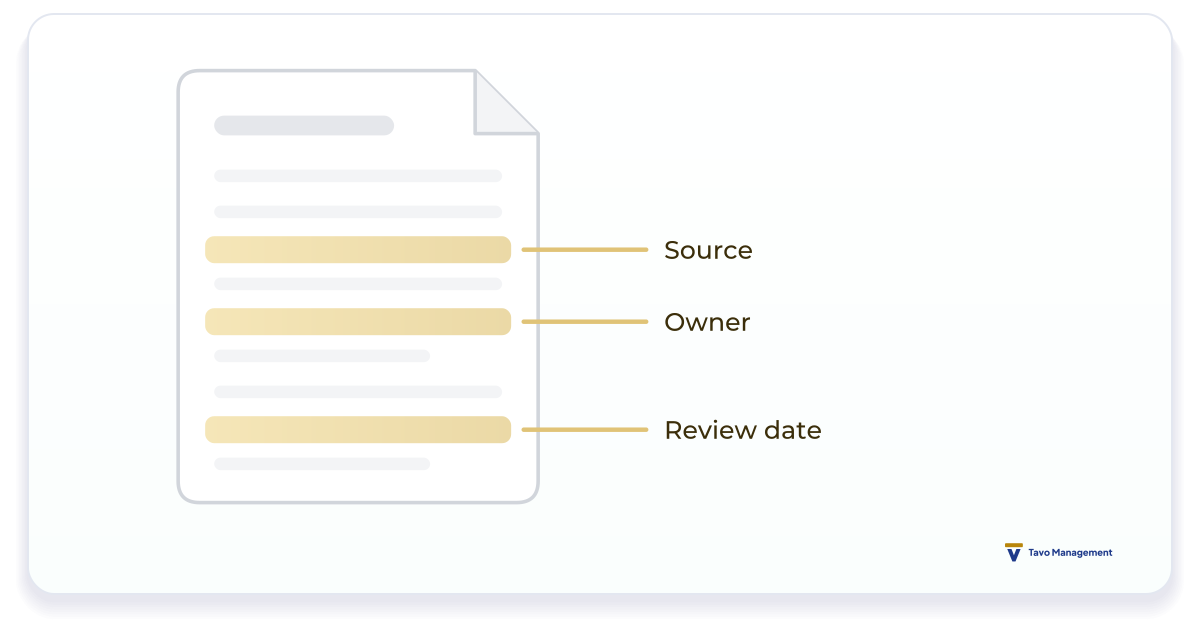
Everything starts with a list. Regulations, license conditions, contract clauses, insurance requirements and your own policies all belong in one register, with the source, the area of the business they touch and the date they were last checked. The biggest surprise for most clients is length: a mid-sized firm often finds more obligations in its customer contracts than in any regulation.
Keep it plain. A spreadsheet with columns for source, summary, owner, risk rating, review date and evidence location is enough for many businesses. Ask your lawyer to confirm how rules apply to you, and write the answer into the register so the reading stays consistent after people change roles.
Block Two: Owners, Backups and Three Lines of Responsibility
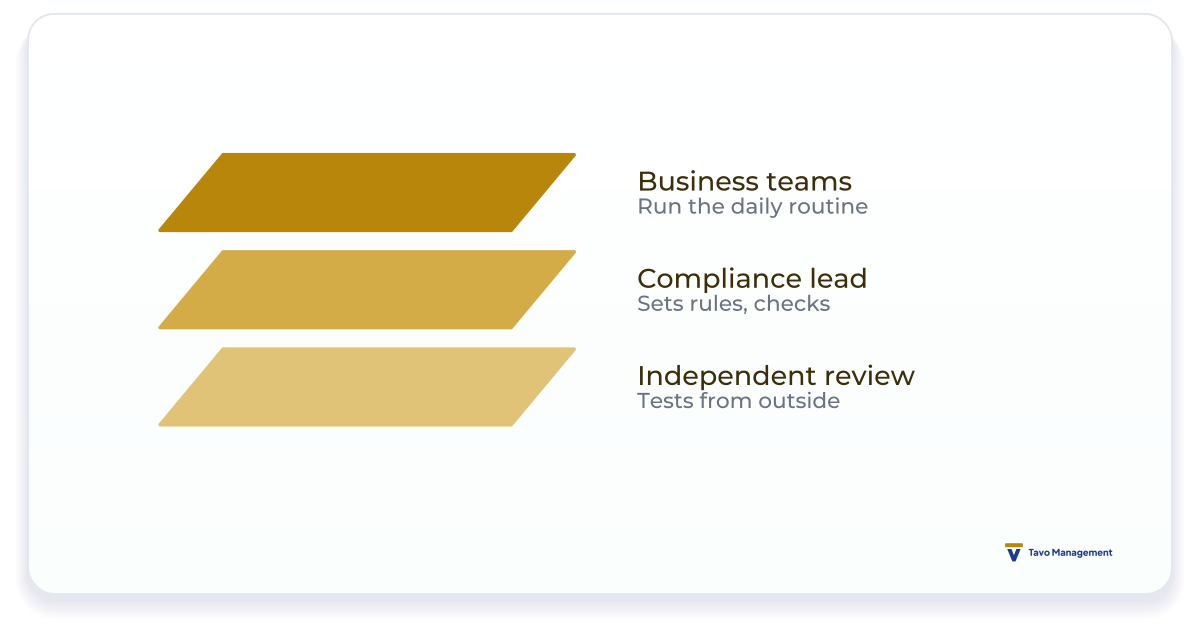
A duty without an owner is a wish. Every row in the register needs a named person, a backup and a place to escalate. I also ask who checks the owner. The Three Lines Model, published by the Institute of Internal Auditors, gives a useful picture: the people who run the work own the day-to-day controls, specialist functions such as compliance advise and monitor, and internal audit gives independent assurance. A small business may have only one or two of those lines, and that is fine if you know which is which.
The failure I see most often is shared ownership. Two teams each believe the other handles a renewal, so nobody does. Name one owner per duty, even when several teams contribute.
Block Three: Risk Ratings That Set Priorities
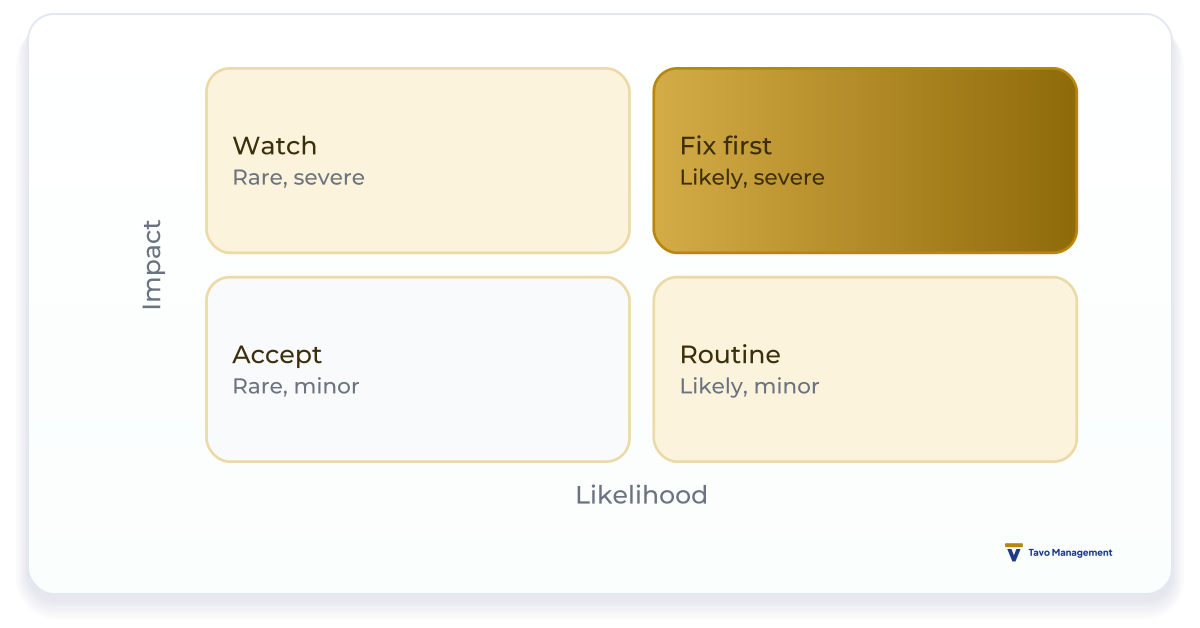
You cannot give every duty the same attention, and a good framework does not pretend to. Rate each obligation by two things: how likely a miss is, and what it would cost you in fines, lost business, safety or reputation. A simple three-level scale is enough. High-rated duties get tighter controls and more frequent checks, and low-rated ones get a yearly review.
Priorities become the backbone of your plan, and my compliance management strategy playbook shows how to turn those ratings into a sequence of projects. Risk ratings also keep the program from growing into a burden: when someone asks for another control, you check the rating first.
Block Four: Controls and Procedures People Can Follow
A control is anything that makes the right behavior likely: a checklist, an approval step, a system setting, a second pair of eyes. Procedures describe the routine in plain steps. I keep them to one page where possible, written with the person who does the work. A procedure nobody helped write is a procedure nobody follows.
Good controls leave evidence as a side effect. A signed approval or a ticket history is proof you did the work, and nobody has to create it later. For a view of controls in real businesses, my compliance management examples walk through ten routines with the steps spelled out.
Block Five: Training and Communication Where the Work Happens
Training is the block that gets the most hours and delivers the least. A yearly slide deck covers every rule once, and people forget it by March. I prefer short training linked to the moment a duty arises: a ten-minute session when someone starts a role, a checklist at the point of use and a quick reminder when a rule changes.
Record who was trained on what, because a training log is among the first things an auditor asks for. Also tell people where to raise a concern. A framework without a way to speak up misses the problems that people see first.
Block Six: Monitoring, Issues and Reporting
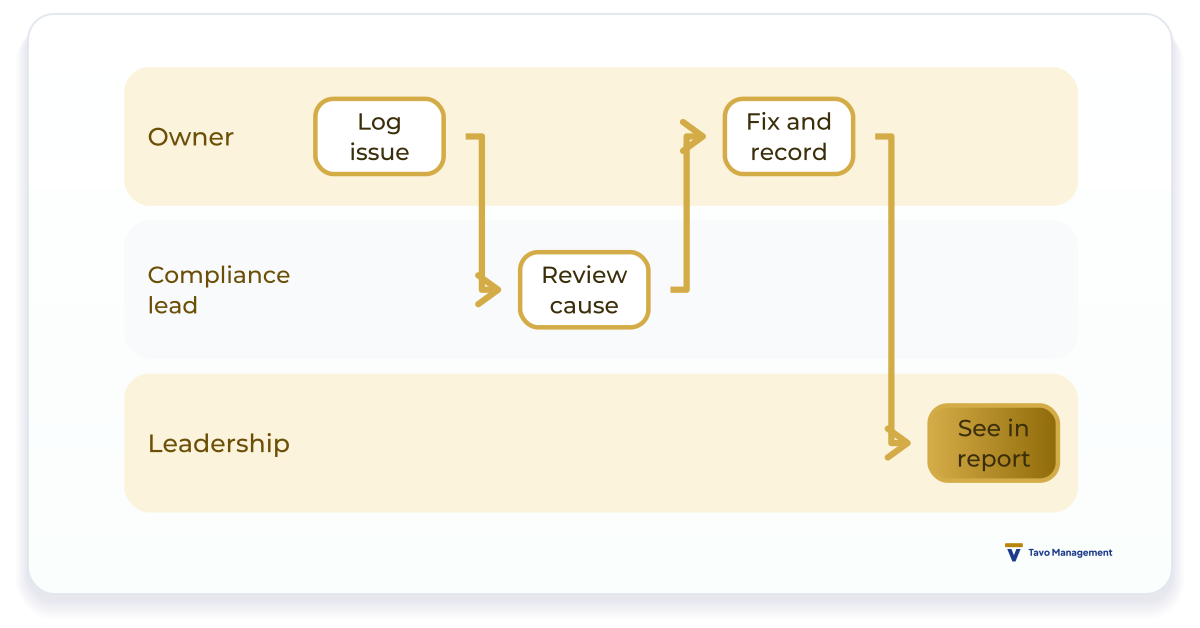
Monitoring answers the question the other blocks cannot: does it work in practice? Spot checks, internal reviews and control tests show where daily practice drifts from the procedure. Findings go into an issues log with an owner, a due date and a closing note, and the same log shows patterns over time.
Leadership should see a short monthly or quarterly report: open items, overdue tasks, new findings and upcoming deadlines. Tools can automate parts of the evidence work, and my ranking of compliance management software compares the main platforms. A shared tracker does the same job for many small organizations.
How Published Standards Frame the Same Blocks
You do not have to invent the structure. ISO 37301:2021 sets out requirements, with guidance, for a compliance management system, covering context, leadership, planning, support, operation, evaluation and improvement. You can use it as a checklist or pursue certification. The standard maps neatly onto the six blocks above, with leadership and planning matching ownership and risk, and operation and evaluation matching controls and monitoring.
In the United States, the Department of Justice publishes guidance on how prosecutors evaluate corporate compliance programs. It asks whether a program is well designed, whether it is applied earnestly and in good faith, and whether it works in practice. Those three questions are a good self-test even if you never face a prosecutor. Neither source replaces advice from your counsel on what applies to you.
Light Framework or Full System: What Fits Your Size
A twelve-person company and a 600-person manufacturer need the same blocks at different weights. The table shows how I scale them.
| Block | Small business | Mid-sized or multi-site |
|---|---|---|
| Register | One spreadsheet, reviewed yearly | Shared tool with site-level views |
| Ownership | Owner plus backups, one lead | Compliance lead plus local owners |
| Risk rating | Three-level scale | Scored scale with annual review |
| Controls | One-page checklists | Procedure library with version control |
| Training | Role onboarding sessions | Role-based paths with tracking |
| Monitoring | Quarterly spot checks | Internal audits and control testing |
A Ten-Minute Health Check for Your Own Framework
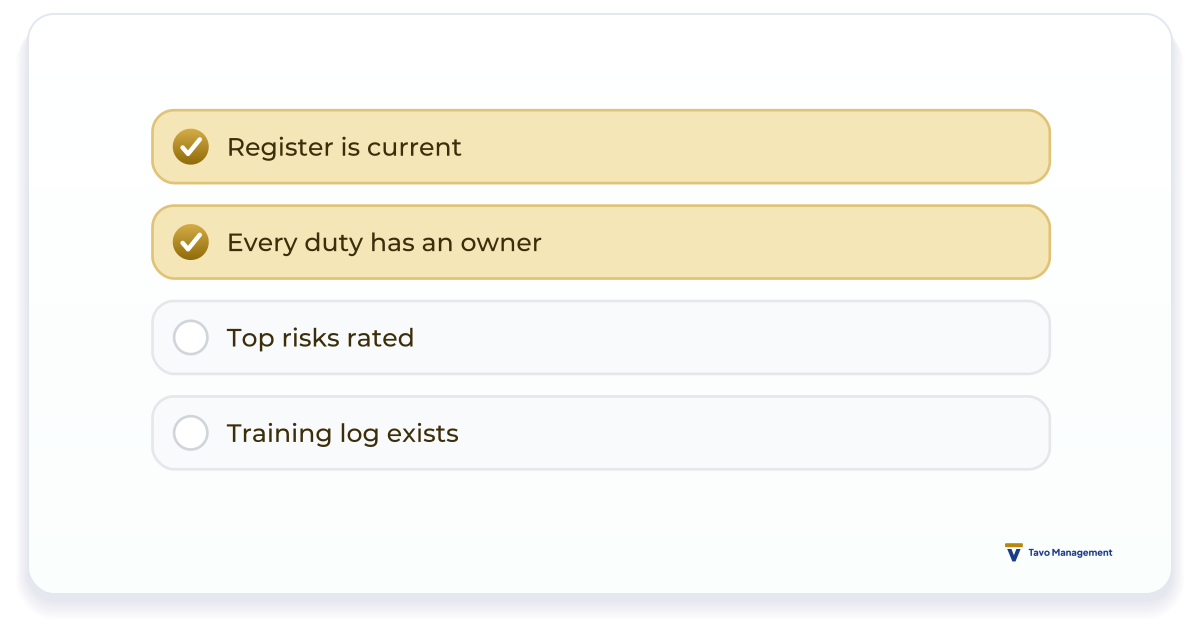
Pick one duty you consider important and trace it through the blocks. If you can answer every question below without asking around, your framework is doing its job.
- Is the obligation in the register, with its source?
- Can you name the owner and the backup?
- Does a risk rating explain how closely you watch it?
- Is there a procedure, and did the person who uses it help write it?
- Has the owner been trained, and is it recorded?
- When was it last tested, and where are the results?
Any no points to the block you work on first.
Choosing Your Starting Point
If you have nothing written down, build the register this month and nothing else. If you have a register but no owners, assign owners next. If your register and owners exist but audits still hurt, the missing block is usually evidence and monitoring. Sequencing the work is the subject of my compliance management implementation guide, which lays out the first 90 days.
Pick the block with the largest gap and the clearest owner. Finishing one block properly beats starting six.
Questions About Compliance Management Frameworks
What Is a Compliance Management Framework?
It is the structure that tells your organization which obligations apply, who owns each one, how risk sets priorities, which controls do the daily work and how you check that they function. A framework is the system around the individual policies, so a missed duty has a place to be noticed. Most are built from six blocks, and you can run a small version in a shared register.
How Is a Framework Different from a Compliance Program?
The framework is the design, and the program is the running version of it. Your framework says that every obligation has an owner and a review date. Your program is the real calendar, the real training sessions and the real findings log. I find it useful to keep the two words apart, because a good design on paper says nothing about what happens on a Tuesday.
Do I Have to Follow ISO 37301 or Another Standard?
No. ISO 37301 is a voluntary standard for compliance management systems, and you can use it as a checklist or seek certification. Many organizations borrow its structure without certifying. If a customer or regulator names a specific standard, follow that one, and ask your counsel what applies to your situation.
How Many People Do I Need to Run a Framework?
A small business can run one with a part-time owner and a handful of named duty owners. What matters is that one person holds the register and chases the dates, with support from leadership. Larger organizations add a compliance lead and local owners at each site or department.
Where Should a Small Company Start?
Start with the obligations register. List every rule, contract term and policy you must follow, with a source and an owner, then rate each one by what a miss would cost. In my client work, that single document exposes more gaps than any policy rewrite, and it gives every later block something to attach to.
Does a Framework Replace Legal Advice?
No. A framework organizes the work of meeting your obligations. It does not tell you what a specific law requires, and it does not interpret a contract clause. Keep your lawyer involved for those questions and record their answers in the register, so everyone follows the same reading.
How Often Should I Review the Framework?
Review the register at least once a year and whenever your business changes, such as a new product, site, supplier or country. Review individual controls on a schedule linked to their risk rating, with high-risk items checked more often. A calendar invite for each owner works better than a long policy about reviews.
Sources
- ISO 37301:2021, Compliance management systems: Requirements with guidance for use
- U.S. Department of Justice, Evaluation of Corporate Compliance Programs (updated September 2024)
General information only: this is not legal, financial or tax advice. Examples and numbers reflect typical projects; check the specifics with your advisers before deciding.
Did you find this helpful?
Thank you for your feedback.
Delaney Brisco
Delaney leads the Tavo editorial team and works with our consultants to turn real client projects into practical guides on project delivery, process design and organizational change. Before joining Tavo, she spent 12 years in operations and program management roles. She has since edited more than 300 articles on management practice and reviewed PMO setups and process redesigns from over 100 client projects. She is based in Minneapolis, Minnesota.