Summary
- Nine areas cover almost everything a growing business needs from its finance routine, from separate accounts to a twice-yearly review.
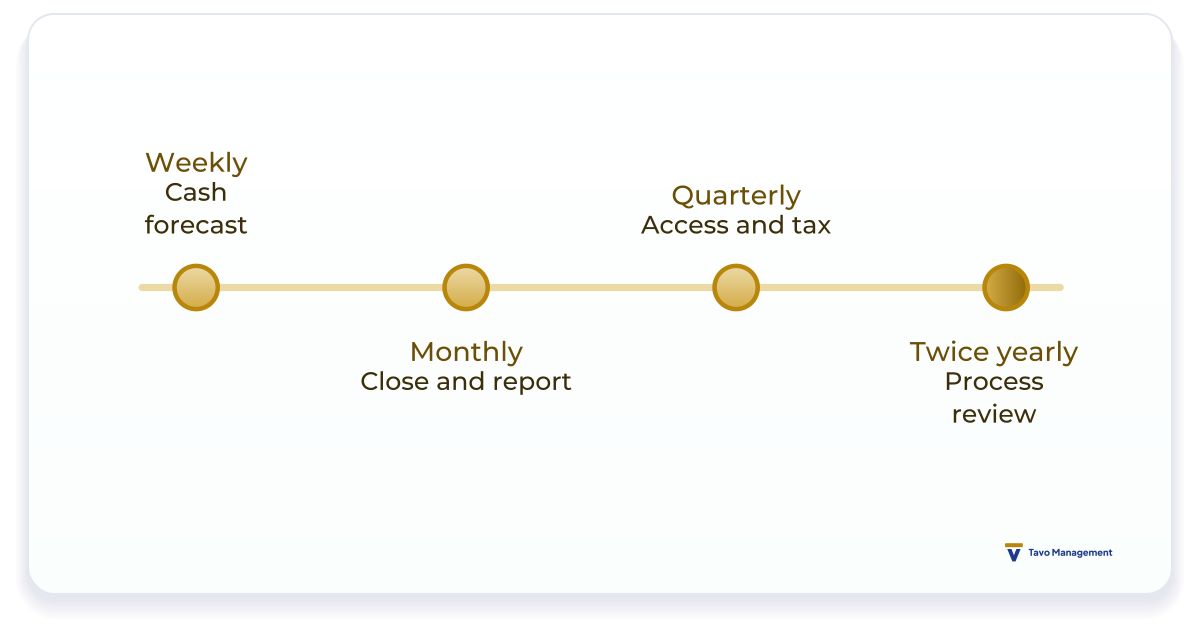
- Each item has a frequency: weekly for cash, monthly for the close and reports, yearly for taxes and records.
- One owner per item, and a different person approving than paying, prevents most errors.
- Start with accounts, reconciliation and a cash forecast, then add the other six as you grow.
When a client asks me where to start with their finance function, I hand them a list. Not a long policy, just nine areas and the items inside each. If you want the work done with you, financial management consulting builds this into a calendar your team runs. If you prefer to do it yourself, this checklist is the version I use.
Work through it once to see what is missing, then turn the recurring items into calendar entries. Gaps are normal. Most businesses I review have six of the nine covered in some form and miss the cash forecast, the approval rules or the review.
The Nine Areas and How Often Each Needs Attention
| Area | Frequency | Main question it answers |
|---|---|---|
| 1. Accounts and chart of accounts | Once, then yearly | Is every transaction recorded in the right place? |
| 2. Bank reconciliation | Monthly | Do the books match the bank? |
| 3. Month-end close | Monthly | Are the numbers final and reviewed? |
| 4. Budget and variance review | Monthly | Are we on plan, and why not? |
| 5. Cash forecast | Weekly | Will we have enough cash in 13 weeks? |
| 6. Approvals and controls | Continuous, reviewed quarterly | Who can spend, and who checks? |
| 7. Reporting and KPIs | Monthly | Does leadership see the same numbers? |
| 8. Taxes and records | Quarterly and yearly | Are filings and documents in order? |
| 9. Process review | Twice a year | Is the routine still worth running? |
1. Accounts and Chart of Accounts
Everything else rests on clean accounts. A chart of accounts that grew by accident, with three different names for the same cost, makes every report harder to read. I give new clients a simple rule: if two accounts could hold the same transaction, merge them.
- One business bank account and one business card, used only for business
- A chart of accounts reviewed once a year, with duplicates merged
- Revenue split into streams that match how you manage the business
- Opening balances and loan balances matched to lender statements
A common mistake here is treating the chart of accounts as an accountant-only topic. You are the one reading the reports, so you decide how revenue and costs are grouped. I usually sit with the owner for an hour, list the five questions they ask about the business every month, and shape the accounts so the answer is one report away.
2. Bank Reconciliation
A reconciliation proves that your books and your bank agree. It is also the cheapest fraud check you have, because unfamiliar payments show up here first. Do it monthly at the least, and weekly if volume is high.
- Every bank, card and payment-processor account reconciled to its statement
- Unmatched items older than 30 days investigated
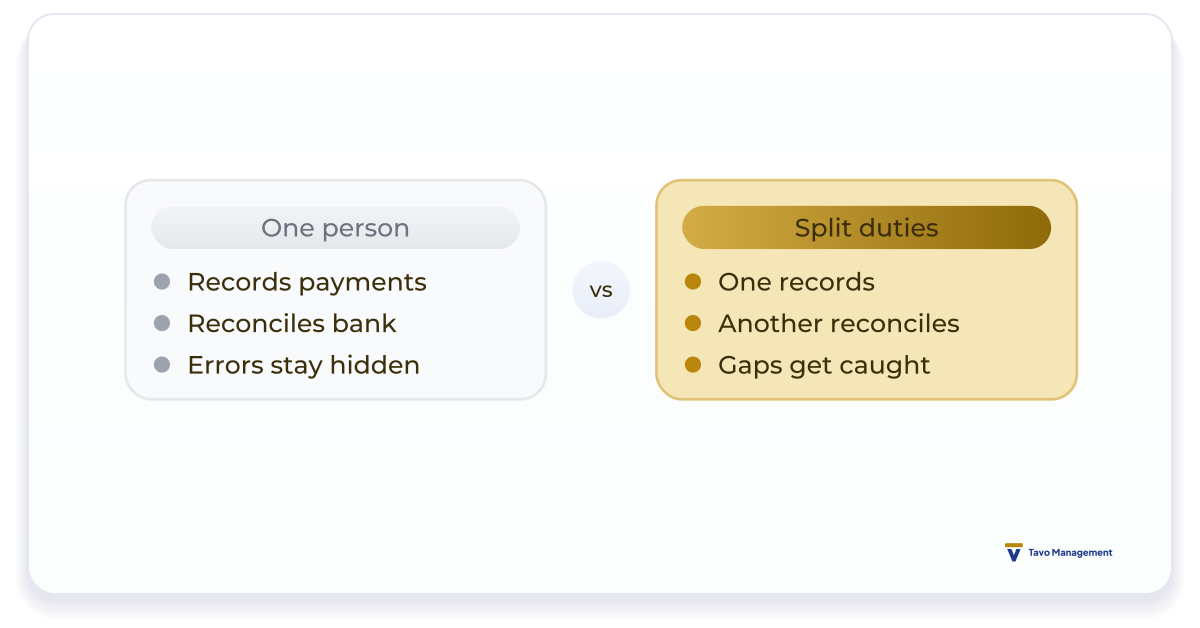
- Reconciliation signed off by someone other than the person who posted
- Payment-processor fees and payouts matched to sales
One pattern I see often: the person who reconciles is also the person who posted the entries, so errors never get a second pair of eyes. A short review by the owner, even fifteen minutes, catches duplicated bills, missing deposits and payments to vendors you do not recognize. If your team is a single person, schedule a quarterly review with your accountant instead.
3. Month-End Close
The close turns a month of transactions into numbers you can rely on. A written calendar with owners cuts the delay more than any tool does. The financial management framework shows how the close feeds budgets and forecasts.
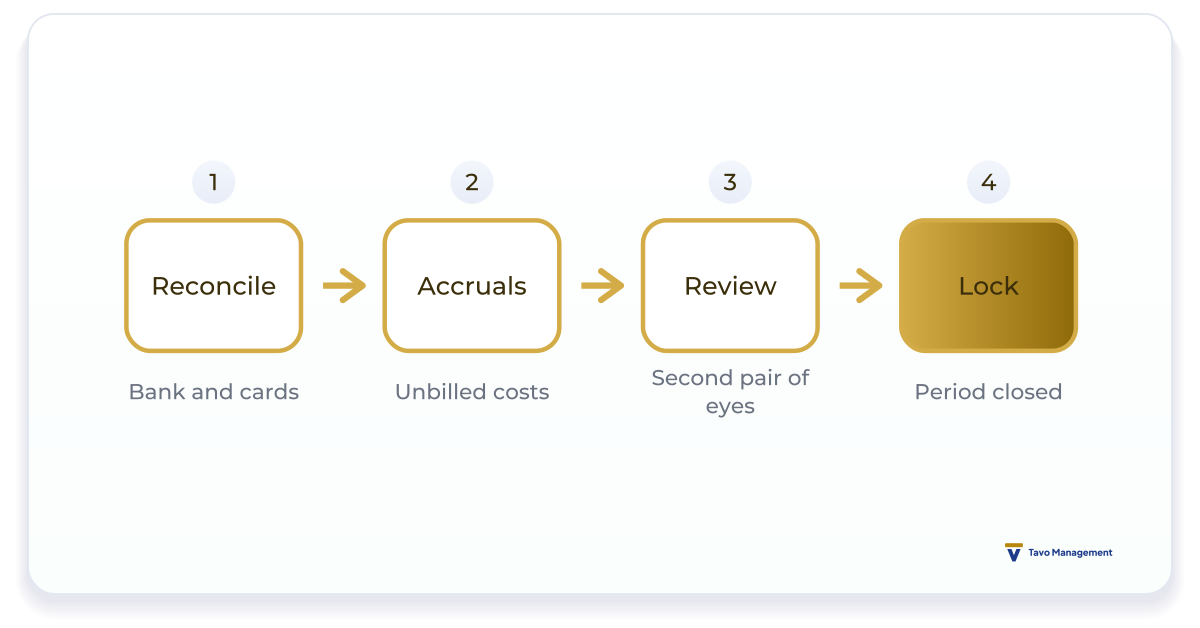
- A close calendar with tasks, owners and due days
- Accruals for bills received late and revenue earned but not invoiced
- Depreciation, prepaid items and payroll liabilities reviewed
- Accounts receivable and payable agings checked against the ledger
- The period locked after review, with changes only by approval
Timing matters as much as accuracy. Late closes are the usual reason monthly reconciliations slip, and a slipping reconciliation delays every later step. Fix the close calendar first, and the rest of the month gets calmer. I also suggest a short checklist inside the close for accruals, because forgotten bills are the most frequent cause of a month that looks better than it was.
4. Budget and Variance Review
A budget turns your goals into numbers, and the monthly variance review shows whether reality is following. Keep it to the drivers that matter. The financial management best practices go into how to build one around a handful of drivers.
- An annual budget built from drivers such as customers, price, headcount and material cost
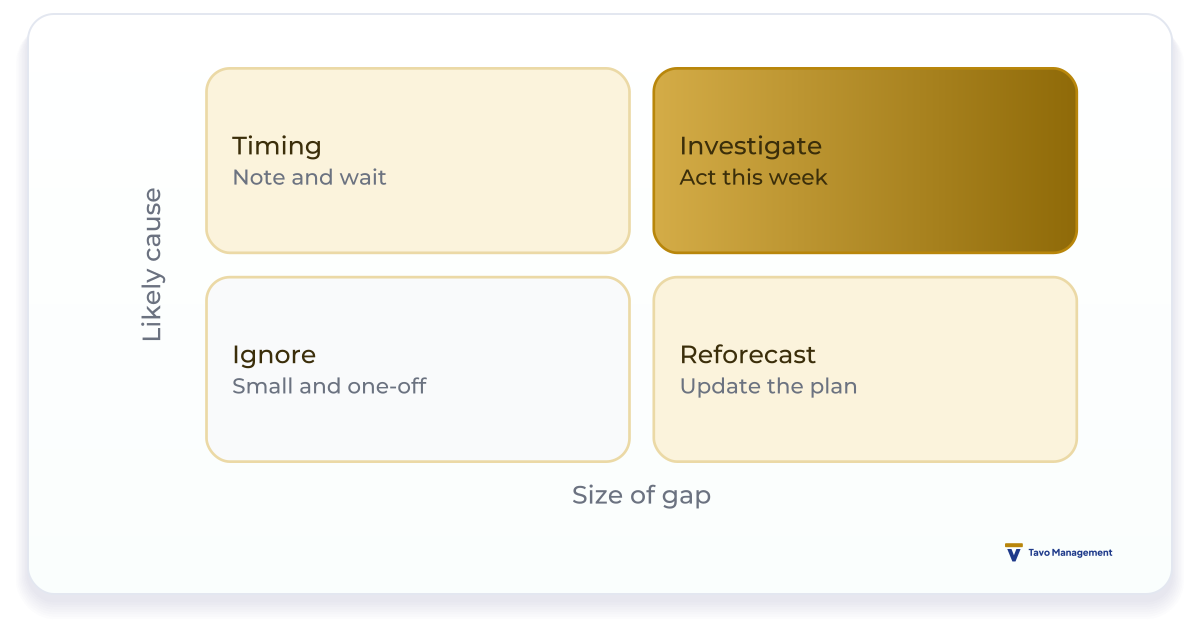
- Monthly actual against budget, with a written reason for each large gap
- A rolling forecast updated when a major assumption changes
- Owners named for each major cost line
In practice, the variance review works best as a thirty-minute meeting with the people who own the cost lines. Ask each owner to explain their gap in one sentence before the meeting. That keeps the discussion on decisions: cut, delay, accept or change the plan. A gap without a decision is just a number.
5. Cash Forecast
Cash decides how long you can keep going. A 13-week forecast lists expected receipts and payments by week, using real invoices and bills, and it takes about thirty minutes to update once it exists. Most of the businesses I help were surprised at least once by a cash gap that a forecast would have shown.
- A 13-week forecast built from open invoices, bills, payroll and taxes
- Weekly update with actuals and a note where the forecast was wrong
- A minimum cash level that triggers a defined action
- Accounts receivable follow-up routine for invoices past due
Make the forecast visible. I put it on a single sheet that the owner reads every Monday, and I mark the weeks where the balance falls below the minimum. That small habit turns a spreadsheet into a decision tool, because the owner can act on a tight week while there is still time to collect an invoice or move a purchase.
6. Approvals and Controls
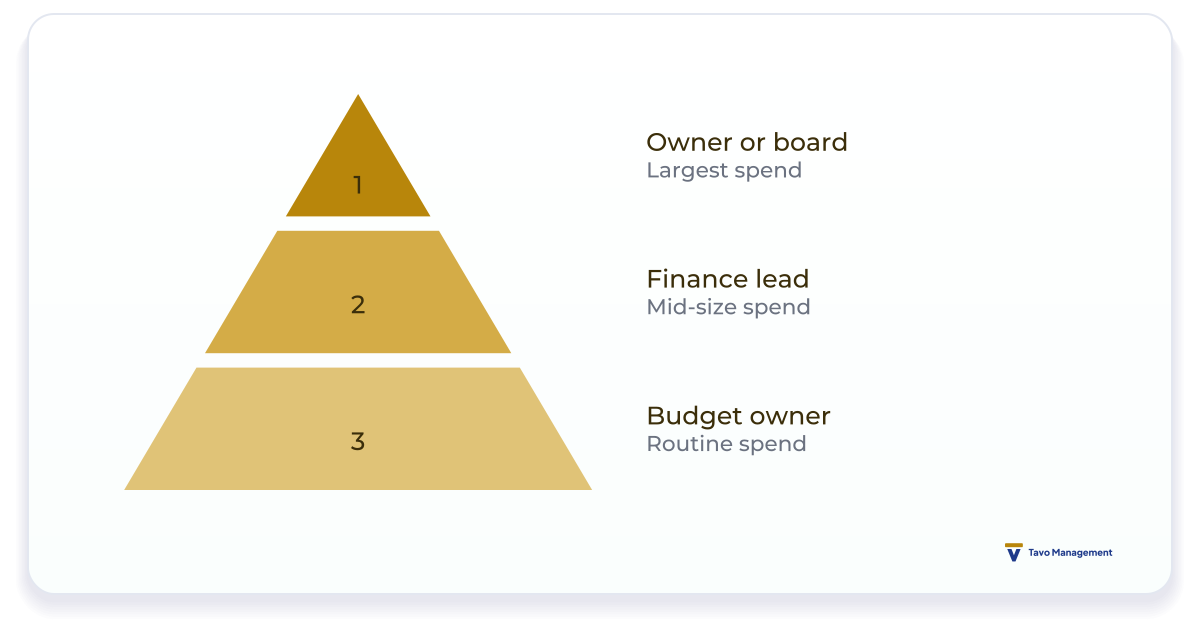
Controls keep honest mistakes small and make dishonest ones harder. They do not need to be heavy. Define who can add a vendor, who approves bills, who releases payments and who looks at bank access, and make sure approving and paying are separate roles.
- Approval limits written down by role and amount
- Approving and paying done by different people
- New vendors and changes to bank details confirmed by phone
- User access to banking and accounting reviewed every quarter
Controls also protect the people who work for you. When approval rules are clear, an employee never has to wonder whether a payment was allowed, and nobody ends up the only person who knew about a mistake. I explain it to teams as a safety net rather than a sign of distrust, and that framing keeps the rules from being worked around.
7. Reporting and KPIs
Leadership needs one short report with defined numbers. I aim for a single page: profit and loss against budget, cash and forecast, receivables aging, payables due and five to eight KPIs. If you are weighing tools to produce it, my list of financial management software shows what each option reports out of the box.
- One monthly report pack on the same day each month
- Written definitions for revenue, margin, overdue and every KPI
- Comparison to last month and the same month last year
- A sentence on each significant variance
Reports only help if they are read. I ask leadership teams to use the same page in every meeting for three months before changing it. By the third month, people start to expect the numbers and ask better questions, such as why margin fell in one product line or why receivables aged in one region.
8. Taxes and Records
Deadlines and documents are where small lapses become expensive. Put filing and payment dates in a shared calendar, and keep supporting documents where your accountant can reach them. The IRS says to keep records for as long as they may be needed for the return's period of limitations, which is generally three years, with longer periods in specific cases and a separate rule for employment tax records. Ask your accountant what applies to you.
- A tax calendar with filing and payment dates for each entity
- Sales tax and payroll tax accounts reconciled to what you paid
- Receipts and contracts stored digitally and named consistently
- A written retention rule agreed with your accountant
Keep a short list of tax and compliance questions for your accountant throughout the year, and send them in one batch each quarter. That is cheaper than many small emails, and it gives your accountant context. Do not rely on this article for legal or tax advice. Rules differ by country, state and business type, and they change.
9. Process Review
Routines age, so look at yours twice a year. Ask which reports were used, which steps take longest, where errors appeared and what changed in the business. Remove, simplify or automate accordingly.
- A two-hour review on the calendar every six months
- A list of steps that nobody can explain, with a decision on each
- Tools and subscriptions checked against actual use
- The checklist itself updated with what you learned
The most valuable item in this review is the one nobody wants to touch: a step that exists because of something that happened years ago. Find out what problem it solved and whether that problem still exists. If it does not, retire the step and note the date, so the next review can confirm nothing broke.
Which Items Belong in Which Calendar Slot
Once you have scored the nine areas, move the recurring items onto the calendar. The split below is the one I use with most small teams. Adjust it to your volume: a business with hundreds of daily transactions may reconcile weekly, while a quiet one can stay monthly.
| Slot | Items | Time needed |
|---|---|---|
| Every Monday | Cash forecast update, receivables follow-up, payments due this week | About 30 to 45 minutes |
| Monthly, days 1 to 10 | Reconciliations, accruals, close review, report pack, variance meeting | One to two days spread across the team |
| Quarterly | Access review, tax payments, retention check, accountant question batch | Two to three hours |
| Twice a year | Process review, chart of accounts cleanup, budget reforecast | Two to four hours |
How to Put the Checklist to Work
Do not try to complete everything in one week. I suggest a three-step start:
- Score each of the nine areas as done, partly done or missing
- Assign one owner and a first due date to every gap, starting with accounts, reconciliation and cash
- Copy the recurring items into a calendar and review progress at the next close
Within two or three closes you will see which items matter most for your business. If you would like someone to work through the list with you, a short call is free.
Questions About the Financial Management Checklist
How Often Should I Run Through a Financial Management Checklist?
Run the monthly items every month at close, the weekly items every week and the yearly items once a year. I put all three on one calendar, with an owner and a due date for each item, so nothing depends on memory.
What Is the Minimum I Need for a Very Small Business?
Start with sections one, two and five: separate accounts, a monthly reconciliation and a cash forecast. Those three take a few hours a month and give you a clear picture of where you stand. Add the rest as the business grows.
Who Should Own Each Checklist Item?
Every item needs one named person, even in a team of two. Where possible, the person who approves a payment should differ from the person who makes it. If you are the only person, ask your bookkeeper or accountant to review the key items quarterly.
Do I Need Software to Use This Checklist?
No. A spreadsheet and your bank statements are enough to start. Software helps once volume grows, and my ranking of financial management software shows options by business size. Decide on the routine first, then choose the tool.
How Long Should I Keep Financial Records?
The IRS says records should be kept as long as they may be needed for the tax return's limitation period, which is generally three years, and longer in some cases. Employment tax records have their own period. Check the IRS guidance and ask your accountant, because your situation may differ.
What Should the Monthly Report Include?
Keep it to one page: profit and loss against budget, cash balance with the forecast for the next 13 weeks, accounts receivable aging, accounts payable due and the few KPIs you track. Add a sentence on each significant variance.
What Is the Most Commonly Missed Item?
In my client work it is the cash forecast. Businesses check profit every month and the bank balance every day, but few look 13 weeks ahead. That forward view is what turns bad surprises into planned decisions.
Sources
General information only: this is not legal, financial or tax advice. Examples and numbers reflect typical projects; check the specifics with your advisers before deciding.
Did you find this helpful?
Thank you for your feedback.
Delaney Brisco
Delaney leads the Tavo editorial team and works with our consultants to turn real client projects into practical guides on project delivery, process design and organizational change. Before joining Tavo, she spent 12 years in operations and program management roles. She has since edited more than 300 articles on management practice and reviewed PMO setups and process redesigns from over 100 client projects. She is based in Minneapolis, Minnesota.