Summary
- The framework has six phases: goals, records, planning, control, reporting and review. Build them in that order.
- Each phase has one owner, one output and one gate that tells you when it is ready.
- The cash conversion formula gives you one number that shows how quickly your operations turn work into cash.
- Start small: the first three phases can run within a couple of months in a small business.
Financial management advice usually arrives as a pile of tips. A framework shows how the tips connect and in which order to build them. Over many financial management consulting projects I have settled on six phases that hold for businesses from five people to a few hundred.
The model below walks through each phase, what it produces, how to know it is ready and how to measure health with one formula. Use it to decide what to build next, not as a template to fill in at once.
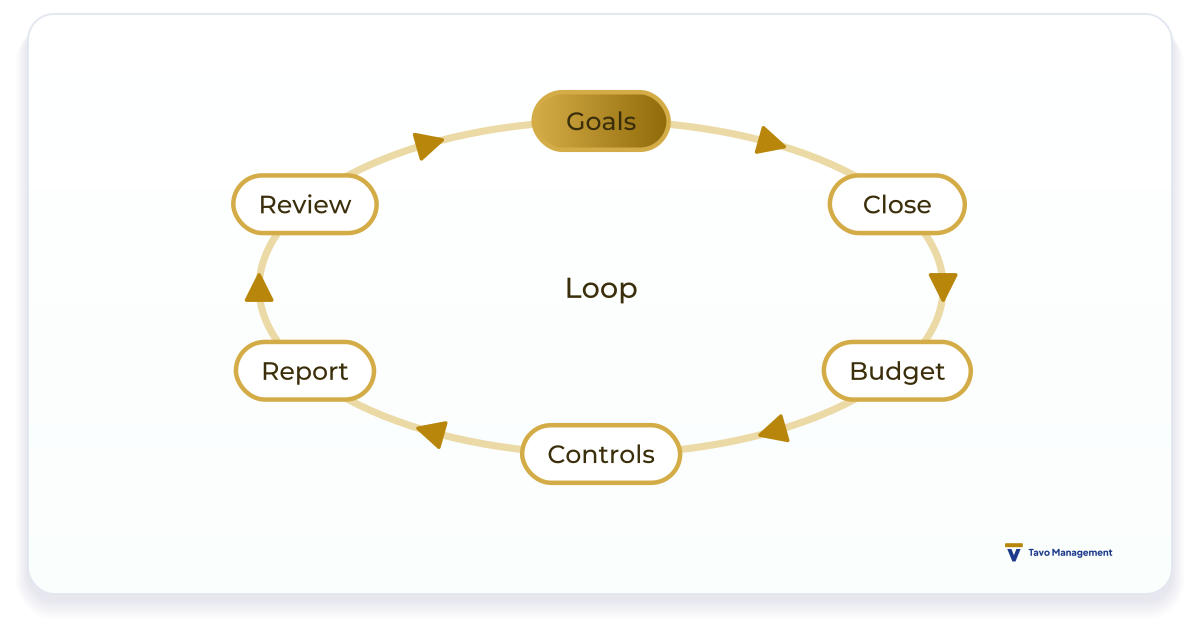
The Six-Phase Model at a Glance
| Phase | Output | Owner | Ready when |
|---|---|---|---|
| 1. Goals and decisions | A short list of financial targets and the decisions they support | Owner or CEO | Everyone can name the three numbers that matter |
| 2. Records and close | Clean books, a close calendar | Bookkeeper or controller | Books close by the same day each month |
| 3. Budget and forecast | Annual budget, rolling cash forecast | Finance lead with budget owners | Forecast is updated weekly |
| 4. Control | Approval rules, split duties, access review | Owner with finance lead | No one approves and pays the same item |
| 5. Reporting | One-page monthly pack with defined KPIs | Finance lead | Leaders quote the same figures |
| 6. Review and improve | A short list of changes every six months | Owner with advisor | Unused steps are retired |
Phase 1: Set Goals and Name the Decisions
Every finance routine should support a decision. Before you touch the books, write down what you need to decide this year: hire two people, open a second location, raise prices, take a loan. Each decision points to the numbers you need, such as margin by product, cash runway or payback time.
Keep the list short. I ask owners for three financial targets, for example a gross margin level, a minimum cash balance and a revenue goal. The test for completing this phase is simple: anyone on the leadership team can name the three numbers and say who owns each.
A quick exercise helps here. List the last five money decisions you made and ask what number you wished you had at that moment. Those wishes are your reporting requirements, and they shape the budget drivers in phase three. Owners who do this exercise usually discover that two or three of their regular reports answer none of their real questions, which saves effort later.
Phase 2: Records and the Monthly Close
Records are the base layer. You need separate business accounts, a chart of accounts that makes sense, reconciled bank and card accounts and a close calendar with an owner for each task. A close that lands on a predictable day is the gate for this phase.
Do not skip this phase to reach budgeting sooner. A budget compared with unreliable actuals produces arguments instead of decisions. The financial management checklist lists the close steps I use, and if you need to pick a ledger, the ranking of financial management software compares the options.
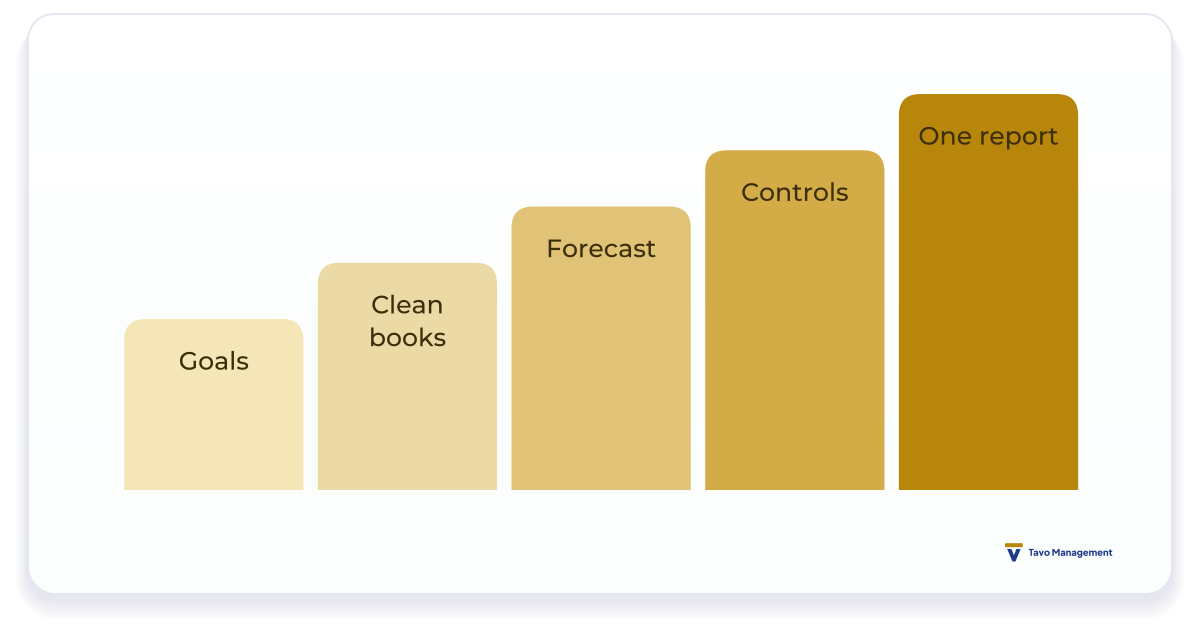
Phase 3: Budget and Rolling Forecast
With reliable actuals you can plan. Build the budget from drivers, the few variables that explain most of your results. A retailer might use footfall, conversion, basket size and margin. A services firm might use billable hours, rate and utilization.
Add a rolling 13-week cash forecast. It starts from open receivables and payables and adds payroll, taxes and known purchases. Update it weekly and compare it with what happened, which trains you to forecast better each month.
A Formula for Judging Cash Health
One number I use often is the cash conversion cycle, which shows how many days your cash is tied up between paying suppliers and collecting from customers.
Cash conversion cycle = days inventory outstanding + days sales outstanding − days payable outstanding
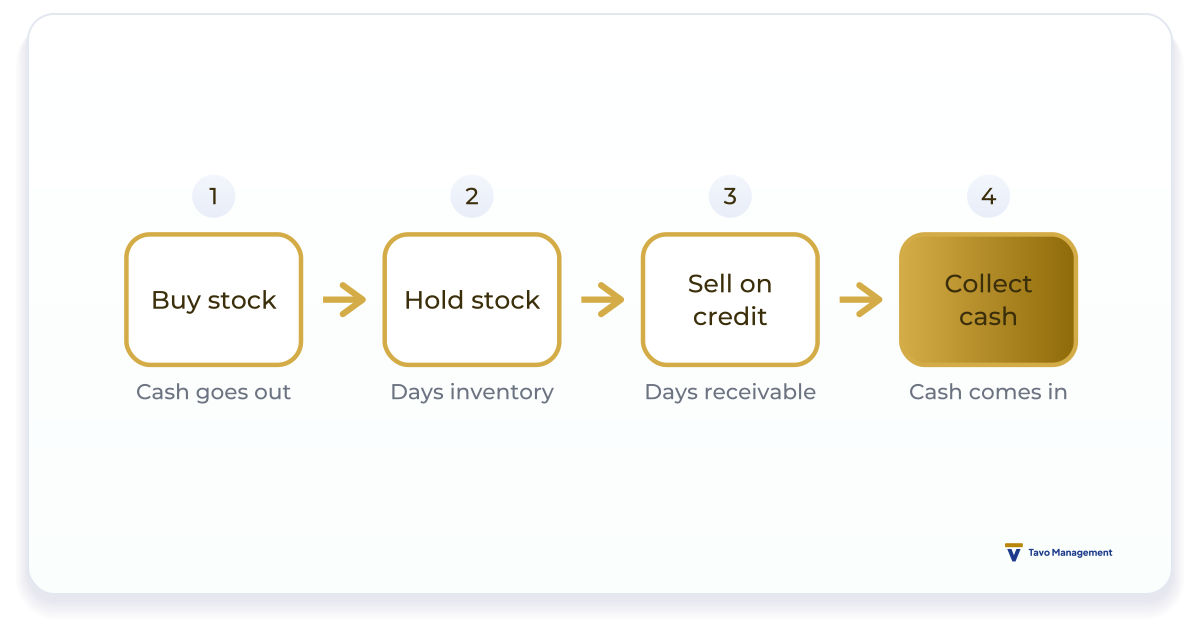
Here is a worked example with illustrative numbers. A small distributor holds stock for 45 days, collects from customers in 38 days and pays suppliers in 30 days. Its cycle is 45 + 38 − 30, which is 53 days. Cutting collection time by seven days through faster invoicing and reminders reduces the cycle to 46 days, which frees cash without any new customers.
| Lever | Starting days | After change | Effect on cycle |
|---|---|---|---|
| Days inventory outstanding | 45 | 45 | No change |
| Days sales outstanding | 38 | 31 | 7 days shorter |
| Days payable outstanding | 30 | 30 | No change |
| Cash conversion cycle | 53 | 46 | 7 days of cash released |
Be careful about stretching supplier payment days to shorten the cycle. Late payment damages supplier relationships and can cost you discounts, so I treat it as the last lever to pull.
Phase 4: Controls That Match Your Size
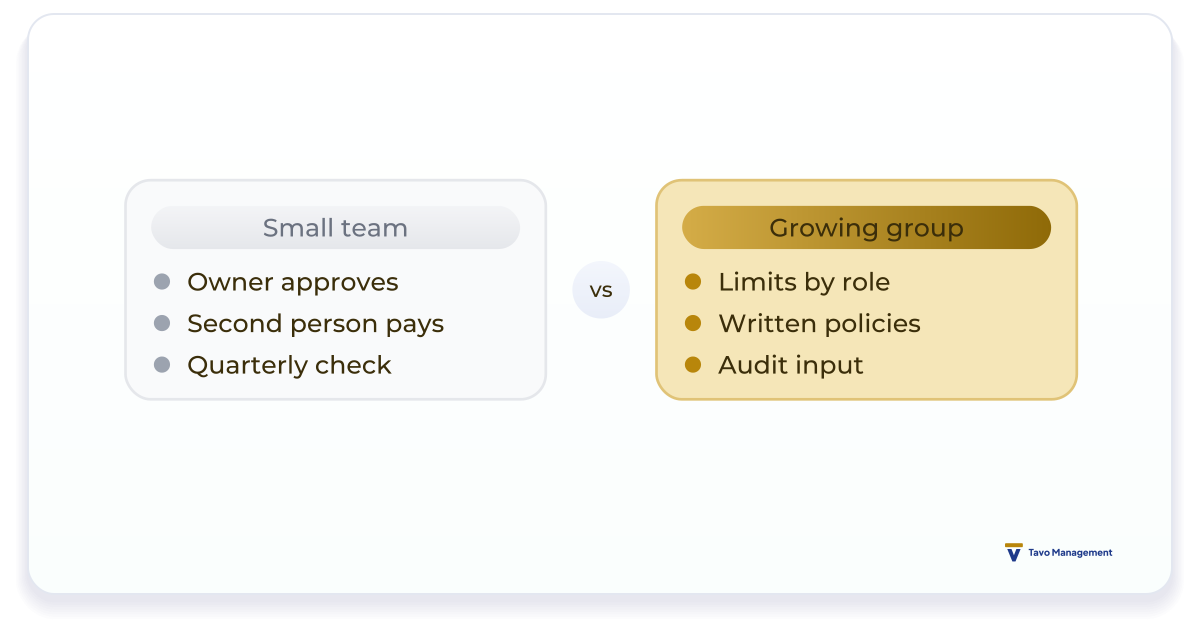
Controls protect the numbers and the cash. For a small team, four rules cover most of the risk: approving and paying are separate roles, new vendors and changed bank details are confirmed by phone, payments above a set amount need a second approval and access to banking is reviewed every quarter.
Larger organizations often connect these controls to a wider risk process. The COSO Enterprise Risk Management framework, updated in 2017, is a common reference for that, and the finance controls here supply much of its day-to-day evidence. Check with your auditor or advisor which standard applies to you.
Phase 5: One Report That Everyone Trusts
Reporting is where the earlier phases show up. Build one page: profit and loss against budget, cash and the 13-week forecast, receivables aging, payables due and five to eight KPIs. Each KPI gets a written definition and an owner.
The test is simple. In the monthly meeting, nobody argues about which number is right. When that happens, you can spend the meeting on decisions. My financial management best practices cover how to choose KPIs and keep definitions stable.
Phase 6: Review and Refine Twice a Year
Close the loop. Every six months, spend two hours asking which reports were used, which steps were slow, where errors appeared and what changed in the business. Then update goals in phase 1 and adjust the other phases accordingly.
This review is the phase most teams skip, and it is why finance routines slowly drift. A calendar entry with a named owner is enough to keep it alive.
How the Framework Changes With Company Size
The six phases stay the same as you grow, but the weight of each shifts. A five-person business can run phases two and three in a spreadsheet and a bookkeeper's calendar. A company with several entities needs consolidation, intercompany rules and a planning tool, and its phase four looks closer to a formal control environment. Start with the column that matches you today and revisit it when you add people, entities or locations.
| Phase | Under 10 people | 10 to 100 people | Multi-entity |
|---|---|---|---|
| Records and close | Bookkeeper, monthly close in a few days | Controller, written close calendar | Shared service team, consolidation step |
| Budget and forecast | Spreadsheet, five drivers | Budget owners per department | Planning platform with scenarios |
| Control | Owner approves, second person pays | Approval limits by role and amount | Formal policies, internal audit input |
| Reporting | One-page monthly pack | Pack with department views | Entity and group reports |
I see the most trouble in the middle column. A business of thirty people often still runs on the owner's memory and a bookkeeper's habits, while volume has outgrown both. Adding one finance lead with clear ownership of phases two and three often fixes more than any software purchase.
Where the Framework Usually Breaks
Three failure patterns show up again and again in my client work. The first is building phase three before phase two: the budget is fine, but actuals arrive late and wrong, so the review turns into a debate about data. The second is a framework without owners. If a phase belongs to everyone, it belongs to nobody, and it slowly stops happening. The third is tool-first thinking, where a new system is bought in the hope that it will create the process.
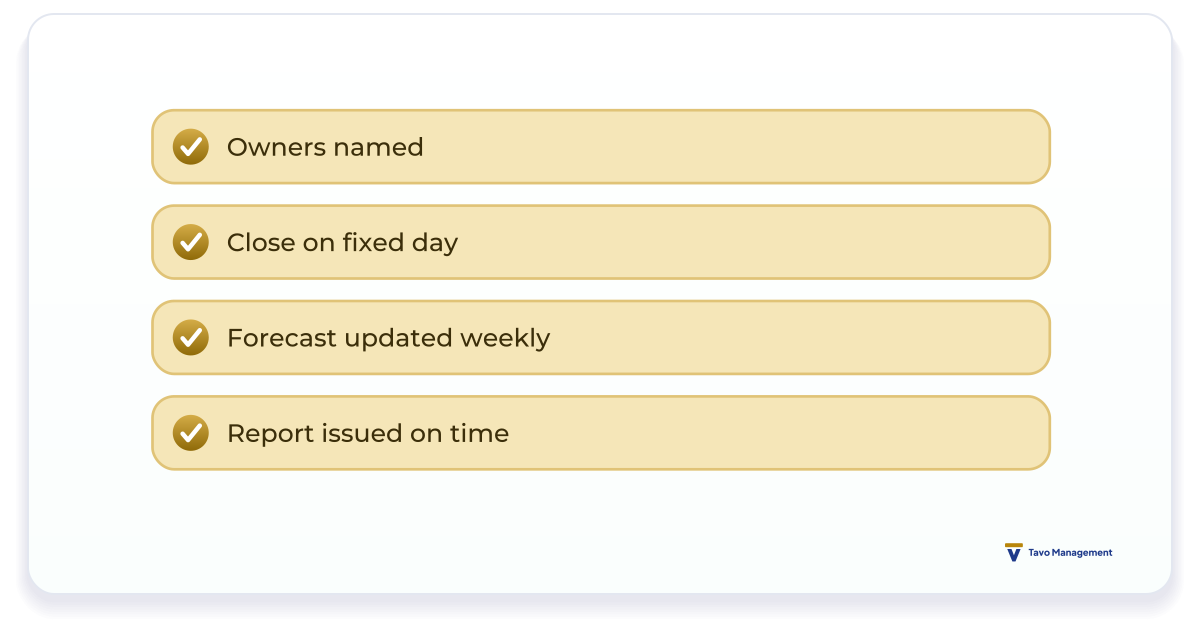
The fix for all three is the gate. Do not move to the next phase until the previous one passes its test, and write the test down. A gate such as "books closed by day ten for three months in a row" is hard to argue with. It also gives the team a clear win to celebrate, which matters more than it sounds.
How to Build the Framework in Order
You do not need to launch all six phases together. This is the sequence I recommend, with realistic timing for a small business:
| Timing | Focus | Gate to move on |
|---|---|---|
| Weeks 1 to 2 | Goals, owners and a first close calendar | Three targets named, calendar agreed |
| Weeks 3 to 6 | Clean records, reconciled accounts, first on-time close | Books closed by the target day |
| Weeks 6 to 10 | Driver-based budget and weekly cash forecast | Forecast updated four weeks in a row |
| Weeks 10 to 14 | Controls and the one-page report | Report issued on a fixed day |
| Month 6 | First review and adjustment | Change list agreed and owned |
Expect delays. Month-end closes often take two or three attempts to land on the right day, and the first forecasts are usually wrong by a wide margin. That is normal and part of how you learn which assumptions to watch. If you want help with sequencing, the free call below covers it.
Questions About the Financial Management Framework
What Is a Financial Management Framework?
It is a simple model that links the main parts of your finance function so they work as one system: goals, records, planning, control, reporting and review. Each part feeds the next, which keeps your numbers consistent from the ledger to the board report.
How Long Does It Take to Put a Framework in Place?
For a small business I usually see the first three phases running within six to ten weeks, with reporting and review following over the next quarter. Larger companies with several entities take longer. Start with one phase and build in order.
Do I Need a CFO to Use This Framework?
No. A bookkeeper or controller can run the records and close, an owner or manager can own the budget, and an outside advisor can review it twice a year. What matters is that every phase has a named owner.
How Is a Framework Different from a Checklist?
A checklist tells you what to tick off. A framework explains how the parts depend on each other and in which order to build them. I use the checklist for weekly and monthly work and the framework to decide where to improve next.
What Is the Cash Conversion Formula in This Model?
Cash conversion cycle equals days inventory outstanding plus days sales outstanding minus days payable outstanding. A shorter cycle means cash returns to the business faster. Service businesses without inventory can use days sales outstanding minus days payable outstanding.
Can the Framework Work Alongside Enterprise Risk Management?
Yes. Larger organizations often connect finance routines to a risk framework such as COSO's Enterprise Risk Management framework. The finance phases here supply the controls and the reporting that a risk process needs.
Which Tools Do I Need?
Start with an accounting system, a bank feed and a spreadsheet for the forecast. Add approval and planning software when volume or complexity grows. Choose tools after the process is clear, not before.
Sources
General information only: this is not legal, financial or tax advice. Examples and numbers reflect typical projects; check the specifics with your advisers before deciding.
Did you find this helpful?
Thank you for your feedback.
Delaney Brisco
Delaney leads the Tavo editorial team and works with our consultants to turn real client projects into practical guides on project delivery, process design and organizational change. Before joining Tavo, she spent 12 years in operations and program management roles. She has since edited more than 300 articles on management practice and reviewed PMO setups and process redesigns from over 100 client projects. She is based in Minneapolis, Minnesota.