Summary
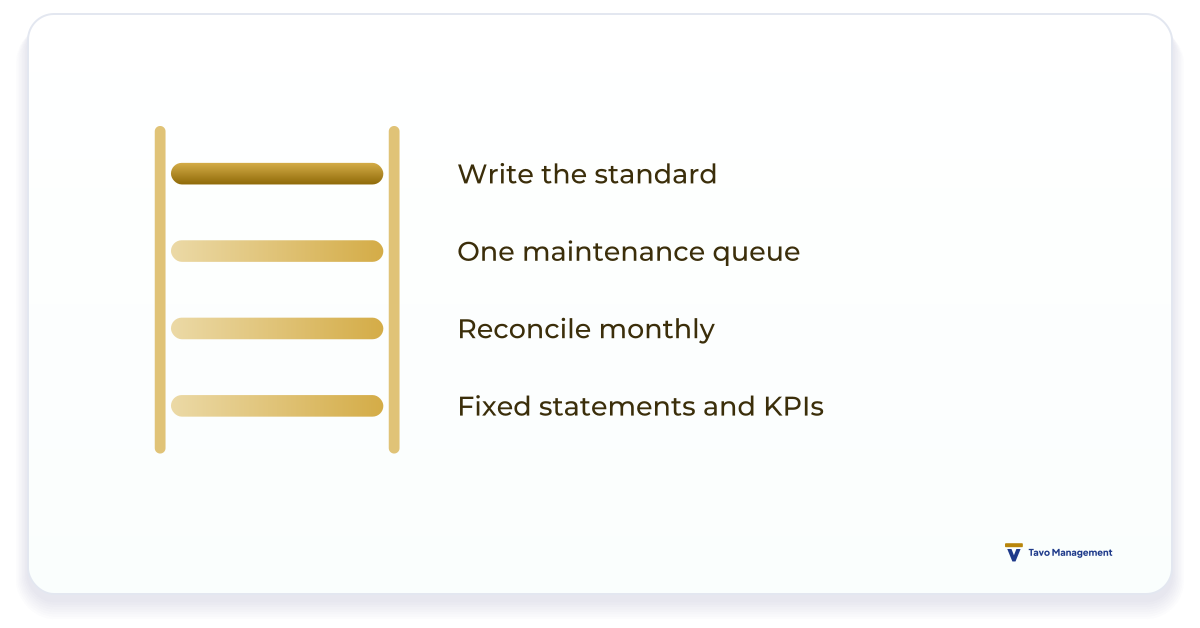
- Write your standards down so the process survives staff turnover.
- One maintenance queue with priorities and due dates closes most service gaps.
- Reconcile accounts monthly and send owner statements on a fixed date.
- Adopt the practices one at a time, starting where you lose the most money.
Good property managers rarely do anything exotic. They do the same nine things every week, and they do them in the same way. The difference between a calm portfolio and a chaotic one usually comes down to whether these habits are in place.
Below are nine practices I use as the starting point of a property management consulting engagement. Each one has a do and an avoid, so you can check your own setup in a few minutes.
The 9 Practices Side by Side
| Practice | Do this | Avoid this |
|---|---|---|
| 1. Write the Standard Down Before You Hire for It | Put move-in, move-out, repair approval and owner reporting on one page each. | Do not rely on the experienced coordinator's memory. |
| 2. Run One Maintenance Queue With Priorities | Take every request through one channel. | Do not accept requests by text, email and phone and hope someone tracks them. |
| 3. Turn Units on a Schedule, Not on Instinct | Start the turn plan when the notice arrives. | Do not wait until move-out to call vendors. |
| 4. Screen Every Applicant the Same Way | Use written criteria, apply them to everyone and keep the records. | Do not make exceptions by feel. |
| 5. Make Rent Easy to Pay and Late Rent Easy to See | Offer online payment, send automatic reminders and review aging balances weekly. | Do not wait for a balance to reach 30 days before you call. |
| 6. Reconcile Every Account Every Month | Match each bank account to the ledger on a fixed date. | Do not let reconciliation slip to the end of the quarter. |
| 7. Send Owner Statements on a Fixed Date | Choose a date, keep it and add a short note about anything unusual. | Do not send statements late and without comment. |
| 8. Track Six KPIs and Review Them Monthly | Days vacant, collection rate, delinquency, response time, maintenance cost per unit and NOI cover most of what you need.. | Do not build a dashboard with twenty charts that nobody reads. |
| 9. Review Vendors and Software Every Year | List every vendor and tool, what it costs and who uses it. | Do not renew by default. |
The list runs from operations to money to review. If you can only start three, I would begin with the maintenance queue, the turn schedule and the monthly reconciliation, because they affect revenue and owner trust fastest.
The 9 Practices in Detail
1. Write the Standard Down Before You Hire for It
Do this: Put move-in, move-out, repair approval and owner reporting on one page each. Give every step an owner.
Avoid this: Do not rely on the experienced coordinator's memory. Processes that live in one head leave with that person.
A new leasing agent at one client took four weeks to reach full speed. After we wrote one-page procedures, the next hire needed about ten days. The numbers are from that single project, so treat them as an example.
2. Run One Maintenance Queue With Priorities
Do this: Take every request through one channel. Assign a priority (emergency, routine, preventive), a vendor and a due date. Keep a visible list of the oldest open tickets.
Avoid this: Do not accept requests by text, email and phone and hope someone tracks them. Do not leave a ticket without an owner.
The oldest-five check takes ten minutes each week and finds most of the lost tickets.
3. Turn Units on a Schedule, Not on Instinct
Do this: Start the turn plan when the notice arrives. Book the inspection, cleaner, painter and photographer for the whole sequence.
Avoid this: Do not wait until move-out to call vendors. Each call you postpone adds days of vacancy.
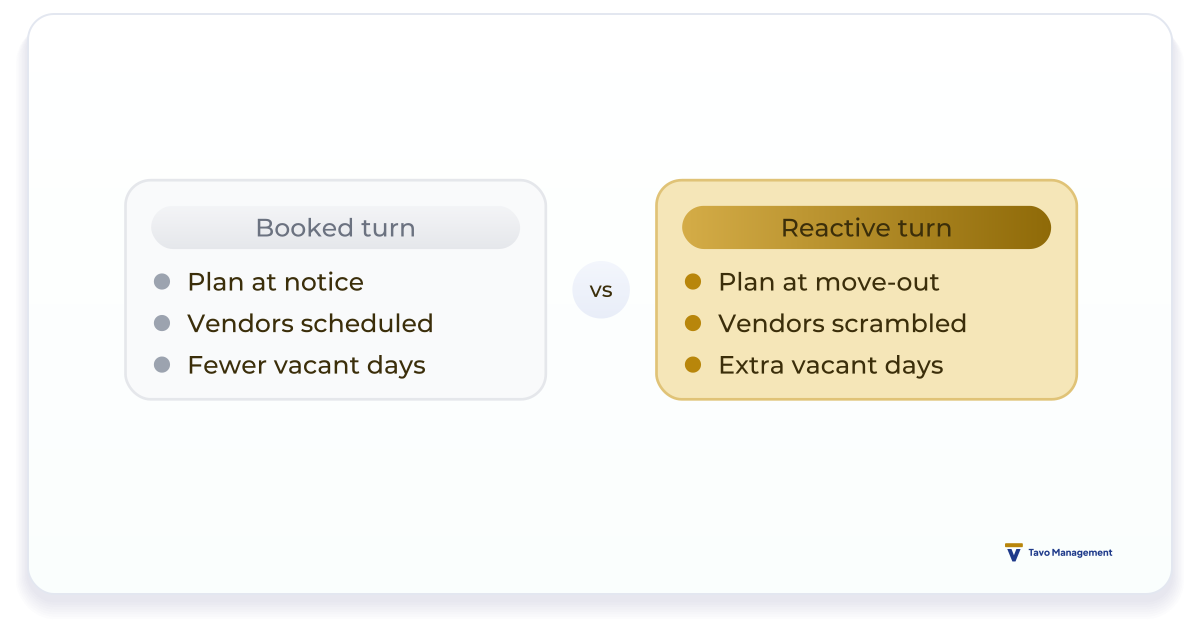
Track make-ready days separately from marketing days, since they need different fixes.
4. Screen Every Applicant the Same Way
Do this: Use written criteria, apply them to everyone and keep the records. Verify income with a source other than the applicant's own documents.
Avoid this: Do not make exceptions by feel. Inconsistent decisions create fair housing risk and bad tenants.
Have your criteria reviewed by a local attorney, since the rules depend on where you operate.
5. Make Rent Easy to Pay and Late Rent Easy to See
Do this: Offer online payment, send automatic reminders and review aging balances weekly. Contact residents early.
Avoid this: Do not wait for a balance to reach 30 days before you call. Do not apply late fees differently for different residents.
Check the current rules for fees and notices in each place you manage.
6. Reconcile Every Account Every Month
Do this: Match each bank account to the ledger on a fixed date. Keep owner funds and operating funds separate.
Avoid this: Do not let reconciliation slip to the end of the quarter. A single unexplained difference can take hours to trace after three months.
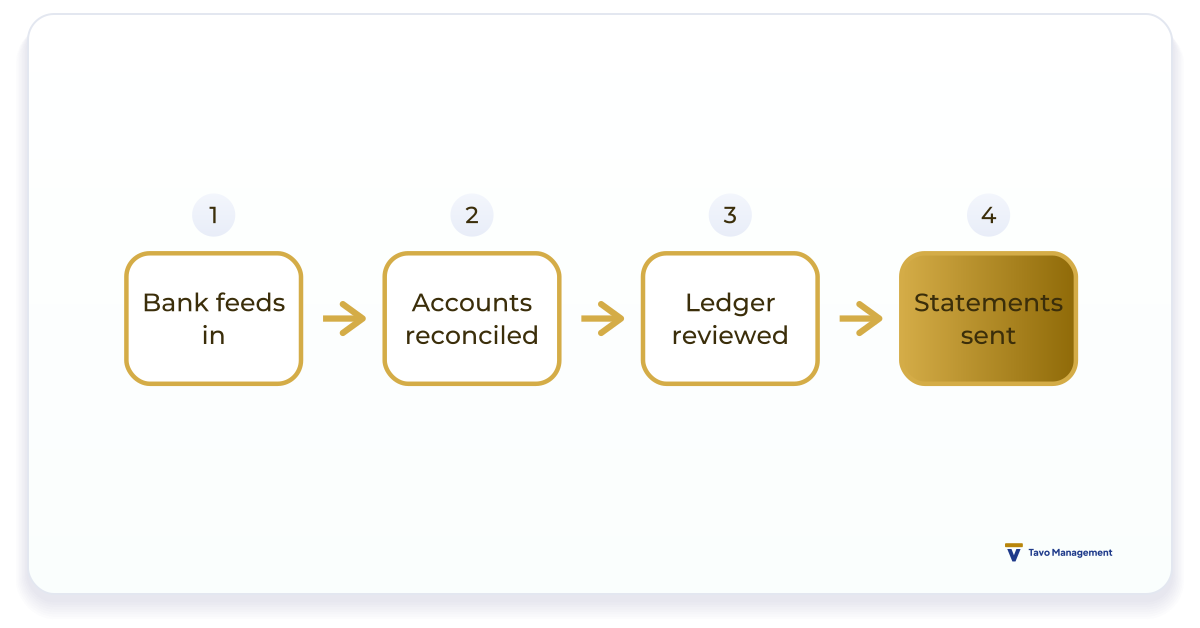
Ask your accountant which trust accounting rules apply to you.
7. Send Owner Statements on a Fixed Date
Do this: Choose a date, keep it and add a short note about anything unusual. Include income, expenses, fees and next planned work.
Avoid this: Do not send statements late and without comment. Owners treat silence as bad news.
Track how long owner emails sit unanswered. It is an early warning sign of process problems.
8. Track Six KPIs and Review Them Monthly
Do this: Days vacant, collection rate, delinquency, response time, maintenance cost per unit and NOI cover most of what you need.
Avoid this: Do not build a dashboard with twenty charts that nobody reads. Do not compare your numbers with generic benchmarks.
Set targets from your own best months and change one target at a time.
9. Review Vendors and Software Every Year
Do this: List every vendor and tool, what it costs and who uses it. Remove overlaps and renegotiate rates.
Avoid this: Do not renew by default. Do not add a new tool before using the features you already pay for.
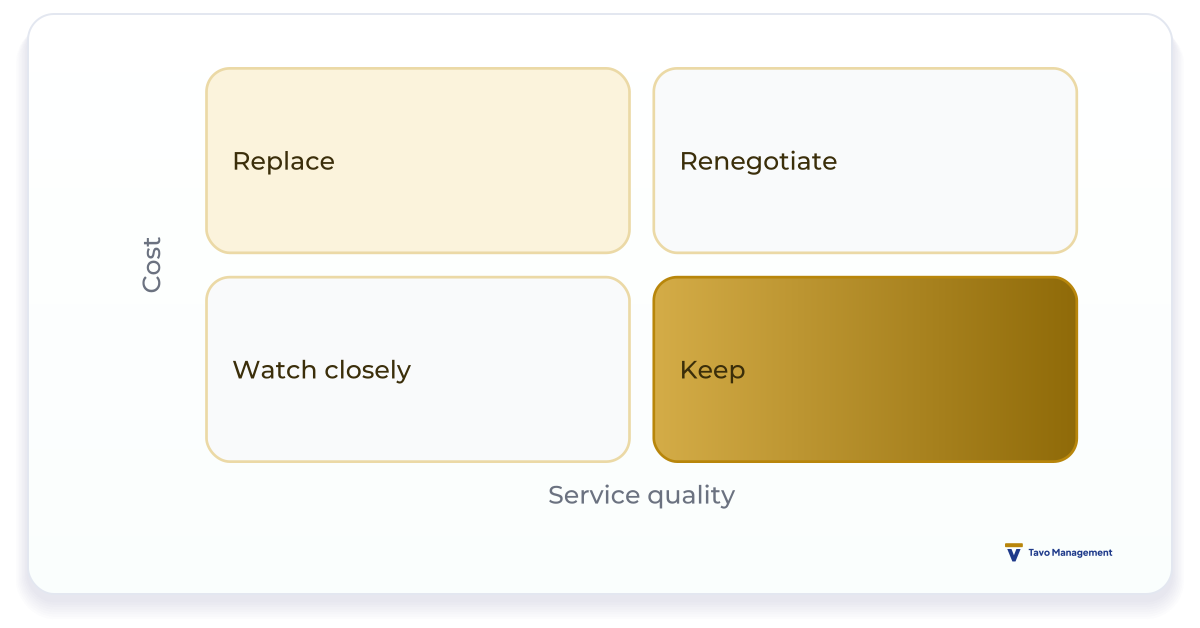
A yearly review also gives you a reason to check licenses and insurance certificates.
Mistakes That Undo the Practices
Three mistakes show up again and again. The first is writing procedures that nobody reads. Keep each to one page and put it where the work happens, such as inside the checklist in your system. The second is changing the process every month. Give each change a full quarter before you judge it. The third is leaving it to one person. If the coordinator is on vacation and the process stops, you have a person-dependent routine, not a standard.
I also see managers adopt a practice for the owner's benefit and forget the resident. A fast repair queue helps both. A strict late fee policy helps the owner and may cost you a good resident. Check each rule from both sides before you roll it out.
What Good Looks Like After 90 Days
Within three months you should see a few simple signs. Open work orders have owners and due dates. Turns follow a booked sequence, and you can say how many days each phase took. Owner statements go out on the same date, and reconciliations are finished before the statements. Your dashboard has six numbers, and you can explain the biggest change in each.
If any of these are missing after 90 days, look at who owns the step. In my experience, the missing piece is almost always a named person and a date.
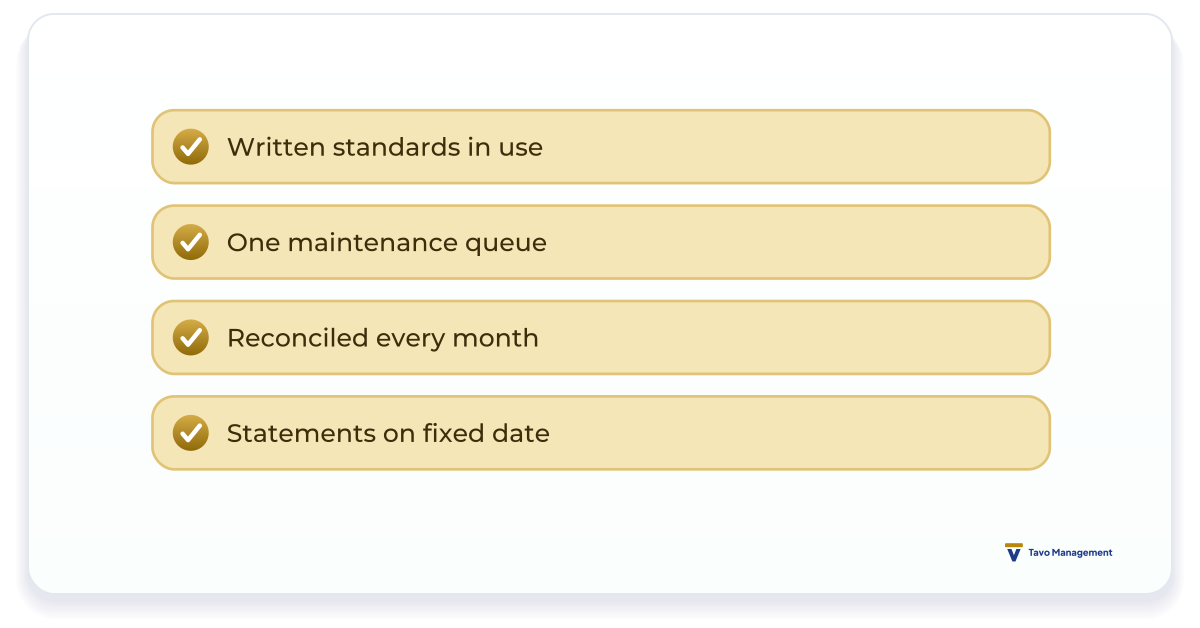
Explaining the Practices to Owners
Owners often see process work as overhead, so tell them what it buys. A written turn schedule shortens vacancy, which raises their income. A single maintenance queue reduces surprise invoices. A fixed statement date means they stop chasing you for numbers. Put those three outcomes in the first conversation after you adopt the practices, and show the first month's numbers. Owners who see a link between your routine and their money tend to renew, and they refer other owners.
It also helps to ask them what they want. Some owners care most about a low turnover, others about the lowest repair cost. Knowing which one drives their decisions tells you which practice to show first.
Finally, review the whole list once a year. Staff change, software changes and owners change. A practice that fit a 60-unit portfolio may need an update at 150, so schedule an annual session where you read each procedure, remove steps nobody follows and add the ones people invented as workarounds.
Adapting the Practices to a Small Portfolio
If you manage fewer than fifty units, you do not need a team to apply this list. A shared spreadsheet can serve as your maintenance queue, a calendar reminder can trigger the monthly reconciliation and one page per procedure is enough. The point of the practices is a repeatable routine, and that works with a pen and a phone. When the spreadsheet starts to slow you down, that is the moment to look at software, and not before.
In What Order to Adopt Them
Do not start all nine on the same Monday. Pick one from each of the three groups: operations (1 to 3), money (5 to 7) and review (8, 9). Run each for a month, check it against your property management KPIs and then add the next. A quarterly pass with the property management checklist confirms that the foundations hold while you build.
Mistakes happen, and the usual ones are skipping the written standard, adding software before fixing the process and measuring too many things. If you want to see how the full picture fits, read my property management guide. When you do get to the software stage, my comparison of property management software saves research time, and the overview of property management trends tells you where the industry is heading.
Choosing Your Starting Point
Look at where you lose money. If units sit empty, start with the turn schedule. If owners complain, start with statements and the maintenance queue. If your books never match, start with reconciliation. A short assessment of your numbers usually makes the choice obvious, and one weak area often explains several symptoms.
Questions About Property Management Best Practices
What Are the Most Important Property Management Best Practices?
Standard written procedures, one maintenance queue with priorities, scheduled unit turns and monthly reconciliation have the biggest effect. They protect revenue, resident satisfaction and owner trust.
How Do I Reduce Vacancy?
Start the turn plan when the notice arrives and book every vendor for the sequence. Track make-ready days and marketing days separately, because they have different fixes.
How Should I Handle Maintenance Requests?
Use one intake channel, give every request a priority and a due date and review the oldest open tickets each week. Keep a short list of vetted vendors for each trade.
What Should an Owner Statement Include?
Income, expenses, fees, the amount sent to the owner and a short note on large or unusual items. Send it on the same date every month.
How Often Should I Reconcile Accounts?
Every month, on a fixed date, for every bank account. Ask your accountant about the trust accounting rules that apply to you.
Which KPIs Should a Property Manager Track?
Days vacant, rent collection rate, delinquency, work order response time, maintenance cost per unit and net operating income cover most needs.
Do I Need a Consultant to Apply These Practices?
Not always. A small portfolio can adopt them one by one. A consultant helps when you manage several property types, when growth has outrun your process or when you plan a software change.
General information only: this is not legal, financial or tax advice. Examples and numbers reflect typical projects; check the specifics with your advisers before deciding.
Did you find this helpful?
Thank you for your feedback.
Delaney Brisco
Delaney leads the Tavo editorial team and works with our consultants to turn real client projects into practical guides on project delivery, process design and organizational change. Before joining Tavo, she spent 12 years in operations and program management roles. She has since edited more than 300 articles on management practice and reviewed PMO setups and process redesigns from over 100 client projects. She is based in Minneapolis, Minnesota.