Summary
- Margin pressure from food, labor and fees sits behind most restaurant management challenges.
- Turnover, scheduling and manager workload are connected, so fix them together.
- Weekly numbers such as prime cost and food cost variance show problems while you can still act.
- Start with the one challenge that costs you most each month, fix it, then move to the next.
Running a restaurant means solving the same problems under pressure: costs rise, people leave and guests expect the same experience every night. Most owners I talk to know the problems by name. What they lack is a way to rank them and a first step for each. That is where a restaurant management consulting review usually starts.
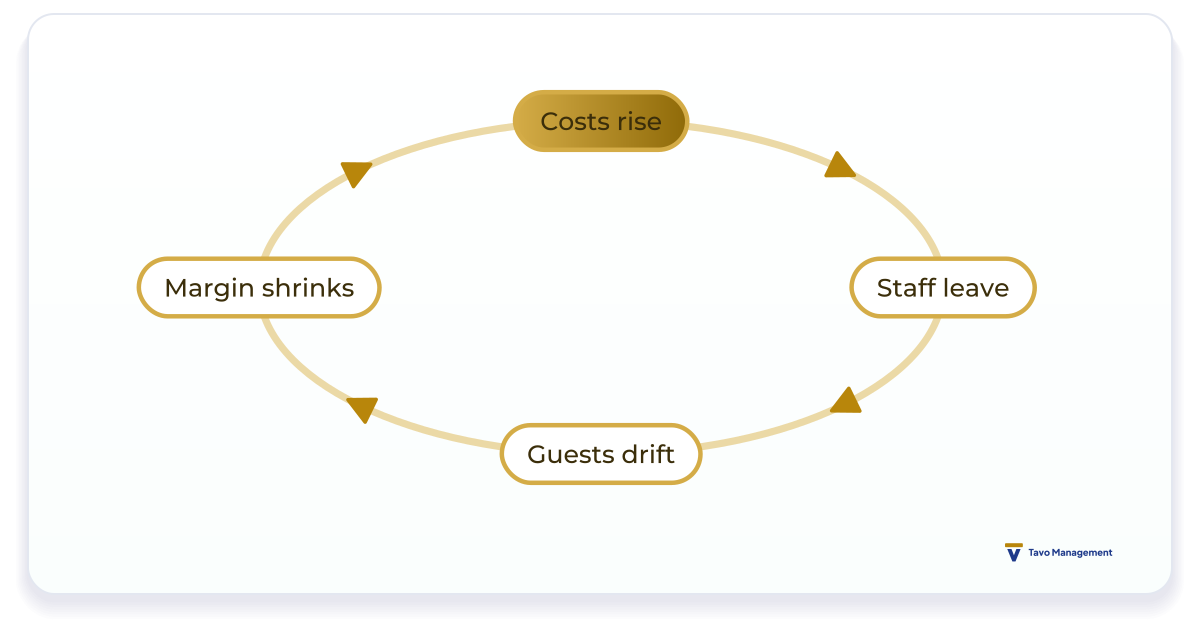
Below are 11 challenges I see again and again, with the cause, the number to watch and the first steps. Where I use outside figures, I link the source at the end.
The 11 Challenges at a Glance
The table groups each challenge by area and shows what it does to your restaurant. If you only have time to fix one, pick the one that touches money first.
| Challenge | Area | What it does |
|---|---|---|
| 1. Rising Food Costs | Costs | Cuts gross margin |
| 2. Staff Turnover and Hiring | People | Raises training cost |
| 3. Scheduling Against Uneven Demand | Labor | Wastes labor hours |
| 4. Thin Margins and Unknown Prime Cost | Money | Hides losses |
| 5. Waste, Over-Portioning and Theft | Inventory | Drains stock value |
| 6. A Menu That Does Not Match Your Kitchen | Menu | Slows tickets |
| 7. Inconsistent Service Between Shifts | Service | Hurts reviews |
| 8. Manager Burnout and Training Gaps | People | Weakens control |
| 9. Third-Party Delivery Fees | Sales | Erodes order profit |
| 10. Too Many Disconnected Systems | Technology | Duplicates work |
| 11. Softer Traffic and Weak Repeat Visits | Guests | Lowers covers |
For the numbers behind these challenges, see my breakdown of the restaurant management KPIs I track in client work.
11 Restaurant Management Challenges and How to Fix Them
Each challenge below follows the same path: what goes wrong, why it keeps happening and the steps I would take first. You can read them in order or jump to the one that hurts most. For routines that prevent several of these at once, my list of restaurant management best practices covers the weekly habits.
Rising Food Costs
Food prices move faster than menu prices, and most restaurants raise prices late. By the time a supplier increase shows up in your monthly statement, you have already sold weeks of dishes at the old margin. In my client work, the owners who suffer most are the ones who still price from a menu built two years ago.
The fix starts with knowing the real plate cost. Costed recipes, a weekly price check on your top 20 ingredients and a short list of dishes you can reprice or reformulate give you room to move before the margin disappears.
How to Check Your Plate Costs
- Cost your 20 best-selling dishes from current invoice prices.
- Flag any dish where plate cost has moved more than a few points.
- Reprice, resize or reformulate the flagged dishes.
- Compare two suppliers on your five biggest purchases.
- Repeat the check every month.
Prerequisites for Cost Tracking
A spreadsheet works for a single location. A recipe-costing tool that reads supplier invoices saves hours once you pass a few dozen ingredients.
Staff Turnover and Hiring
Restaurants lose people faster than almost any other industry. The Bureau of Labor Statistics put the quits rate in accommodation and food services at 3.5% in August 2026, against 2.1% for all private industry. Every departure costs you a hiring cycle, training time and a dip in service quality while the new person learns the pace.
Turnover usually has a manager-sized cause. Unclear schedules, no onboarding plan and last-minute changes push good people out. When I review a restaurant with high turnover, the first fix is rarely pay. It is a predictable schedule and a real first week.
How to Keep People Longer
- Write a one-page first-week plan for every role.
- Publish schedules at least a week ahead.
- Pair each new hire with a named trainer.
- Hold a short check-in after day 30.
- Track turnover by role every quarter.
Tools Worth Using with Retention
A scheduling app that lets staff swap shifts removes a common frustration. An onboarding checklist in a shared doc is enough for most single locations.
Scheduling Against Uneven Demand
Traffic swings by daypart, weekday and weather, but many schedules are copied from last week. You end up with four servers on a slow Tuesday lunch and two on a packed Friday. Both cost you, one in payroll and one in service.
A schedule built from forecast sales per hour fixes most of it. Set a labor percentage target for each daypart, compare it with the POS after each shift and adjust the next schedule. It takes a few weeks to settle, and managers need to hold the line when the target says to send someone home.
How to Build a Schedule That Follows Demand
- Pull hourly sales for the last eight comparable weeks.
- Set a labor target for each daypart.
- Build the schedule from forecast covers, not last week.
- Check actual labor against target after every shift.
- Adjust the next schedule and note what changed.
What to Use for Forecasting
Most POS systems export hourly sales. A scheduling app that reads the POS and shows labor percentage while you build the schedule makes the habit easier to keep.
Thin Margins and Unknown Prime Cost
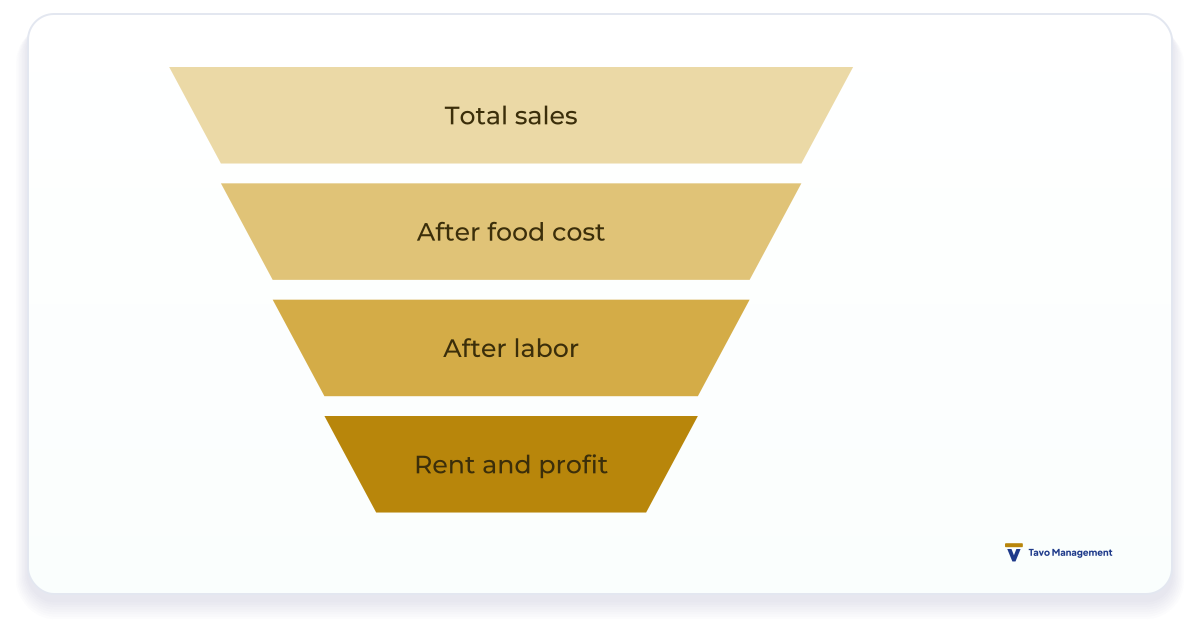
The National Restaurant Association reports that over 9 in 10 operators call food, labor, insurance, energy and swipe fees significant challenges, and 42% said their restaurant was not profitable last year. When margins are that thin, you cannot wait for the quarter to learn where you stand.
Prime cost, which is labor plus cost of goods sold as a share of sales, is the number I ask for first. Benchmarks from 7shifts put it at 60 to 65% for full service, and the useful habit is tracking your own number weekly. A rising line tells you something changed while you can still act.
How to Calculate Prime Cost
- Add last week's labor and cost of goods sold.
- Divide by last week's sales to get prime cost.
- Compare it with your own average of the last 12 weeks.
- Investigate any week more than two points off.
- Share the number with your managers every Monday.
Where the Data Lives
Your POS gives sales and labor. Your invoices or an inventory tool give cost of goods sold. A simple weekly sheet is enough to start.
Waste, Over-Portioning and Theft
Food that is bought and never sold is the quietest leak in a restaurant. Spoilage, trim waste, heavy portions and unrecorded comps add up, and without regular counts nobody sees it happen. A 3 point gap between theoretical and actual food cost on $60,000 monthly sales is $1,800 a month.
You do not need to count everything every week. Count the 10 to 15 items that make up most of your spend, compare actual use with what sales say you should have used and look into the biggest gaps first.
How to Run a Weekly Count
- List the items that make up most of your food spend.
- Count them on the same day each week.
- Compare actual use with theoretical use from sales.
- Investigate the three biggest gaps.
- Log waste with a reason code on the line.
Counting Tools
A tablet count sheet is enough to begin. Inventory software adds recipe-based theoretical usage, which makes gaps easier to spot.
Inconsistent Service Between Shifts
Guests judge you by the shift they happened to visit. When opening, lunch and Friday close each run on different habits, quality becomes a matter of who is on. Reviews then swing between praise and complaints about the same dish.
Consistency comes from short, written routines: a pre-shift talk, a checklist for the pass and a standard for how a table is greeted. Managers who run the same ten-minute meeting every shift make the biggest difference I see.
How to Make Every Shift Consistent
- Write the five standards every guest should get.
- Hold a pre-shift meeting before every service.
- Use a checklist for opening and closing.
- Review tickets that exceed your target time.
- Share one guest comment, good or bad, each day.
Supporting Tools
Paper checklists work well. A kitchen display system gives ticket-time data that makes problems visible.
Manager Burnout and Training Gaps
Many managers were promoted for being good on the floor, not for planning, costing or coaching. They work long shifts, fix problems by hand and have no time to look at numbers. When one leaves, the knowledge goes with them.
Write down what a manager must do each day and each week, then train to that list. A manager who owns the schedule, the order and the weekly count has a job with edges, and that helps keep good people in the role.
How to Build a Deeper Manager Bench
- List daily, weekly and monthly manager tasks.
- Mark which tasks only one person knows.
- Document those tasks first.
- Train a second person for each.
- Review the list every quarter.
Documentation Tools
A shared drive with short one-page procedures is enough. Add photos for plating and station setups.
Third-Party Delivery Fees
Delivery apps bring orders and take a large share. When commission, packaging and remakes come out of a $30 order, little may remain after food and labor. Many owners sell delivery at the same menu price as dine-in and then wonder why profit does not follow volume.
Work out the profit on a typical delivery order, including packaging. Then decide which items to offer, whether to raise delivery prices and how to move repeat guests to your own ordering channel.
How to Make Delivery Profitable
- Calculate profit on an average app order.
- Remove low-margin dishes from the delivery menu.
- Set delivery prices that cover the commission.
- Include a card inviting repeat guests to order direct.
- Review fees each quarter.
Ordering Options
Most POS platforms offer direct online ordering. Compare their fees with the app commission before you move volume.
Too Many Disconnected Systems
A POS, a scheduling app, an inventory tool, an accounting package and a reservation system that do not talk to each other create double entry and conflicting numbers. Managers spend time copying data between them.
Map where each number is entered and who reads it. Remove tools that duplicate each other and make sure the ones you keep share data with your POS. If two systems disagree on sales, decide which one wins.
How to Simplify Your Systems
- List every system and what it is used for.
- Mark overlaps and double entry.
- Pick one source of truth for sales and labor.
- Connect or drop tools that do not share data.
- Train managers on the final set.
Choosing the Stack
My ranking of restaurant management software compares the main POS, scheduling, inventory and accounting tools by use case.
Softer Traffic and Weak Repeat Visits
The National Restaurant Association reports that 60% of operators saw softer customer traffic over the past year. When guests visit less often, the regulars you already have become your most valuable asset, and many restaurants do little to bring them back.
Collect contact details at the table or through online ordering, then give guests a reason to return: a seasonal dish, a quiet-night offer or a simple thank-you. Keep it modest. A few steady regulars on weekday lunches help more than one big promotion.
How to Bring Guests Back
- Capture email or phone with consent at ordering.
- Segment guests by visit count.
- Send one useful message a month.
- Track returns within 30 days.
- Keep the offers that bring people back.
Guest Data Tools
Many POS systems include basic loyalty and email tools. Start with what you already pay for.
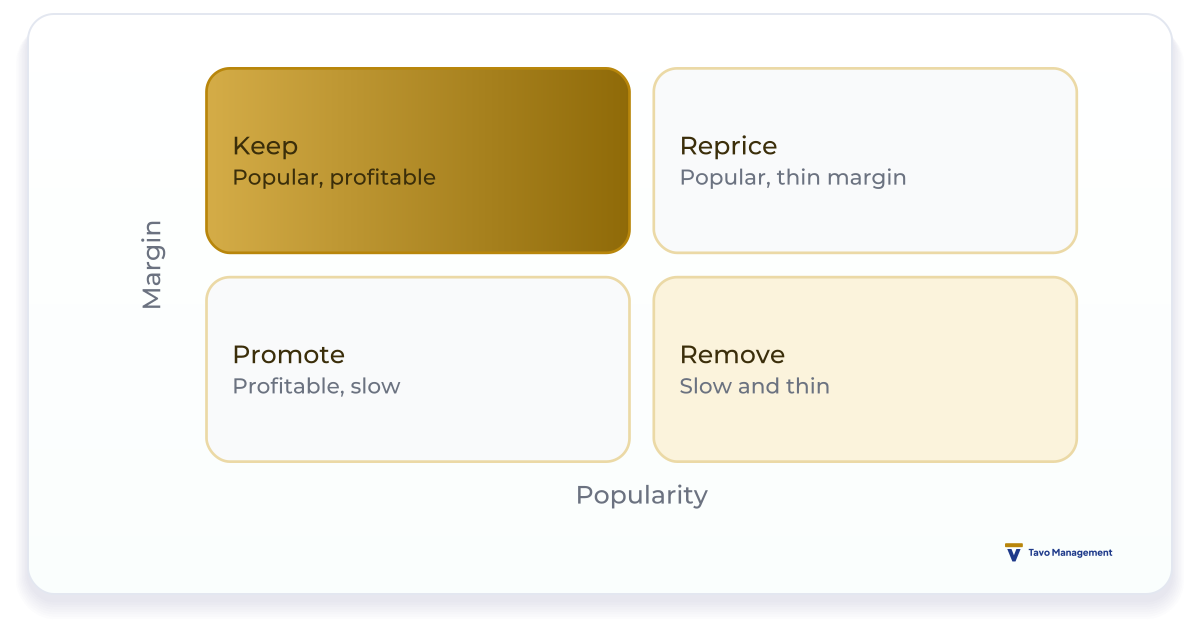
The menu sort and the delivery order math are the two checks that fit on a single sheet.
How to Choose the Challenge to Tackle First
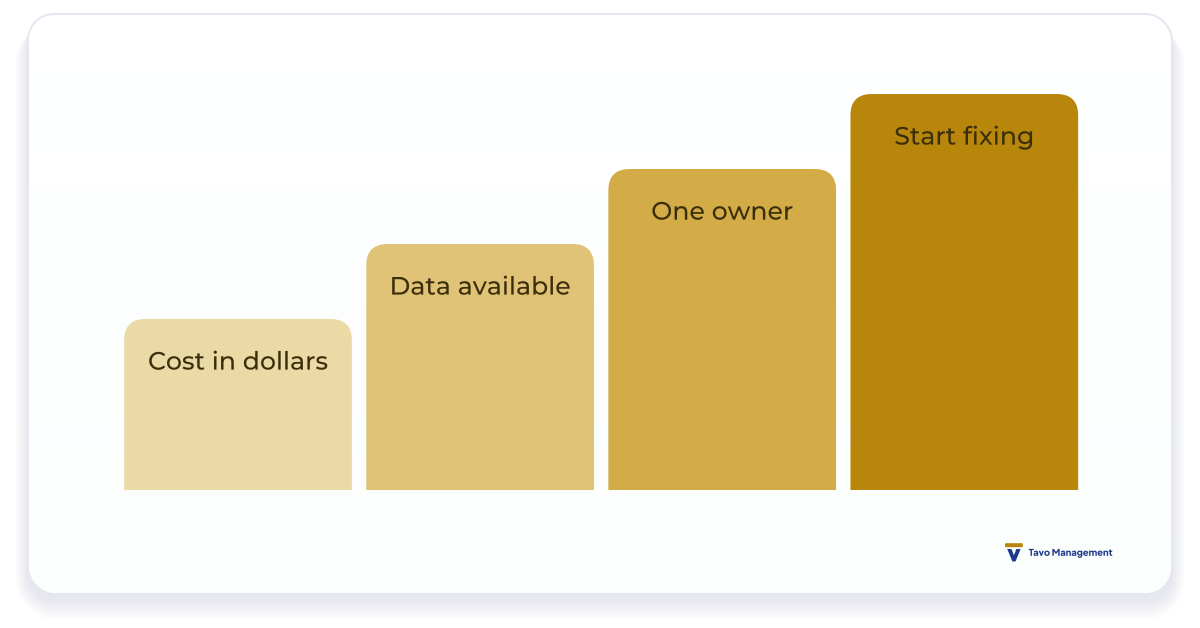
You cannot fix eleven things at once, and trying to do so is a challenge of its own. I rank the list with three questions:
- How many dollars a month does this cost you?
- Can you measure it with data you already have?
- Can one manager own the fix within two weeks?
Pick the challenge with the biggest answer to the first question and a yes to the other two. Prime cost, labor and food waste usually win. If your team is stretched, the software options in my best restaurant management software ranking can take some of the manual work off your managers. For a full overview of how the pieces fit together, start with my restaurant management guide.
Questions About Restaurant Management Challenges
What Is the Biggest Challenge in Restaurant Management?
For most owners I work with, it is margin pressure. Food, labor, insurance and fees rise at the same time, and a restaurant has little room to absorb it. The first step is knowing your prime cost every week, so you can act while a problem is still small.
How Do I Reduce Restaurant Staff Turnover?
Start with predictable schedules, a clear first week and a named trainer for every new hire. Pay matters, but I see most people leave over chaos and unclear expectations. Track turnover by role to see where the problem sits.
How Do I Control Food Costs in a Restaurant?
Cost your recipes, count your top items weekly and compare actual use with sales. A gap between theoretical and actual food cost points to waste, portioning or unrecorded stock. Fix the three biggest gaps first, then repeat.
Is Third-Party Delivery Worth It?
It can be, if you price for it. Work out the profit on an average order after commission and packaging. If it is negative, raise delivery prices, trim the delivery menu or push repeat guests to your own ordering channel.
How Often Should a Restaurant Review Its Numbers?
Weekly for prime cost, labor percentage and food cost variance, and monthly for the full profit and loss. A weekly review lets you correct course before a bad week becomes a bad month.
What Do I Do If My Managers Are Overwhelmed?
Write down the manager role in one page, remove tasks that do not need a manager and train a second person on every critical task. A role with clear edges is easier to do well and easier to hand over.
When Should I Bring in a Restaurant Management Consultant?
A consultant helps when you know margins are thin but cannot see why, when you plan to open a second location or when the same problems come back every season. An outside review finds patterns that are hard to see from inside.
Sources
- Bar & Restaurant: National Restaurant Association releases 2026 State of the Restaurant Industry
- U.S. Bureau of Labor Statistics: Quits rate 3.5 percent in accommodation and food services, August 2026
- 7shifts: Restaurant prime cost guide
General information only: this is not legal, financial or tax advice. Examples and numbers reflect typical projects; check the specifics with your advisers before deciding.
Did you find this helpful?
Thank you for your feedback.
Delaney Brisco
Delaney leads the Tavo editorial team and works with our consultants to turn real client projects into practical guides on project delivery, process design and organizational change. Before joining Tavo, she spent 12 years in operations and program management roles. She has since edited more than 300 articles on management practice and reviewed PMO setups and process redesigns from over 100 client projects. She is based in Minneapolis, Minnesota.