Summary
- Small business management has five jobs: direction, money, work, people and review.
- Cash and routines matter more than formal plans when your team is small.
- Write down repeating work, set decision limits and look at five numbers every week.
- Start with the free plan of one tool and add software only when a routine needs it.
Small business management is the daily work of deciding what matters, paying for it, organizing the work, leading your people and checking that it worked. In a company of six, you do all of that between customer calls, which is why it often feels like no management at all. A small business management consulting engagement starts by making those five jobs visible.
This guide explains how each job works, what to put in place first and how to build the habits from zero. I write it from my client work with teams of three to fifty people, so expect plain advice rather than theory.
The Five Jobs of Managing a Small Business
Every small business needs the same five jobs, whether it sells coffee or runs a plumbing crew. Larger companies give each job to a department. You will probably do several of them yourself, so it helps to know what each one asks for.
| Job | What it tells you | A simple routine |
|---|---|---|
| Direction | Who do we serve and what do we say no to? | One-page strategy, three weekly priorities |
| Money | Can we pay what is due next month? | Weekly numbers page, thirteen-week cash forecast |
| Work | How does an order reach the customer? | One-page procedures for repeating jobs |
| People | Who owns what, and what can they decide? | Roles, limits and a short weekly meeting |
| Review | Did it work, and what do we change? | Quarterly half-day review |
Direction: Decide What You Will and Won't Do
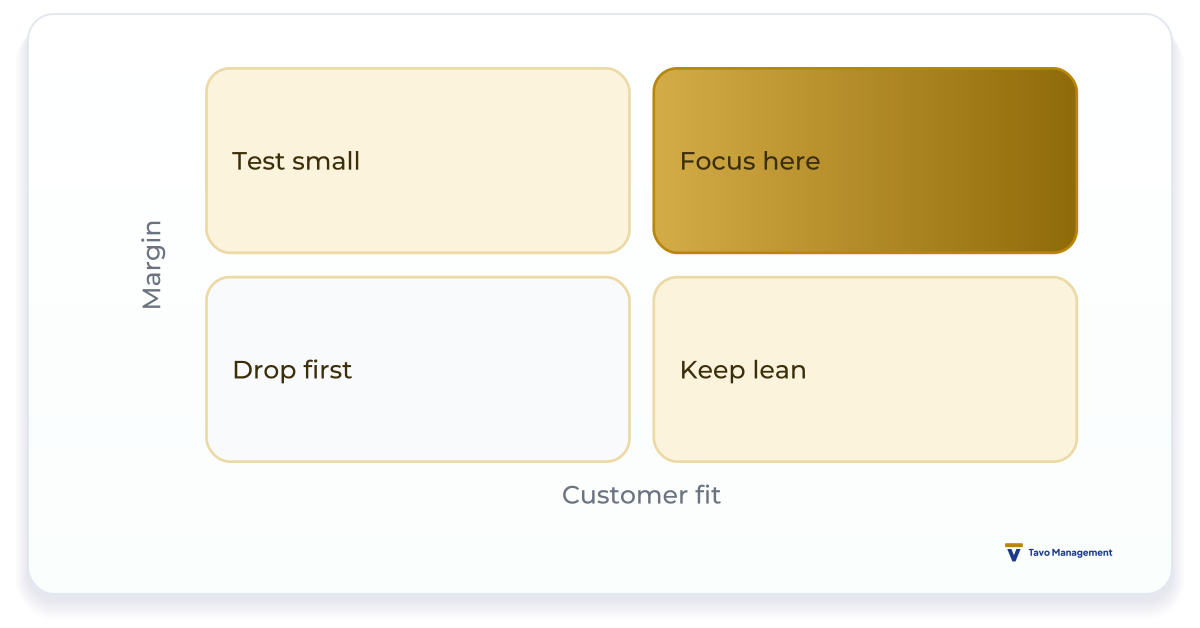
Direction sounds grand, but for a small business it means one page. Write who your best customers are, what you sell them and what you refuse to do. Add three goals for the year, each with a number. A bakery might aim to double wholesale orders, hold the price of bread and open one more day a week.
Then break the goals into three priorities for each week. When a new request comes in, check it against the page. If it doesn't fit, say no or raise the price. I have seen owners recover half a day a week by turning down one type of low-margin work.
Money: Watch Cash Before Profit
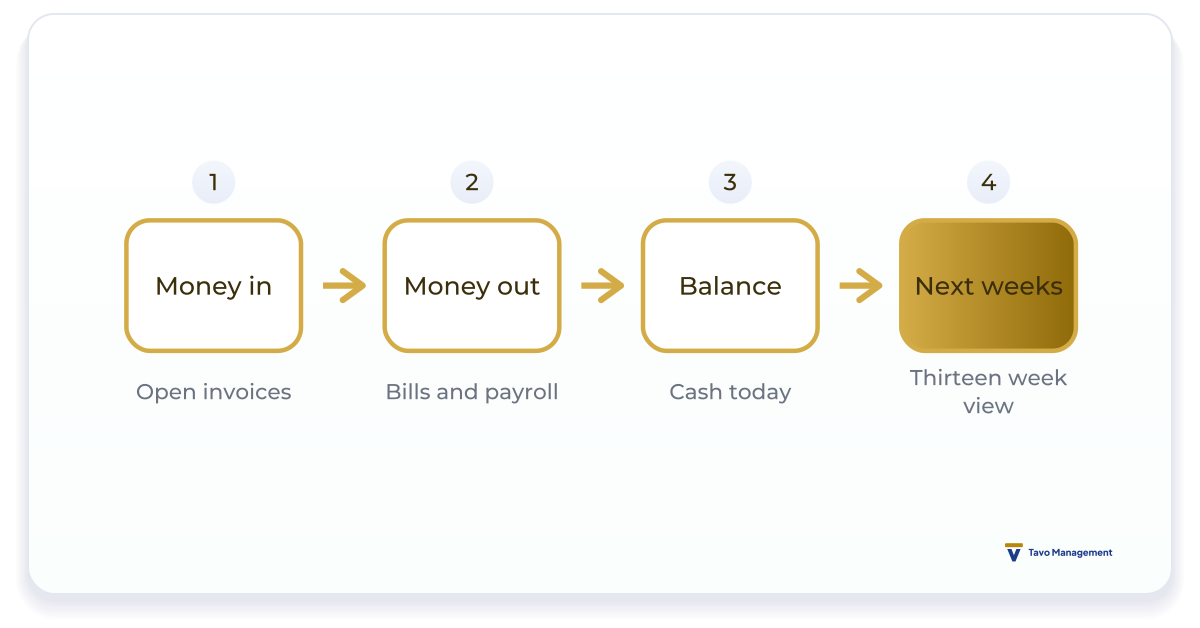
Profit tells you how the year went. Cash tells you whether you can open on Monday. Check five figures every week: cash in the bank, money owed to you, sales against last week, open jobs and one quality measure such as returns.
Then add a forecast of the next thirteen weeks. List the money you expect and the bills that are due, including taxes, rent and seasonal orders. The forecast is rarely right to the euro, but it shows you in advance when a bad week is coming. Two cheap fixes help straight away: send invoices on the day the work is done and call anything overdue by thirty days.
How the numbers page looks
It fits on one sheet. Put the five figures in a column, this week next to last week, with a short note beside each. A spreadsheet is fine. Most accounting packages can fill the numbers for you, which is the first place a tool earns its price.
Work: Write Down How Jobs Move
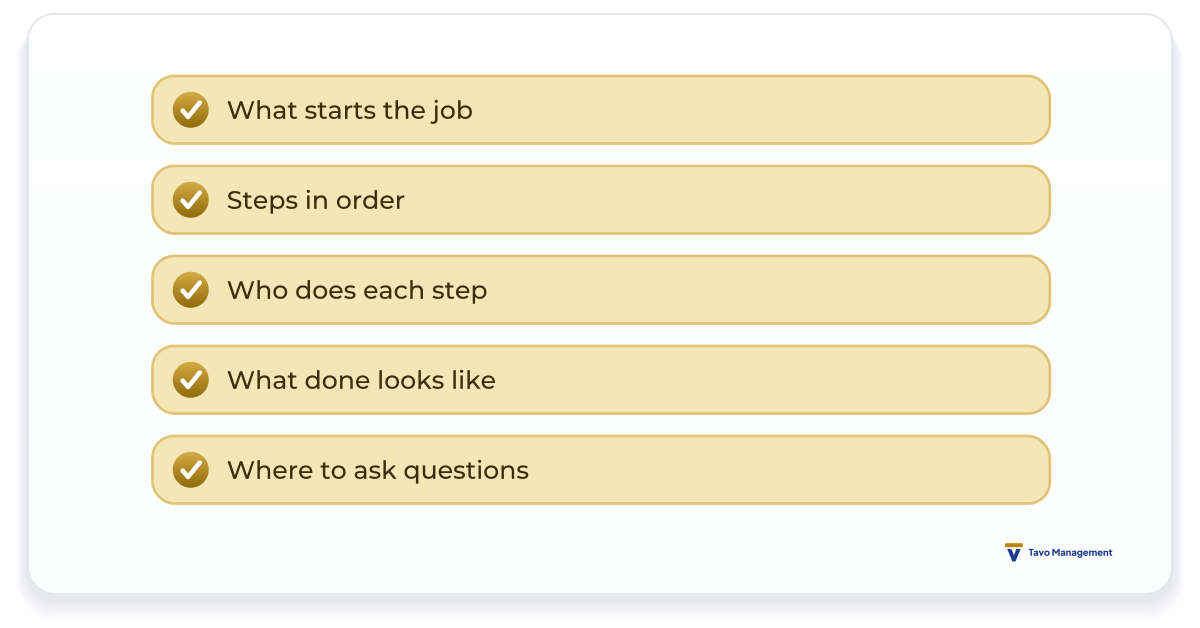
Work management means that a job moves from order to payment without losing something on the way. Start by mapping one flow on a whiteboard with the person who does it. Draw each step, who owns it and where the job waits. The waiting points are where you gain time.
Next, write a one-page procedure for the five jobs that cause the most rework. Keep each page to the steps, the owner and what done looks like. Let a newer colleague test it before you call it final. If the process is broad, such as order-to-cash across several teams, the same mapping technique scales up in the business process management approach.
People: Clear Roles and Limits
People problems in small teams are often role problems. Two people think a task is theirs, or nobody does. Write one line for each person: what they own and which decisions they make alone. Add spending limits in plain numbers.
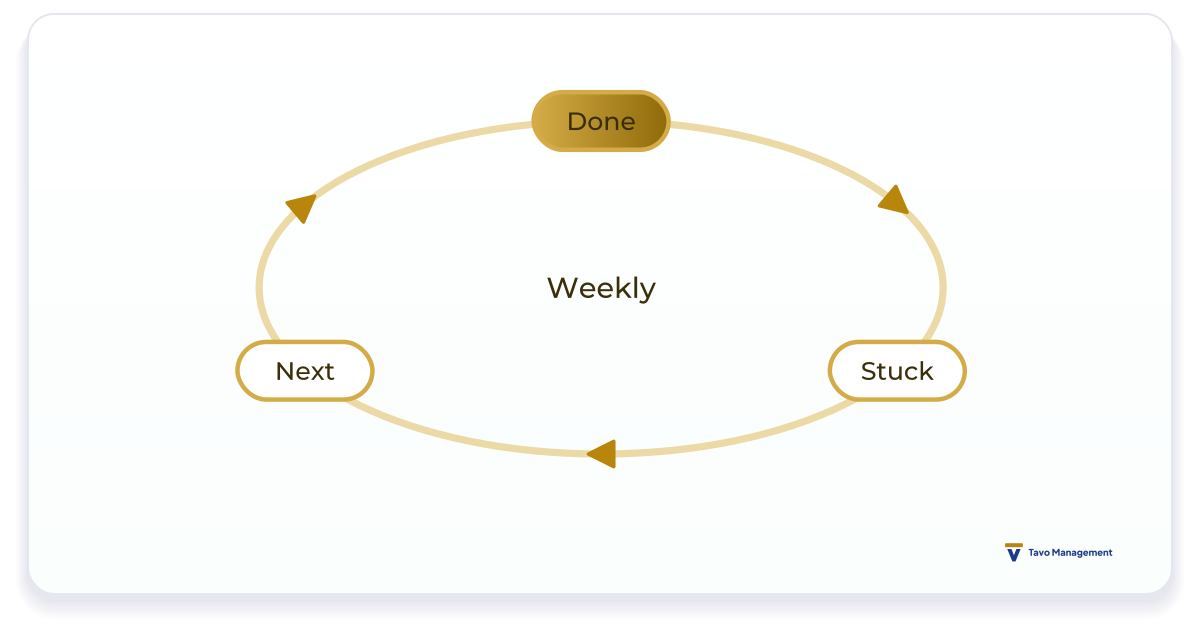
A weekly fifteen-minute meeting keeps it moving. Ask what is done, what is stuck and what is next, and write the actions with names and dates. If you are ready to turn habits like this into a full plan, my small business management strategies article sets them in order over a quarter.
Review: Check What Worked
Once a quarter, take half a day. Look at the weekly numbers, the priorities you set and what slipped. Choose three decisions for the next quarter and one thing to stop. It is a small habit, and it catches slow problems before they turn into a yearly surprise.
Between reviews, keep a short list of habits that work. My collection of small business management tips gives you eleven that I use again and again with clients.
Where Software Helps and Where It Doesn't
Tools hold routines in place, but they don't create them. If your process is unclear, a tool copies the mess. Once the flow is written down, software makes it easier to follow: a task board for work, an accounting package for money and a shared calendar for meetings.
| What you manage | Start with | Upgrade when |
|---|---|---|
| Tasks and projects | A free task board or spreadsheet | Several people need views, deadlines and reports |
| Customers and sales | A shared contact list | You lose track of follow-ups |
| Money | Accounting software with bank feeds | You need approvals or multi-currency support |
| Everything in one place | An all-in-one suite on a trial | Your team uses it daily without reminders |
I compare the main products, with prices and ratings, in my ranking of small business management software. Test any tool on a real project for two weeks and ask your team what slows them down.
What the First Ninety Days Look Like
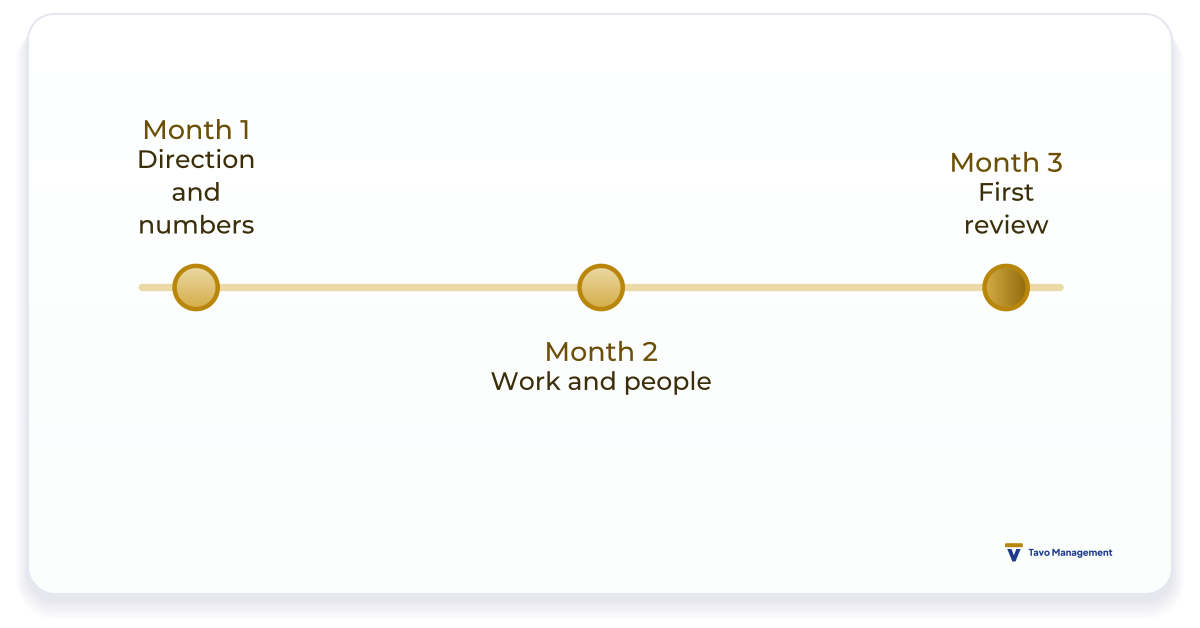
New owners often ask how long all of this takes. In my client work, the first month goes to direction and money: the one-page strategy, the numbers page and the cash forecast. Few of these steps need more than a day, but the habit of looking every Monday takes a month to stick.
The second month goes to work and people. You write the five key procedures, give each person a role line and start the weekly meeting. Expect friction here, because staff are used to asking you. Answer with a question, such as "what would you do?", and the habit changes within a few weeks.
The third month is the first review. Compare the numbers with day one, note which routines survived and which were dropped and choose three decisions for the next quarter. A realistic result after ninety days is not a perfect system. It is fewer interruptions, invoices that go out on time and a cash forecast you trust. Those three changes alone give many owners back several hours a week.
Common slips in the first quarter
Owners most often try to do everything at once and give up in week three. The second slip is building the numbers page but not looking at it. Put a recurring Monday slot in your calendar, and treat it like a client meeting. The third slip is writing procedures alone. A page written without the person who does the job is usually wrong in small ways that make people ignore it.
None of this needs special software or a long course. It needs a calendar slot, a pen and a willingness to write down what you currently carry in your head. Owners who do that tend to find that the business already runs better on paper than they feared, and the gaps are smaller than they felt in the middle of a busy week.
A Zero-to-Pro Checklist
Work through these in order. Each step builds on the one before it, and most take less than a day.
- Write one page: best customers, what you sell, three goals and what you refuse.
- Post three weekly priorities where the team sees them.
- Build the five-figure numbers page and update it every Monday.
- Create a thirteen-week cash forecast.
- Send invoices on the day the work is done.
- Write one-page procedures for the five jobs that cause most rework.
- Give every person a role line with decision limits.
- Start a fifteen-minute weekly meeting with an action list.
- Schedule a half-day quarterly review.
Estimate the Time a Routine Gives Back
Pick one repeating task from your week, such as chasing payments or compiling a status update. The calculator shows what a routine or a tool could save over a year.
How Much Time Could You Save?
Move the sliders to match one repetitive task in your business.
How to Know When You Need Outside Help
You can start every step above on your own. Outside help pays off in a few situations, and you will probably recognize yours:
- You work longer hours, yet results stay flat.
- Work stalls whenever you are away.
- You are about to grow quickly, open a location or hire several people.
- You can't see the problem from the inside.
If one of those lines fits, the consultants I work with offer a free first call that ranks your gaps.
Questions About Small Business Management
What Does Small Business Management Include?
It covers five jobs: deciding what matters, managing money, organizing the work, leading people and checking results. In a small business, one or two people do all five, which is why simple routines matter more than formal systems.
How Is Small Business Management Different from Running a Large Company?
You have fewer people, less cash buffer and no specialist departments. Decisions are faster, but so are mistakes. A small business needs short procedures, a few key numbers and clear limits for delegation, not layers of approval or long planning cycles.
Do I Need a Business Degree to Manage a Small Business?
No. Most owners I work with learned by doing. What helps is a handful of habits: a weekly look at cash, written procedures for repeating work and a regular meeting with your team. You can learn these in a few weeks.
What Is the Biggest Mistake New Small Business Owners Make?
Running out of cash while the business looks profitable on paper. Customers pay late, suppliers want money early and growth ties up more cash. A weekly cash view and a thirteen-week forecast prevent most of these surprises.
Which Management Software Should I Use?
It depends on what you manage: tasks, customers, projects or the whole business. Start with the free plan of one tool, test it on a real project and keep what your team actually uses. My ranking of small business management software sets the main options side by side.
How Many Employees Can I Manage Without a Formal Structure?
Most owners manage up to around eight to ten direct reports with a weekly meeting and clear roles. Beyond that, you will want a team lead or a manager for each group. The signal is when you spend most of your day answering questions.
When Should I Get Outside Help with Management?
When you work more hours but results don't improve, when work stalls whenever you are away or when you are about to grow quickly. A free first call shows whether the problem is a quick fix or a bigger change.
General information only: this is not legal, financial or tax advice. Examples and numbers reflect typical projects; check the specifics with your advisers before deciding.
Did you find this helpful?
Thank you for your feedback.
Delaney Brisco
Delaney leads the Tavo editorial team and works with our consultants to turn real client projects into practical guides on project delivery, process design and organizational change. Before joining Tavo, she spent 12 years in operations and program management roles. She has since edited more than 300 articles on management practice and reviewed PMO setups and process redesigns from over 100 client projects. She is based in Minneapolis, Minnesota.