Summary
- Tie each risk to a business goal, an owner and a measure.
- Use one scoring scale across all departments so risks can be compared.
- Write risk appetite as limits with an amber alert, not as adjectives.
- Keep the register short, the report to one page and the reviews on a fixed rhythm.
After setting up risk programs in healthcare, manufacturing and services, I have noticed that the same eleven habits separate programs that last from those that fade after the first workshop. This list is what I would put in place first at any organization that asked for enterprise risk management consulting.
Each practice has a short explanation, a "do this" and an "avoid this" so you can apply it in a day. For real cases that use these habits, see the enterprise risk management examples, and when you are ready to check your own program, run it against the enterprise risk management checklist.
The 11 Practices at a Glance
| Practice | Effort | What you gain |
|---|---|---|
| 1. Tie Every Risk to a Business Goal | Low | Risks that connect to results |
| 2. Use One Scoring Scale for the Whole Organization | Low | Scores leaders can compare |
| 3. Name One Owner per Risk | Low | Someone who acts |
| 4. Write Your Risk Appetite as Numbers | Medium | Decisions that speed up |
| 5. Keep the Register Short Enough to Read | Low | A register people read |
| 6. Review the Top Risks on a Fixed Rhythm | Low | A habit that lasts |
| 7. Turn Risks Into Triggers and Actions | Medium | A plan, not a worry |
| 8. Count the Exposure Whenever You Can | Medium | Budget that follows evidence |
| 9. Look at Risks Together, Not One by One | Low | Shared causes found |
| 10. Make Reporting Short and Visual | Low | Faster board decisions |
| 11. Train Owners and Test the Program | Medium | A tested program |
11 Enterprise Risk Management Best Practices to Put in Place
They are ordered roughly in the sequence I would introduce them: structure first, routines next, measurement and testing last.
1. Tie Every Risk to a Business Goal
A risk only matters if it can stop something you want. Starting from goals keeps the register short and makes the conversation with leaders easier, because each entry answers the question: which target does this threaten?
Do this: Write the goal next to each risk, such as "open two new sites by June" or "keep on-time delivery above the contract level".
Avoid this: Copying a generic list of risk categories from a framework and rating every line.
2. Use One Scoring Scale for the Whole Organization
If finance rates a risk on money and IT rates it on downtime, nobody can compare them. I use a five-by-five grid with impact described in money, time and reputation, and I keep the descriptions to one line each.
Do this: Define impact levels in plain amounts and likelihood levels in plain frequencies, and publish them on one page.
Avoid this: Letting each department keep its own scale because it was there first.
3. Name One Owner per Risk
Committees do not manage risks, people do. The owner is the person who can change a budget, a process or a contract. In my client work, the single fastest improvement to a weak register is replacing group owners with names. If owners push back, my notes on enterprise risk management challenges cover the usual objections.
Do this: Pick the owner by authority to act, and tell them in writing what the role involves.
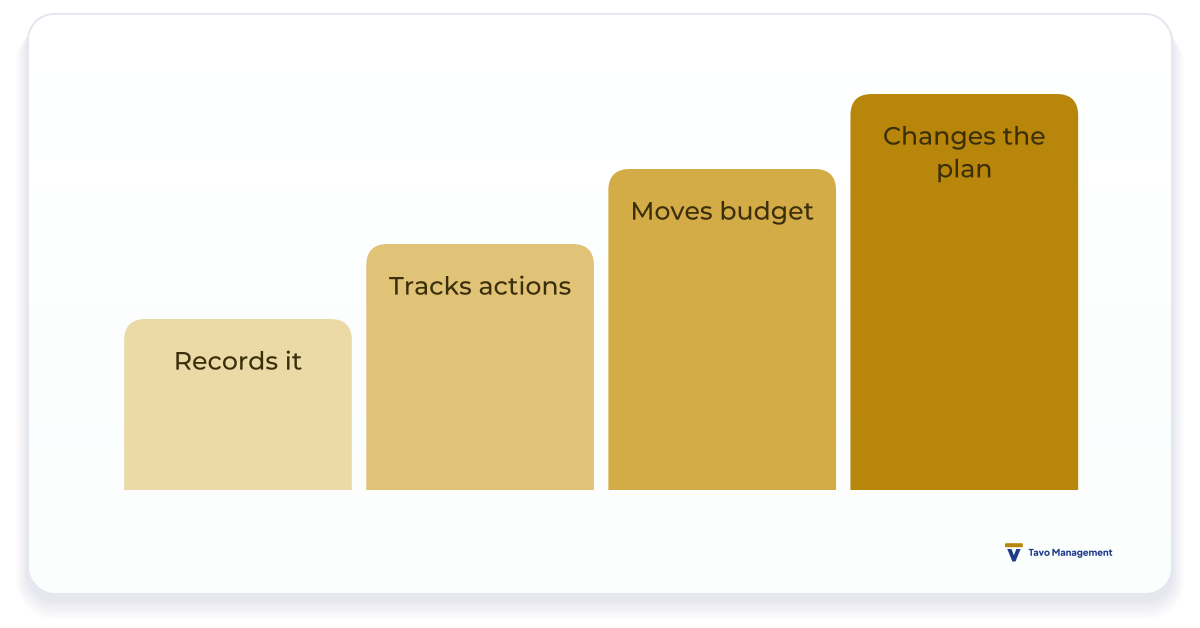
Avoid this: Naming the risk manager as owner of every entry.
4. Write Your Risk Appetite as Numbers
An appetite statement full of adjectives gives nobody a rule. A limit with an amber level does. Boards that approve three or four of these find that decisions speed up, because the question becomes whether you are inside the limit.
Do this: Set a limit and an amber alert for your three most important exposures and review them with the board.
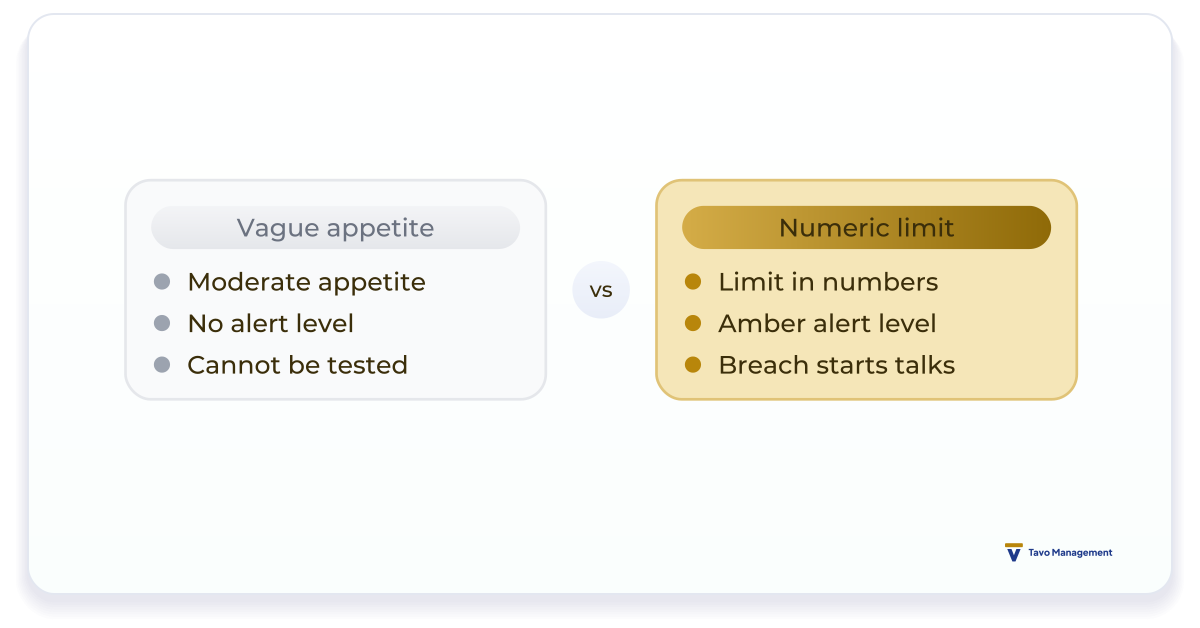
Avoid this: Approving a paragraph that says you have a "moderate" appetite.
5. Keep the Register Short Enough to Read
A register with 300 lines is a filing system. Leaders read the top 10 to 20. Keep detail inside departments and roll up only the risks that could change your results.
Do this: Cap the enterprise register around 15 to 40 risks and move the rest to departmental lists.
Avoid this: Adding every item raised in a workshop.
6. Review the Top Risks on a Fixed Rhythm
Risk reviews that happen when someone has time stop happening. A quarterly slot of 45 minutes, with the same agenda each time, keeps the habit. Monthly works for fast-moving risks such as cash or cyber.
Do this: Put the review in the leadership calendar for the full year and send a one-page report in advance.
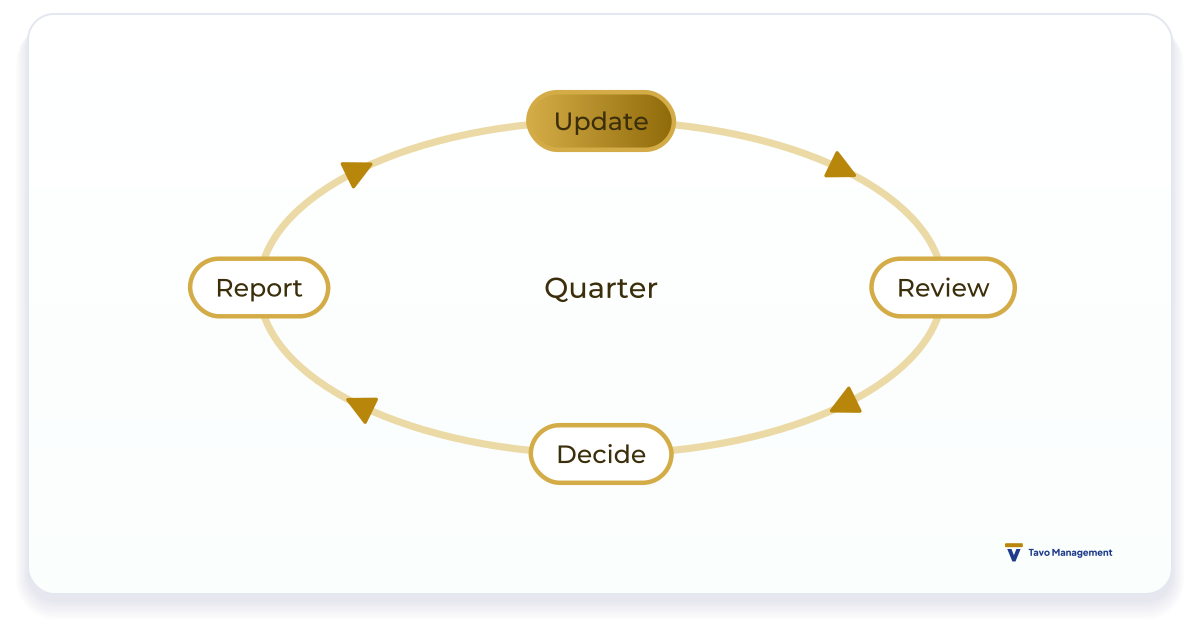
Avoid this: Waiting for the annual planning cycle to look at risks.
7. Turn Risks Into Triggers and Actions
A rating describes a feeling. A trigger tells you when to act. For each top risk, write the measure that signals trouble, the level that starts a response and what you will do at that level.
Do this: Add a trigger, an action and an owner to each top ten risk.
Avoid this: Writing "monitor" as the response.
8. Count the Exposure Whenever You Can
A count or a cost moves budgets in ways that a color does not. Parts bought from one source, days of cash left or the number of unreviewed vendor contracts are measures you can pull from systems you already own. The numbers leaders track are listed in my enterprise risk management KPIs article.
Do this: Pick one measure per top risk and report it each quarter. Start rough and improve it.
Avoid this: Waiting for perfect data before reporting anything.
9. Look at Risks Together, Not One by One
Risks share causes. One thin pharmacy team can sit behind a safety risk and a budget risk at the same time. Tag each risk with its cause and look for causes that appear three or more times.
Do this: Add a cause column to the register and review the most common causes each quarter.
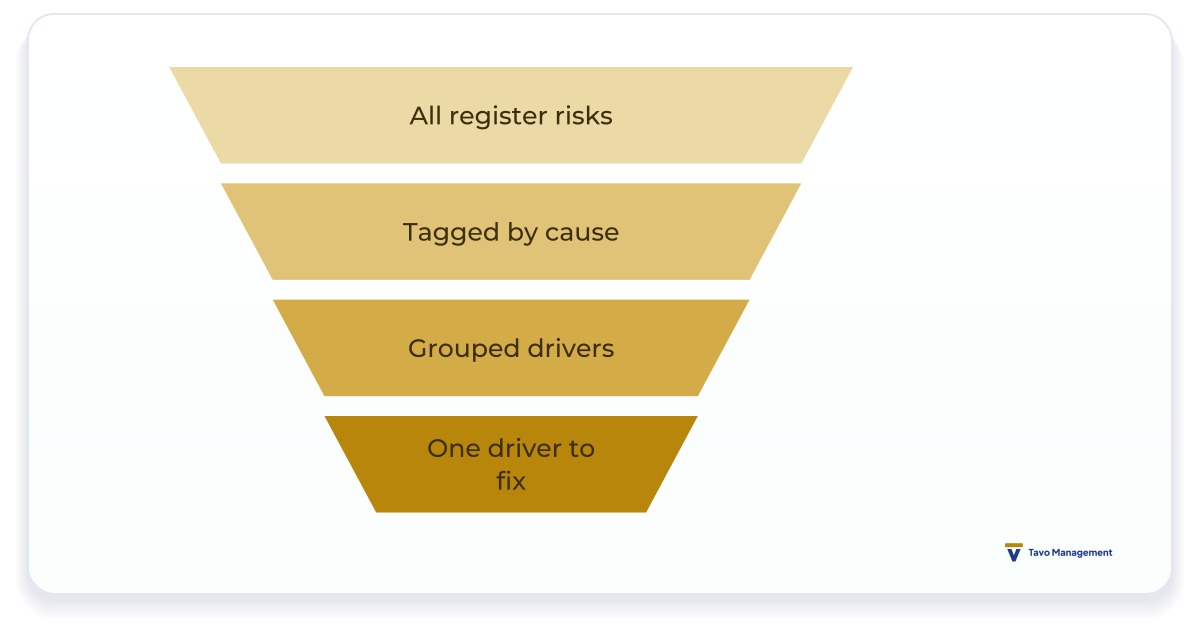
Avoid this: Reviewing every risk in isolation and missing the common driver.
10. Make Reporting Short and Visual
Leaders act on a page they can read in ten minutes. Show the top risks, movement since last quarter, overdue actions and any limit breaches. Put detail in an appendix.
Do this: Use one page for the board, with the same layout every quarter so trends are easy to see.
Avoid this: Sending a 40-page register as an attachment.
11. Train Owners and Test the Program
People manage risks well when they know what is expected. A one-hour session for owners, plus a yearly test such as a tabletop exercise, shows what works. Tests also reveal risks that were not on the list.
Do this: Run a scenario exercise once a year on one of your top three risks and record what changed.
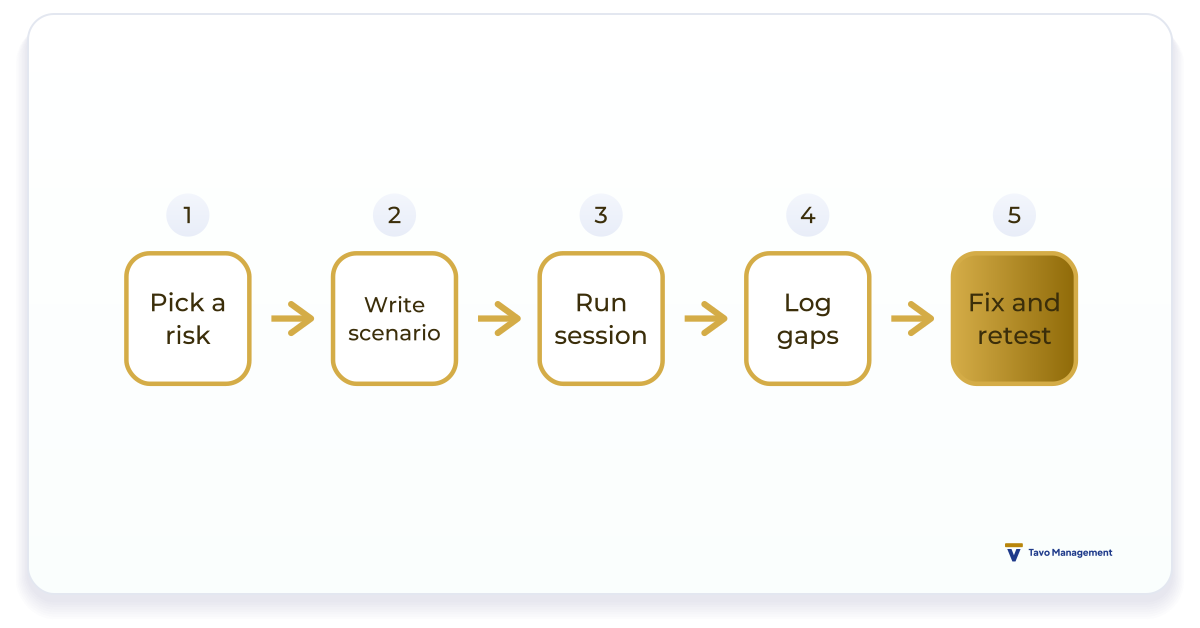
Avoid this: Assuming the framework works because the register is complete.
What the Practices Look Like at Three Levels of Maturity
You do not need all eleven at full strength on day one. Here is what I expect at each stage so you can set a realistic target for the next year.
| Stage | What you have | Next step |
|---|---|---|
| Starting out | A single list, a shared scale and named owners | Add triggers for the top five risks |
| Working | Quarterly reviews, appetite limits and a one-page report | Count exposures and tag causes |
| Embedded | Measures in the report, yearly tests and trained owners | Link risk to budget and strategy reviews |
A spreadsheet is enough for the first two stages in most organizations. When owners, reviews and audits outgrow it, see the enterprise risk management software comparison before you buy anything.
A 90-Day Plan to Put the Practices in Place
Trying to introduce eleven habits at once overwhelms owners. I stage them over a quarter so each one has time to settle before the next arrives.
| Weeks | Focus | Result you can show |
|---|---|---|
| 1 to 2 | Goals, one scale, owner list | A one-page scale and a named owner for each top risk |
| 3 to 6 | Gather and shortlist risks, set appetite limits | A register of 15 to 40 risks and three or four approved limits |
| 7 to 10 | Triggers, measures and the first review | Top ten risks with a trigger, a measure and a review in the calendar |
| 11 to 13 | One-page report and a scenario test | A report in a fixed layout and a documented exercise |
The first review is rarely perfect, and that is fine. What matters is that it happens on the date, with the report in hand, and that two or three decisions come out of it. In the programs I have seen stall, the first review slipped by a month and the rhythm never recovered.
Keep the plan visible. A simple tracker with the weeks, owners and status, shared with your sponsor, is enough. When a step slips, say so early and move the next one, instead of letting the whole plan drift. Sponsors forgive a late start and rarely forgive silence.
Do not worry if your program looks uneven during the first year. Most organizations are strong on two or three practices and weak on the rest, and that is normal. Pick the weakest practice that causes visible pain and give it one quarter. A steady gain of one practice per quarter reaches a solid program within three years.
Choosing Your Starting Point
Pick the practice that fixes your most visible problem. If nobody acts on risks, start with owners. If leaders ignore the report, shorten it. If scores cannot be compared, start with the scale. A few questions help:
- Does every top risk have a named owner who can act?
- Do all departments score on the same scale?
- Is there a review in the calendar for the next four quarters?
- Does the report fit on one page?
Two or three "no" answers mean you can finish the first set of practices in about a month. A consultant can speed that up, and a first call costs nothing.
Sources
Questions About Enterprise Risk Management Best Practices
What Are the Best Practices for Enterprise Risk Management?
The eleven in this article cover most of what works: tie risks to goals, use one scale, name owners, write appetite as numbers, keep the register short, review on a fixed rhythm, add triggers, count exposures, look at shared causes, keep reports short and test the program.
How Often Should We Review Enterprise Risks?
Quarterly works for most organizations, and monthly suits fast-moving exposures such as cash, cyber or a major project. Add an event-driven review whenever something large changes, such as an acquisition or a new regulation.
Who Should Own Enterprise Risk Management?
The board or executive team oversees it, a risk lead or small team runs the process, and each risk has an owner in the business. The risk lead does not own the risks, which stay with the people who can act on them.
Do Small Organizations Need All Eleven Practices?
No. A small organization can start with four: one scale, named owners, a short register and a quarterly review. Add the others as the number of risks and people grows.
Should We Follow COSO ERM or ISO 31000?
Either works. COSO ERM ties risk closely to strategy and performance, and ISO 31000 sets out principles and a process that scale easily. Many organizations borrow from both, which is fine as long as the scale and the roles are consistent.
What Is the Most Common Mistake in ERM Programs?
Building a long register without owners or triggers. The list looks thorough, but nobody acts on it, and leaders stop reading the report within a year.
Do We Need Software to Apply These Practices?
Not at first. A spreadsheet handles the first year in most organizations. Software helps when many owners update risks, when audits need evidence or when you have more than a few dozen risks to track.
General information only: this is not legal, financial or tax advice. Examples and numbers reflect typical projects; check the specifics with your advisers before deciding.
Did you find this helpful?
Thank you for your feedback.
Delaney Brisco
Delaney leads the Tavo editorial team and works with our consultants to turn real client projects into practical guides on project delivery, process design and organizational change. Before joining Tavo, she spent 12 years in operations and program management roles. She has since edited more than 300 articles on management practice and reviewed PMO setups and process redesigns from over 100 client projects. She is based in Minneapolis, Minnesota.