Summary
- The checklist has eleven points and 33 items, grouped as foundation, usefulness and upkeep.
- Tick an item only if you can show the evidence to someone else.
- Gaps usually sit in ownership and review dates, which are cheap to fix.
- Score yourself, fix the three biggest gaps and repeat in six months.
A risk program can look complete on paper and still fail on the first bad day. This checklist is the one I use when I review an existing program or help a team build one under enterprise risk management consulting. It has eleven points, and each one has concrete checks you can tick off.
You can work through it in an afternoon with your risk lead. Where the answer is no, the best practices explain how to fix the gap, and the enterprise risk management examples show it in action.
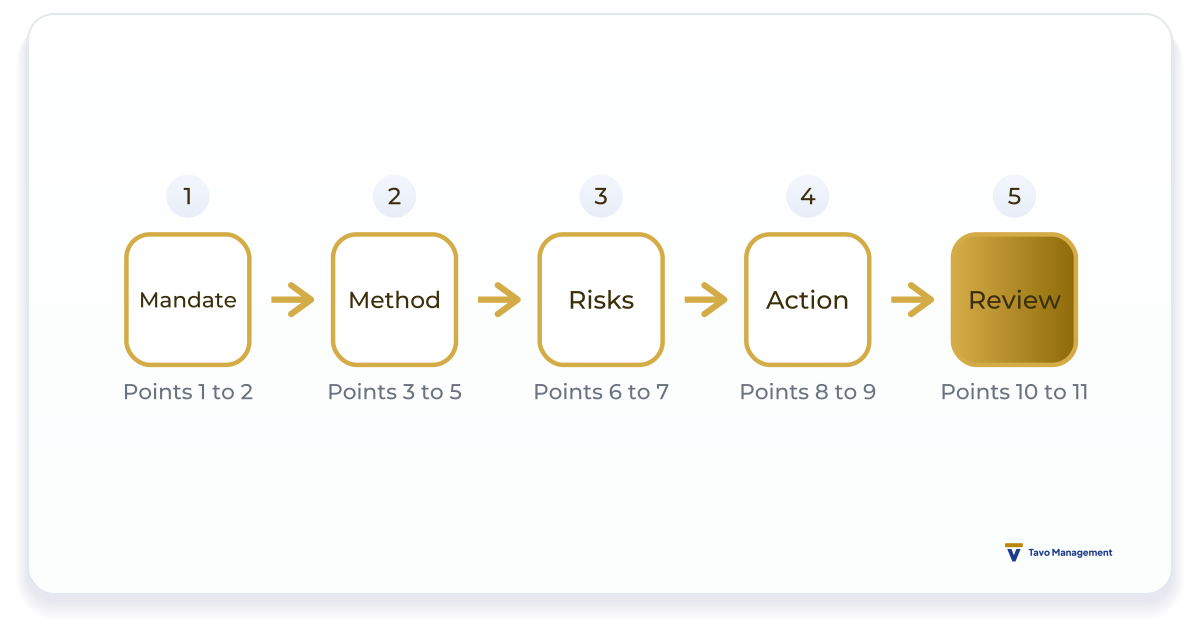
The 11 Points at a Glance
| Point | What to confirm | Typical time to fix |
|---|---|---|
| 1. Leadership Sponsorship Is in Writing | The sponsor and their role are named in a one-page charter. | 1 week |
| 2. Goals and Decisions Are Listed | Each goal has an owner. | 1 week |
| 3. A Framework Has Been Chosen | The framework and its terms are defined on a short page. | 2 weeks |
| 4. One Scoring Scale Exists | Five levels for each axis, with one line each. | 2 weeks |
| 5. Risk Appetite Has Limits | Three to five limits are written as numbers. | 4 weeks |
| 6. Risks Have Been Gathered | Every department has contributed. | 4 weeks |
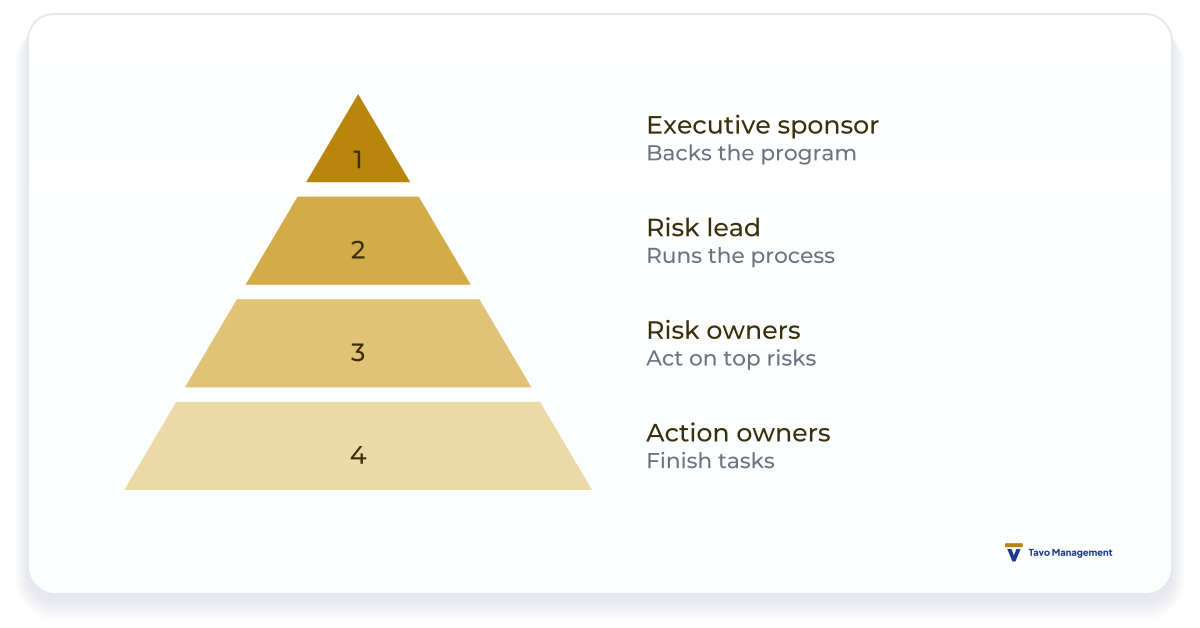
| 7. Every Top Risk Has an Owner | Owners have been told in writing. | 1 week |
| 8. Responses Have Dates | Actions are small enough to finish in a quarter. | 4 weeks |
| 9. Triggers and Measures Are Defined | Each measure has a data source. | 4 weeks |
| 10. Reviews and Reporting Are Scheduled | The report shows top risks, movement, breaches and overdue actions. | 1 week |
| 11. The Program Is Tested and Improved | One exercise has been run and documented. | Yearly |
The Enterprise Risk Management Checklist, Point by Point
Work from the top. The first five points form the foundation, the next four make the register useful and the last two keep it alive. Tick an item only if you could show someone the evidence.
1. Leadership Sponsorship Is in Writing
A named executive sponsors the program and the board has agreed to receive risk reports. Without this, owners treat requests as optional.
- The sponsor and their role are named in a one-page charter.
- The board or executive team has put risk on its calendar for the year.
- The budget for the first year is approved, even if small.
Tip: If the sponsor leaves, name a successor within a month.
2. Goals and Decisions Are Listed
Risks only matter against something. List the five to ten goals and the major decisions of the next twelve months, such as a new site, a product launch or a big contract.
- Each goal has an owner.
- Each major decision has a date.
- The list fits on one page.
Tip: Update it whenever the strategy changes.
3. A Framework Has Been Chosen
You have picked COSO ERM, ISO 31000 or a simple blend, and written down the process in plain language: identify, assess, respond, monitor, report.
- The framework and its terms are defined on a short page.
- Roles are named: board, executive team, risk lead, risk owners.
- The process is the same in every department.
Tip: Do not copy a 60-page manual. Ten pages is plenty for most organizations.
4. One Scoring Scale Exists
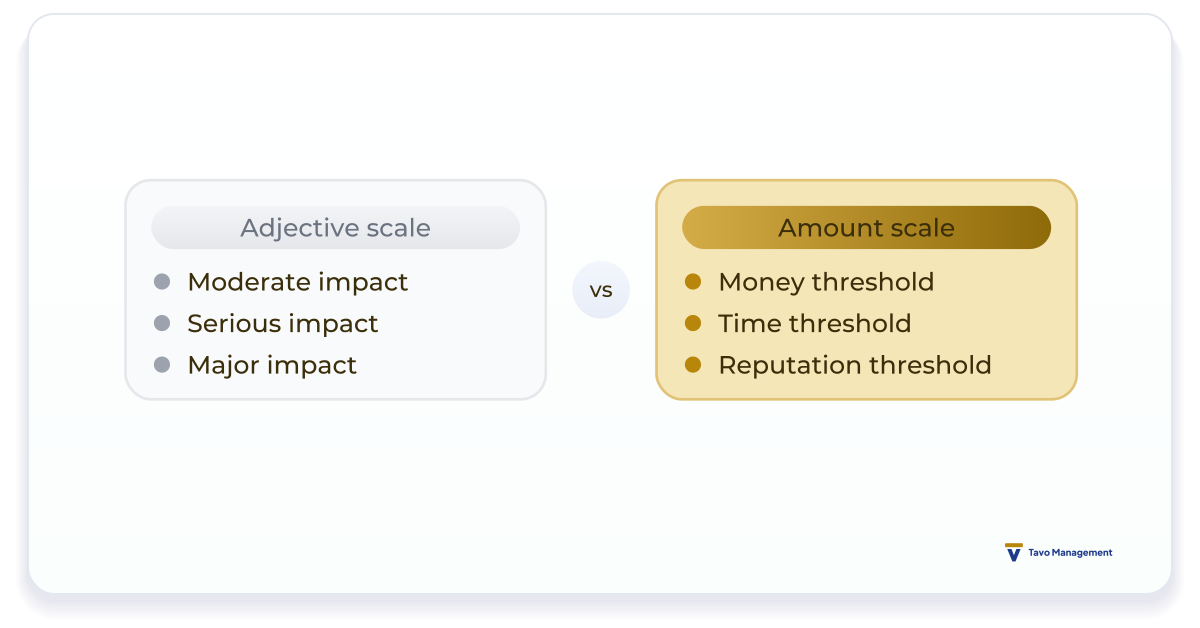
Likelihood and impact levels are defined once, in plain amounts and frequencies. Impact covers money, operations, people and reputation.
- Five levels for each axis, with one line each.
- Every department has tested the scale on two or three real risks.
- Scores are recorded as numbers, so they can be sorted.
Tip: If two teams score the same event differently, adjust the wording, not the people.
5. Risk Appetite Has Limits
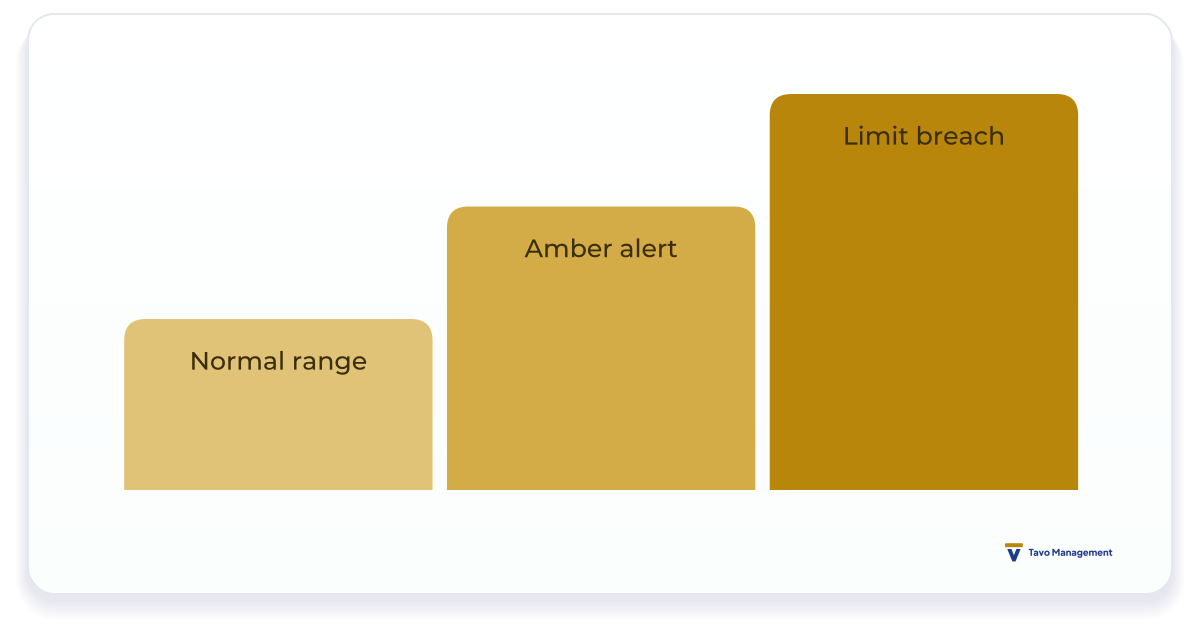
The board has approved limits and amber levels for the exposures it cares about most. These can be rough in the first year. If you need worked limits, the KPI list shows which numbers boards track.
- Three to five limits are written as numbers.
- Each limit has an owner who reports against it.
- The board has seen current positions at least once.
Tip: Review the limits once a year or after a major change.
6. Risks Have Been Gathered
Workshops and interviews have produced a long list from every function. Duplicates are merged and each risk is written as a cause, an event and an effect.
- Every department has contributed.
- Risks are written in one sentence, such as "supplier X fails, parts stop, deliveries slip".
- The long list has been reduced to a top 15 to 40.
Tip: Keep the long list in a back-up sheet in case a risk rises later.
7. Every Top Risk Has an Owner
One named person, with the authority to act, owns each top risk. Group owners and departments do not count.
- Owners have been told in writing.
- Owners know what is expected: update, respond, report.
- Each owner has a deputy.
Tip: Check ownership after any reorganization.
8. Responses Have Dates
Each top risk has a response, such as avoid, reduce, transfer or accept, with an action, a date and a measure of progress.
- Actions are small enough to finish in a quarter.
- Accepted risks are signed off by someone with authority.
- Overdue actions are visible in the report.
Tip: A response of 'monitor' is acceptable only with a trigger attached.
9. Triggers and Measures Are Defined
Top risks have a measure that shows movement, and a level that starts a response. Examples are weeks of cash, single-source parts or open audit findings.
- Each measure has a data source.
- Each trigger has an amber and a red level.
- One person checks the data on a set date.
Tip: Start with rough measures and improve them over time.
10. Reviews and Reporting Are Scheduled
The calendar has risk reviews for the next four quarters and a one-page report in a fixed layout.
- The report shows top risks, movement, breaches and overdue actions.
- Meetings last 45 minutes and follow the same agenda.
- Minutes record decisions, not discussion.
Tip: Skipped reviews are the first sign the program is fading.
11. The Program Is Tested and Improved
Once a year you run a scenario exercise on a top risk and review the framework itself: what was useful, what was ignored, what was missing. If the program stalls, the usual reasons appear in my notes on enterprise risk management challenges.
- One exercise has been run and documented.
- The framework has been reviewed and changes logged.
- Owners have given feedback.
Tip: Use incidents as tests: check whether they were on the register.
How to Score Your Own Program
Give yourself one point for each fully confirmed item and half a point for partial work. The score shows where to put the next month of effort.
| Items confirmed | What it means | What to do next |
|---|---|---|
| 0 to 12 | The foundation is missing | Complete points 1 to 5 before gathering more risks |
| 13 to 24 | A register exists but is not driving decisions | Add owners, triggers and a review rhythm |
| 25 to 33 | The program works and needs sharpening | Add measures, tests and board reporting |
The checklist has 33 items in total across the eleven points. A spreadsheet handles the tracking well, and if you later move to a platform, the enterprise risk management software comparison lists what to look for.
The Gaps I Find Most Often When Teams Run This Checklist
After many reviews, the same few items fail again and again. Knowing them in advance saves an afternoon of surprise.
| Point | Most common gap | Quick repair |
|---|---|---|
| Owners (7) | A committee or department listed instead of a person | Replace with one name and a deputy this week |
| Scale (4) | Impact described in adjectives, not amounts | Add money, time and reputation thresholds for each level |
| Appetite (5) | A paragraph with no numbers | Set three limits with amber levels and get board sign-off |
| Responses (8) | Actions without dates | Add a date within the quarter or split the action |
| Reviews (10) | Meetings on the calendar but no report | Create the one-page layout and send it ahead |
Notice that none of the repairs needs software or a large budget. They need a decision, a name and a date. If you find yourself writing a long project plan for one of these, the item is probably too big and should be split into pieces that fit in a month.
Another pattern is the checklist done once and filed. Teams tick every item in a workshop and never return, so six months later three of the eleven points have slipped. Put the rerun date in the calendar before you leave the room, and give the risk lead the job of reporting the score to the sponsor.
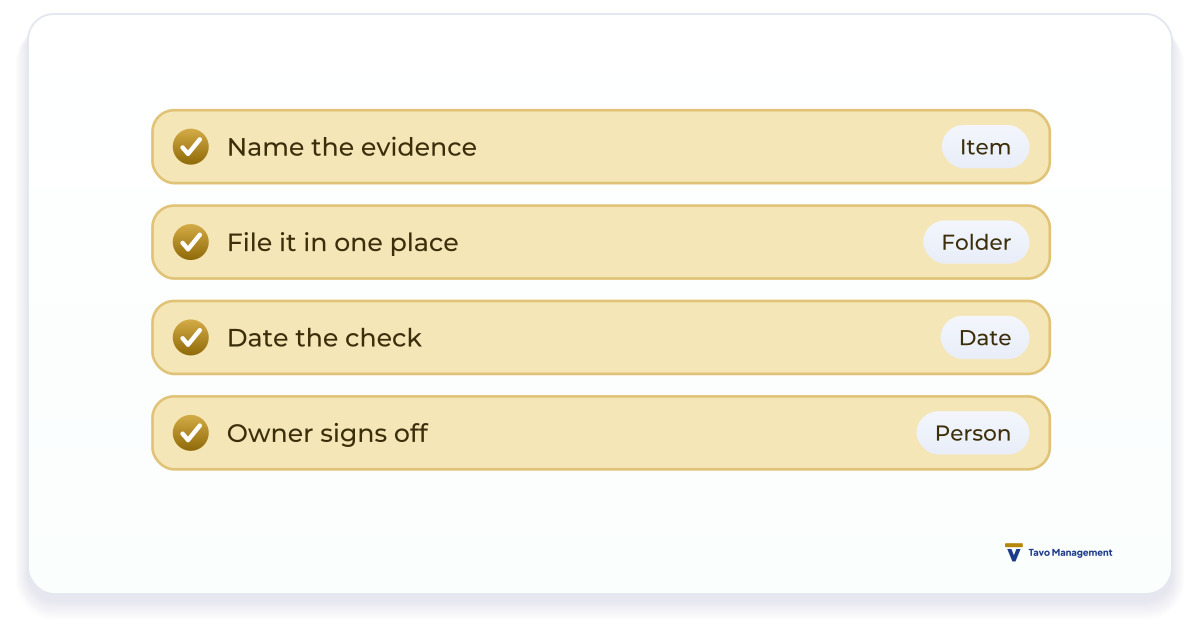
One last practical note on evidence. For each item, decide what you would show an auditor or a board member: a signed charter, a dated scale, a minute from the last review. Writing the evidence down next to the item keeps the checklist honest and makes the next review much faster, because you already know where to look.
How to Use the Checklist With Your Team
Run it as a 90-minute working session, not as a solo task. Bring the risk lead, finance, operations and one board member if you can. Answer each item out loud and ask for the evidence on the spot.
- Print the 33 items and mark each one yes, partly or no.
- Agree the three gaps that hurt most and put a name and a date on each.
- Rerun the checklist in six months and compare the score.
Teams that do this usually move up one band within two quarters. If you want a neutral second pair of eyes, a consultant can run the session with you.
Sources
Questions About the Enterprise Risk Management Checklist
What Should an Enterprise Risk Management Checklist Include?
It should cover sponsorship, goals, a framework, a scoring scale, risk appetite, a risk register, owners, responses, triggers, reviews and testing. The eleven points in this article cover those and break each into items you can check.
How Long Does It Take to Complete the Checklist?
The review itself takes about 90 minutes with the right people in the room. Fixing the gaps takes a few weeks to a few months, depending on how much is missing.
How Often Should We Repeat the Checklist?
Once or twice a year. Repeat it after a reorganization, a merger or any major change in strategy, since owners and goals often shift.
Who Should Complete the Checklist?
The risk lead, with input from finance, operations and compliance. A board member or executive sponsor should see the result. An outside reviewer can add a neutral view.
Do We Need a Risk Register Before Starting?
No. Point 6 covers building one. If you already have a register, the checklist helps you check whether it is useful or just long.
Is This Checklist Based on COSO or ISO 31000?
It follows the shared logic of both: governance, objectives, assessment, response, monitoring and reporting. It is written in plain language and does not replace the full standards.
What Score Should We Aim For?
Aim for 25 of the 33 items within a year. Small organizations may reach a solid program with fewer items, as long as owners, scale and review rhythm are in place.
General information only: this is not legal, financial or tax advice. Examples and numbers reflect typical projects; check the specifics with your advisers before deciding.
Did you find this helpful?
Thank you for your feedback.
Delaney Brisco
Delaney leads the Tavo editorial team and works with our consultants to turn real client projects into practical guides on project delivery, process design and organizational change. Before joining Tavo, she spent 12 years in operations and program management roles. She has since edited more than 300 articles on management practice and reviewed PMO setups and process redesigns from over 100 client projects. She is based in Minneapolis, Minnesota.