Summary
- The strongest examples have a named owner, a measure and a dated response.
- Public cases such as Maersk and Toyota show how single points of failure spread.
- Counting an exposure moves budget faster than rating it high, medium or low.
- Start with two or three examples and run them for one quarter before adding more.
Most guides explain what risk management is. Fewer show you what it looks like inside a hospital, a factory or a restaurant group. In my work on enterprise risk management consulting I find that people grasp the idea fastest through a concrete case, so this article collects twelve.
Three are well-documented public cases, and nine are composites from the kinds of engagements I see. For each you get the lesson, the steps to copy and what to use. If you need a ranked list of platforms, jump to the enterprise risk management software ranking.
What Makes a Good Enterprise Risk Management Example
A good example shows a specific risk, a named owner, a number or trigger and a response that someone took. A weak example is a list of categories. Before you read the cases, here is how I judge them.
| Test | Strong example | Weak example |
|---|---|---|
| Specific risk | A named failure with a cause, such as a single-source part | A category such as "supply chain risk" |
| Owner | A person who can change something | A department or a committee |
| Measure | A count, a cost per day or a trigger level | A rating of high, medium or low |
| Response | An action with a date | "Monitor" with no date |
| Follow-up | Reviewed on a schedule | Reviewed once a year, if at all |
12 Enterprise Risk Management Examples From Real Organizations
The cases run from large public events to smaller, everyday programs. Treat the figures as ranges from the cases I describe, and check them against your own data. For the habits that make these programs last, see my enterprise risk management best practices.
| Example | Sector | Main lesson |
|---|---|---|
| 1. Maersk and the NotPetya Cyberattack | Technology | A single point of failure |
| 2. Toyota and Its Supplier Database | Manufacturing | Knowing who your suppliers' suppliers are |
| 3. Walmart's Hurricane Planning | Retail | Preparing for events you know will come |
| 4. A Hospital Group's Medication Safety Register | Healthcare | Patient safety belongs in the same register |
| 5. A Manufacturer Cuts Single-Source Parts | Manufacturing | Turning a worry into a count |
| 6. A Restaurant Group Tracks Food Safety and Staffing | Restaurants | Operational risk at location level |
| 7. A Property Manager Prices Its Insurance Gaps | Property | Matching risk to cover |
| 8. A Professional Services Firm and Key-Person Risk | Professional services | People risk with a name on it |
| 9. A Dental Group and Patient Data Privacy | Healthcare | Small sites, large exposure |
| 10. A Program Office Manages Capital Project Risk | Program delivery | Risk in a portfolio of projects |
| 11. A Regional Lender Sets Its Risk Appetite | Financial services | Writing the limit down |
| 12. A Retailer Links Cash Risk to Its Plans | Retail | From risk list to budget |
Maersk and the NotPetya Cyberattack
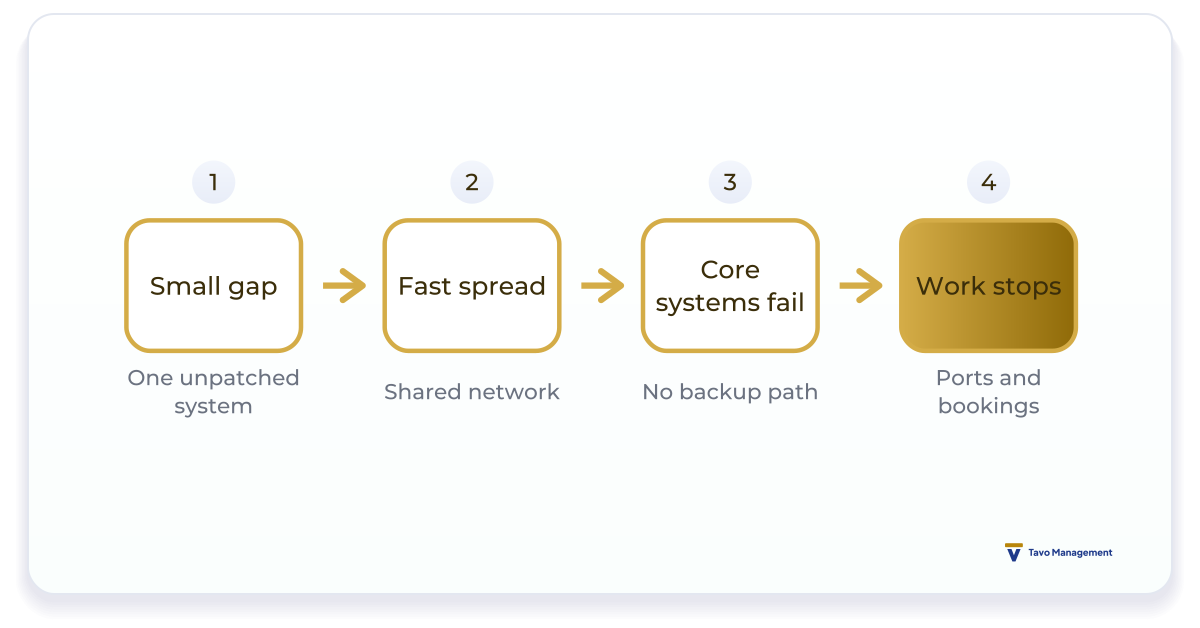
In June 2017 the NotPetya malware spread through a Ukrainian accounting package and hit Maersk, the shipping giant. Maersk later put the damage at roughly $200 to $300 million, and the company had to reinstall thousands of servers and computers. What saved the recovery was an old domain controller in a Ghana office that happened to be offline during the attack, so a clean copy of the directory survived.
The lesson for your risk register is the way a minor-looking item, a tax software update, sat on the same network as everything else. Cyber risk belongs in the enterprise register with an owner, a scenario and a recovery test, because the loss lands on revenue and customers, not only on IT.
How the steps run
- Pick the two or three systems your operations cannot run without.
- Write one plausible failure scenario for each, such as ransomware or a failed vendor update.
- Name the business owner who would decide in the first hour.
- Test a restore from backup and time it.
- Record the result and the gap in the register.
Tools worth a look
A spreadsheet scenario sheet is enough to start. If your IT team already runs a security tool, ask for its asset list so your scenarios use real systems.
Toyota and Its Supplier Database
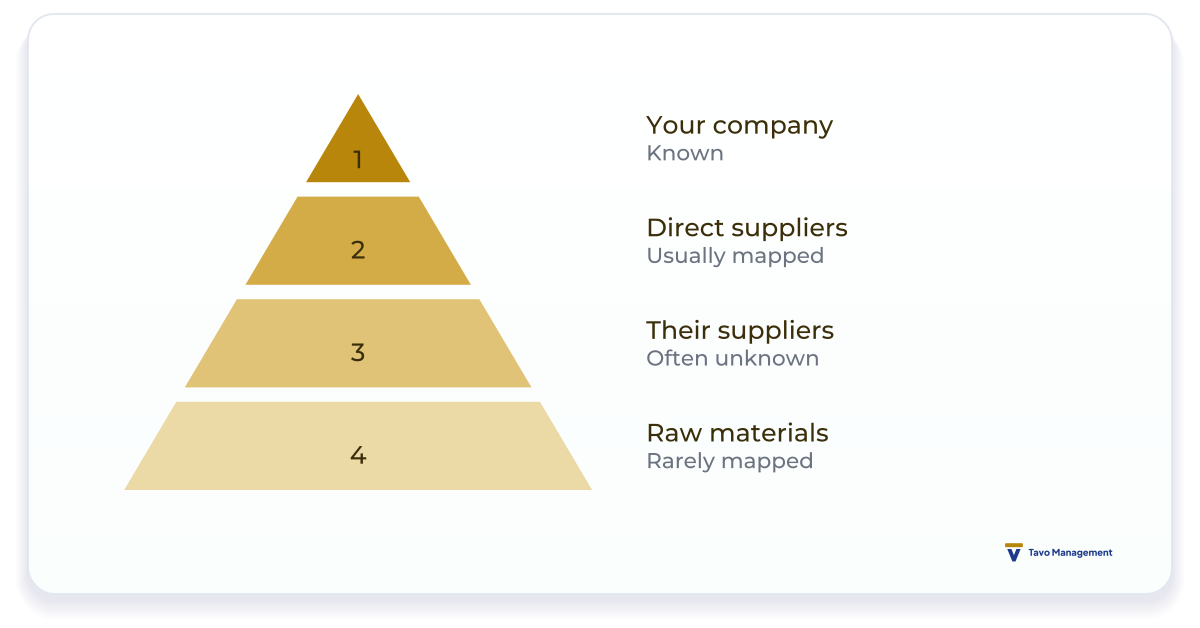
After the 2011 earthquake in Japan, Toyota found that it could not quickly say which parts came from which plant, and several deeper-tier suppliers had no backup. Production stopped for weeks at some sites. Toyota then built a database of its parts and suppliers, often called RESCUE, so that after a disaster it could see within days what was affected.
Supply risk is the most common high-rated risk I see in manufacturing registers, and the weak point is rarely the first-tier supplier you know. Mapping who makes the critical part behind the part is dull work, and it is what turns a vague worry into a decision about dual sourcing. The same approach underlies supply chain risk management consulting.
What to do first
- List your ten most critical parts or inputs.
- Ask each supplier where the part is made and who supplies the raw material.
- Flag every part that comes from one site or one source.
- Decide per flagged part: buffer stock, second source or accept.
- Review the map twice a year.
Tools worth a look
A shared spreadsheet works for the first map. Supplier risk platforms help once you pass a few hundred suppliers.
Walmart's Hurricane Planning
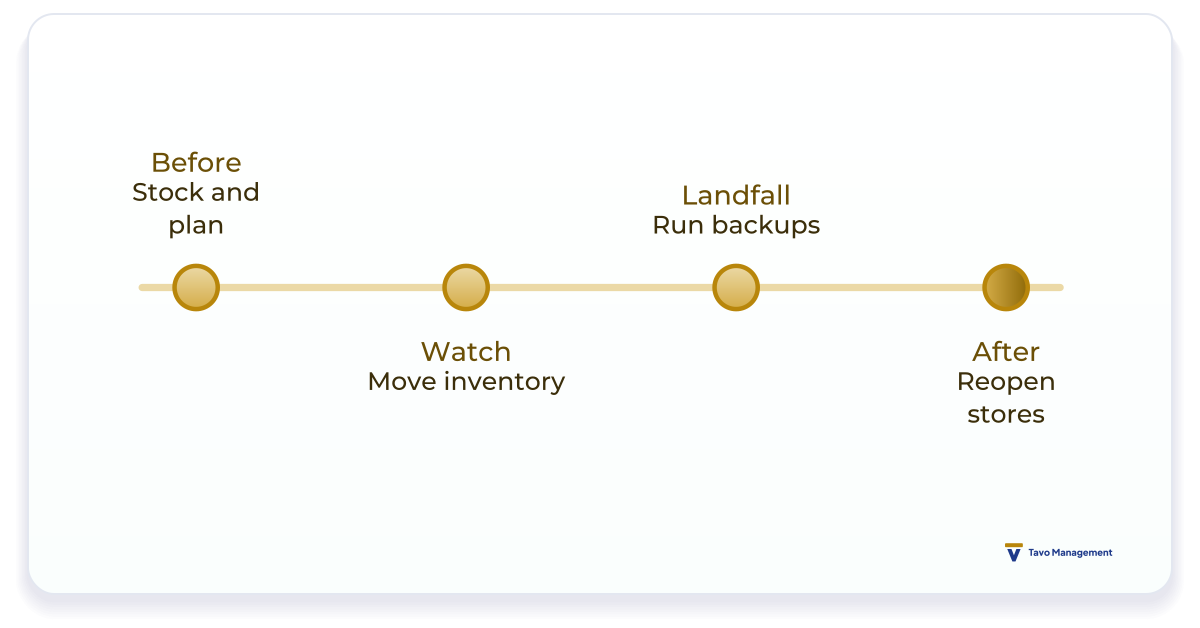
Walmart runs an emergency operations center and plans for hurricanes before the season starts. After Hurricane Katrina in 2005 its stores reopened quickly and supplied water, generators and food to affected communities. The company has long used its sales history to predict what shoppers buy before a storm and pre-positions it.
A hurricane is not an unknown risk for a retailer on the Gulf coast. It is a recurring one, and the register entry should read like a playbook: trigger, stock to move, staff to call, decision owner. Recurring risks are where the cheapest improvements hide, because the pattern is already known.
A simple path to copy
- Name the events that hit you every year or two, such as storms, peak season or flu.
- Write the trigger that starts your response.
- List what you move or buy in advance.
- Assign a decision owner and a backup.
- Run a one-hour rehearsal before the season.
Tools worth a look
A one-page playbook per event is the main tool. Weather and sales data you already have make the trigger concrete.
A Hospital Group's Medication Safety Register
A regional hospital group I worked with kept patient safety risks in the quality department and financial risks in finance. When we merged the lists, a staffing shortage in pharmacy turned out to affect both a medication error risk and a budget overrun, and nobody had seen the link. The fix was a shared scale and a named executive owner for the combined risk.
Healthcare risk spans clinical, financial, privacy and regulatory exposure, and the same event often touches all four. One scale lets your board see that a single understaffed unit is the common cause behind several amber items.
How the program runs
- Pull the clinical, finance and compliance risk lists onto one sheet.
- Agree one likelihood and impact scale with all three owners.
- Merge duplicates and mark shared causes.
- Give each shared cause one executive owner.
- Report the merged top ten to the board.
Tools worth a look
Your incident reporting system is a good source of evidence. Ask the quality team for a monthly export instead of building a new feed.
A Manufacturer Cuts Single-Source Parts
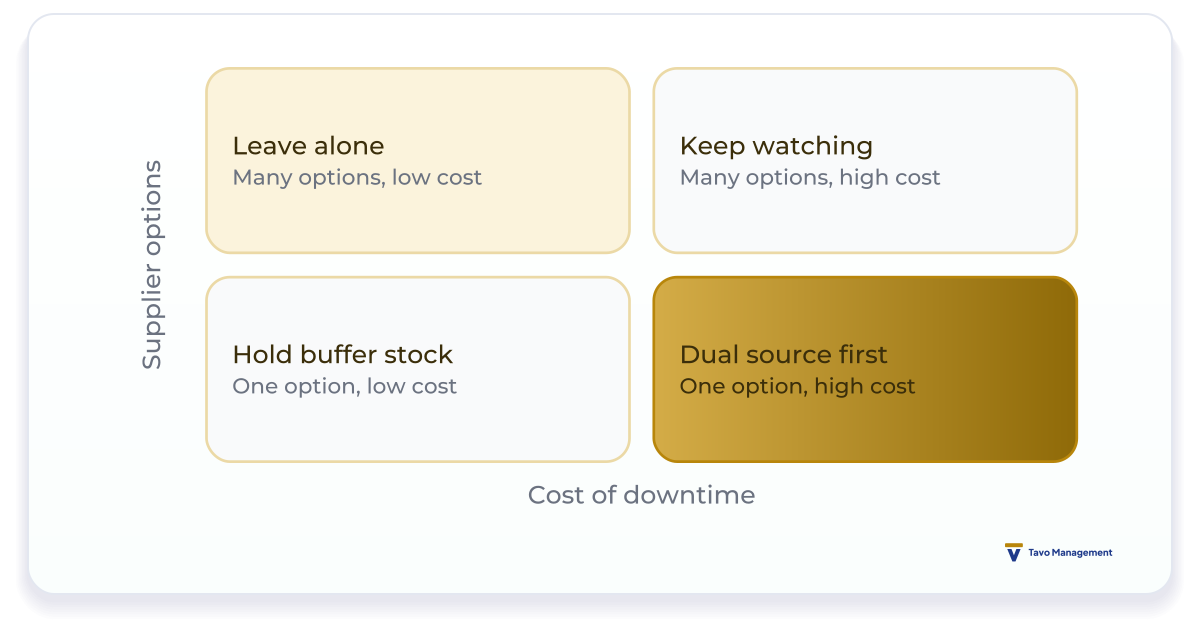
A mid-sized manufacturer had listed supplier dependency as a high risk for years without changing anything. We counted the parts bought from a single source: it was a little under a fifth of the bill of materials. Once the number existed, the operations director funded second sources for the dozen most critical parts over two quarters.
A rating of high rarely moves budget. A count of parts, an estimated days-to-recover and a cost of downtime per day do. If you take one habit from this example, attach a number to every top risk, even a rough one.
How to turn it into a routine
- Choose one measure that describes the exposure, such as single-source parts.
- Count it from your purchasing data.
- Estimate cost per day of a stoppage with finance.
- Set a target and an owner.
- Report the number each quarter.
Tools worth a look
Your ERP can usually produce the count in an afternoon. The cost per day needs one conversation with finance.
A Restaurant Group Tracks Food Safety and Staffing
A restaurant group with a few dozen locations kept food safety as a manager's concern and staffing as an HR concern. Their worst months had both at once: short-staffed kitchens skipped temperature logs. Putting both on the register as linked risks, with a shared owner, led to a rule that a shift below minimum staffing triggers a supervisor check.
Location-based businesses see the same risk repeated many times. Score it once at company level, then track by location, so a weak site stands out. The restaurant management consulting work I do usually starts with this view.
Steps you can copy
- List the five risks that repeat in every location.
- Define one simple check per risk.
- Collect the result weekly in a shared sheet.
- Mark any location that fails two weeks in a row.
- Have the area manager own the follow-up.
Tools worth a look
A shared form that feeds a sheet is enough. Move to software when the number of locations passes what one person can read.
A Property Manager Prices Its Insurance Gaps
A property management company with several hundred units assumed its insurance covered most things. A review found that the water damage deductible was large relative to the margin on small buildings, and that two older properties had little cover for rent loss. Neither item was on any register.
Insurance is a response to a risk, not a replacement for managing it. Put the retained amount, the deductible and the exclusions next to each top risk. If the retained amount is higher than the owner can absorb, the risk is not controlled yet. This ties closely to property management consulting.
From worry to action
- List your top risks that insurance is supposed to cover.
- Read the policy for deductibles, limits and exclusions.
- Write the amount you keep per event.
- Compare it to what a bad month can absorb.
- Ask your broker about each gap.
Tools worth a look
Your broker's coverage summary is the main source. Ask for it in a table, one row per policy.
A Professional Services Firm and Key-Person Risk
A small advisory firm earned most of its revenue through two partners. Nobody wrote that down because it felt rude. When one partner took a long leave, three clients paused projects. On the register it became key-person dependency, with a rating, an owner and a response: deputy assignments on every account and a quarterly handover note.
People risks are easy to skip because they feel personal. The trick is to write the exposure about the role, not the person: revenue held, relationships held, who else knows the work.
A practical sequence
- List roles that hold more than a tenth of revenue or critical knowledge.
- Name a deputy for each.
- Write a one-page handover note.
- Review it every quarter.
- Test it during a planned absence.
Tools worth a look
Your CRM shows which accounts depend on one person. A shared drive folder per account holds the handover notes.
A Dental Group and Patient Data Privacy
A group of dental practices stored patient records on a mix of cloud software and old workstations. A review found shared logins at two sites and no list of who could export records. Nothing had happened, which is why the risk had never been rated.
Privacy risks are often invisible until an incident. Rate them on the potential harm and number of records, and assign the owner to someone who can change access, not to the person who reads the policy. The approach fits dental practice management consulting too.
How to set it up
- List where patient records live.
- Count who has access at each site.
- Remove shared logins.
- Log exports and review them monthly.
- Rate the remaining risk and set a review date.
Tools worth a look
Your practice software has an access report. Ask the vendor for the standard version before paying for a custom one.
A Program Office Manages Capital Project Risk
A company running a dozen capital projects kept a risk log per project. Pooling them showed that eight projects relied on the same contractor and the same lead time for a piece of equipment. Individually each project rated the risk medium. Together it was the largest exposure in the program.
Project risks add up across a portfolio in ways no single project manager can see. Your program or project management office is the natural place to keep a roll-up of shared causes.
Putting it into your register
- Collect each project's top five risks.
- Tag the cause, such as vendor, equipment or approval.
- Count how many projects share each cause.
- Escalate causes that appear in three or more projects.
- Assign a program-level owner.
Tools worth a look
A simple tag column in a spreadsheet is enough. Most project tools can export risk logs for the roll-up.
A Regional Lender Sets Its Risk Appetite
A regional lender knew it did not want too much exposure to one industry, but the limit lived in managers' heads. After a board workshop, it wrote a rule: no single sector above a stated share of the loan book, with an amber alert a few points below. Within a year the alert fired once, and the board slowed new lending in that sector without a debate about whether the rule applied.
Risk appetite works when it is a number that triggers a conversation. The limit and the alert level matter more than the wording of the statement.
How to write the rule
- Pick three exposures the board cares about.
- Propose a limit and an amber level for each.
- Test them against the last two years of data.
- Get written approval from the board.
- Report current position against each limit every quarter.
Tools worth a look
The finance team's existing monthly report usually holds the data. Add the limit as a column.
A Retailer Links Cash Risk to Its Plans
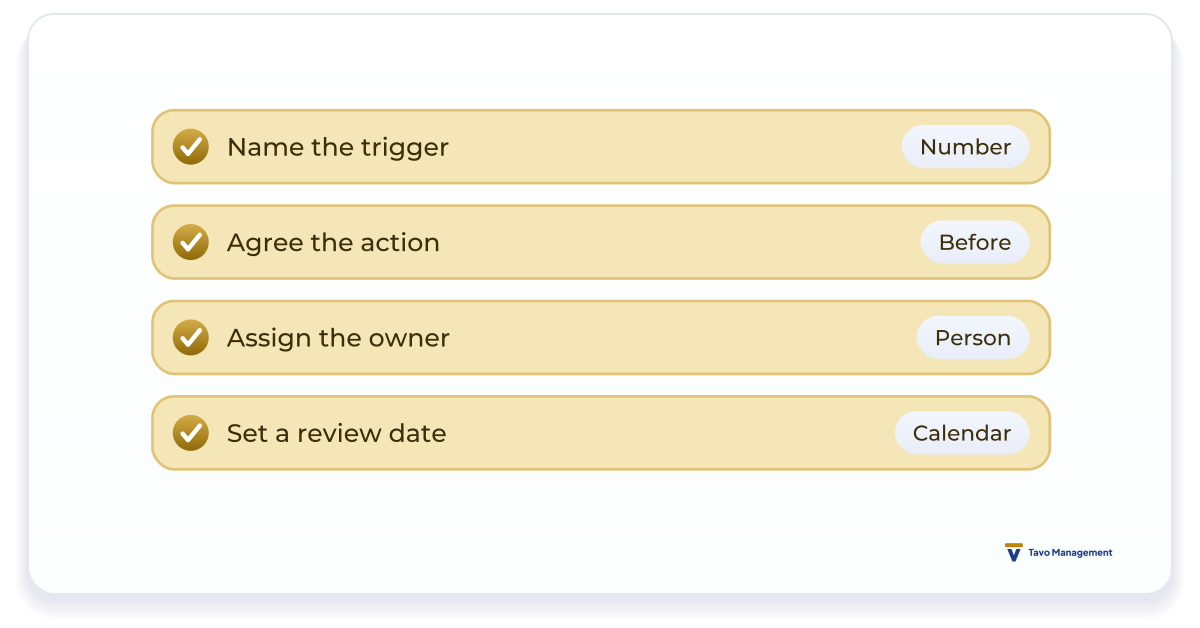
A retail chain kept a cash shortfall risk on its register but never tied it to the budget. In a bad holiday season, sales fell short and the company had to delay supplier payments. The risk owner later added a trigger: if cash covers fewer than a set number of weeks of costs, hiring freezes and orders are trimmed.
Linking a risk to a trigger and a pre-agreed action turns it from a worry into a plan. It also helps your financial management work, since forecasts and risk reviews use the same numbers.
How to link the trigger
- Choose the measure that signals trouble, such as weeks of cash.
- Set an amber and a red level.
- Agree in advance what happens at each level.
- Name who calls it.
- Check it monthly.
Tools worth a look
Your cash forecast already holds the data. Add two lines for the trigger levels.
How to Pick the Examples That Fit Your Organization
Start from the decisions your leaders make, then look for the example closest to one of them. A few questions narrow the list quickly:
- Which loss would hurt you most in the next 12 months?
- Which risk has already cost you money or time?
- Do you have the data to count it?
- Who could own it and change something?
Pick two or three examples, copy the steps and run them for a quarter. If you want to know what to report afterward, the enterprise risk management KPIs list shows the numbers leaders track. For a full walk-through of setting this up, use my enterprise risk management checklist.
If the examples raise more questions than answers, the common obstacles are covered in my piece on enterprise risk management challenges, and a short call with a consultant can settle where to begin.
Sources
Questions About Enterprise Risk Management Examples
What Is an Example of Enterprise Risk Management?
A common one is a manufacturer that counts parts bought from a single supplier, names an owner, estimates the cost per day of a stoppage and funds second sources for the most critical parts. It has a measure, an owner and a response, which is what separates a working program from a list.
What Are the Main Types of Enterprise Risk?
Strategic, operational, financial, compliance, technology and reputational risks cover most registers. Many organizations add people risk and supplier risk as separate categories. What matters more than the categories is that all of them are scored on the same scale.
How Many Risks Should a Register Have?
For most mid-sized organizations, 15 to 40 enterprise-level risks is workable. If you have more, leaders stop reading it. Keep detailed lists inside departments and roll up only the risks that could affect the organization's goals.
Is ERM Only for Large Companies?
No. A small company can run a useful program with one spreadsheet, a short scale and a quarterly meeting. The size of the framework should match the size of the organization and its regulators.
What Is the Difference Between ERM and Traditional Risk Management?
Traditional risk management tends to run in silos, such as insurance, safety or finance. ERM brings those views into one framework linked to strategy, so leaders can compare risks and decide where to spend.
Which Framework Should I Follow for My Examples?
COSO ERM and ISO 31000 are the two most used. COSO links risk to strategy and performance, and ISO 31000 describes principles and a process. Both lead to the same practical steps shown in these examples.
How Long Does It Take to See Results from an ERM Program?
A first ranked list and named owners can be ready in 4 to 8 weeks. Measurable results, such as fewer surprises or faster board reporting, usually show after two or three review cycles.
General information only: this is not legal, financial or tax advice. Examples and numbers reflect typical projects; check the specifics with your advisers before deciding.
Did you find this helpful?
Thank you for your feedback.
Delaney Brisco
Delaney leads the Tavo editorial team and works with our consultants to turn real client projects into practical guides on project delivery, process design and organizational change. Before joining Tavo, she spent 12 years in operations and program management roles. She has since edited more than 300 articles on management practice and reviewed PMO setups and process redesigns from over 100 client projects. She is based in Minneapolis, Minnesota.