Summary
- Every IT management framework rests on a handful of building blocks: governance, service delivery, assets, security, change and vendors.
- ITIL, COBIT, ISO/IEC 20000 and NIST CSF solve different problems, so borrow selectively.
- A weighted maturity score shows where an improvement helps most.
- Keep your own version short enough that new team members read it in an hour.
Ask five IT leaders what a framework is and you will get five answers, from a poster of ITIL processes to a wiki page nobody opens. A useful definition is smaller: a framework is the set of decisions about who is responsible for what, how work flows and how you know it works. Work with IT management consulting and you will usually start by drawing exactly that.
This article breaks an IT management framework into building blocks, compares the models you will hear about and gives you a formula to score your own setup. I wrote it for people who need something they can use this quarter, not a certification roadmap.
What an IT Management Framework Actually Contains
Published models vary in size, but the content is surprisingly consistent. They all answer the same questions. Who decides? How are requests handled? What do we own? How do we stay safe? How do we change things without breaking them? What do we pay vendors for? Those questions become the building blocks below.
| Building block | What it tells you | Typical artifact |
|---|---|---|
| Governance and ownership | Who decides and who is accountable? | Roles list, decision rights, steering meeting |
| Service delivery | How are requests and incidents handled? | Request queue, priorities, response targets |
| Assets and configuration | What do we own and how does it connect? | Asset register, license list, system map |
| Security and risk | What could hurt us and what do we do about it? | Risk register, access rules, backup tests |
| Change and projects | How do we change things safely? | Change record, rollback plan, project intake |
| Vendors and finance | What do we pay for and what do we get? | Contract calendar, service levels, budget view |
| People and skills | Do we have the capacity and knowledge? | Skills matrix, on-call rota, training plan |
Nothing here needs special software at first. In my projects, a shared document per block, each with an owner and a review date, gets a team further than a tool purchase made too early. When you do outgrow documents, my ranking of IT management software covers the options.
How ITIL, COBIT, ISO 20000 and NIST Compare
The named models each cover part of the picture. They overlap, and no one model covers everything. Picking one is less important than knowing which gap it fills.
| Model | Focus | Best when | Watch for |
|---|---|---|---|
| ITIL 4 | Service management practices and the value chain | Your pain is support, incidents and changes | Treating it as a checklist of every practice |
| COBIT 2019 | Governance and management of enterprise IT | Leadership needs control, audit evidence and alignment | Heavy for small teams |
| ISO/IEC 20000-1 | A certifiable service management system | Customers or contracts ask for certification | Documentation load |
| NIST CSF 2.0 | Cybersecurity outcomes across six functions | You need a clear language for security and risk | It describes outcomes, so you decide the methods |
NIST released version 2.0 of its Cybersecurity Framework in 2024. It organizes security work into six functions: Govern, Identify, Protect, Detect, Respond and Recover. The Govern function was added in that version, which puts ownership and strategy next to the technical controls. COBIT, published by ISACA, covers governance of enterprise IT, and ISO/IEC 20000-1 is the international standard for service management systems.
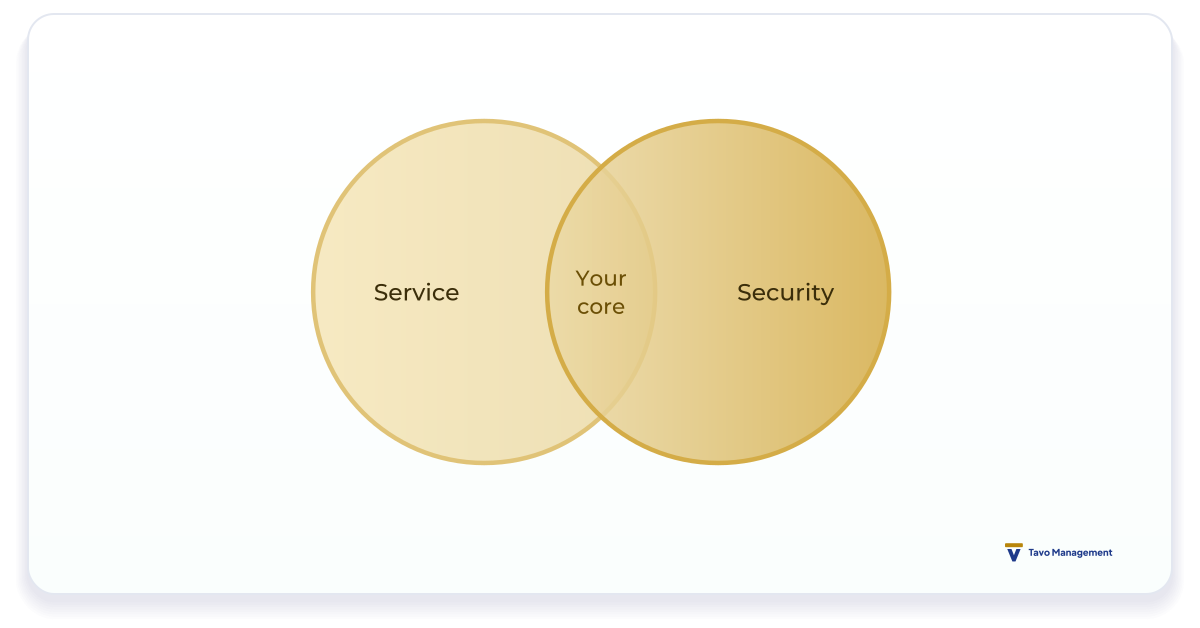
For a small organization, the practical middle path is a short set of habits, which I list in my guide to IT management best practices. For a first version, those habits are enough.
Score Your Framework With a Simple Formula
Frameworks tend to stay abstract until you score them. The method below gives you a number per block and a ranking of where to invest. It takes an hour with your team.
Rate each building block from 1 to 5. A 1 means ad hoc and dependent on individuals, a 3 means defined and mostly followed and a 5 means measured and improved regularly. Then give each block a weight from 1 to 5 for how much it matters to your business. A hospital group might weight security at 5, while a small agency might weight vendors higher.
Maturity score = sum of (score x weight) / sum of weights
The weighted average tells you where you stand overall. The more useful figure is the gap: weight multiplied by the distance to your target score. The biggest gaps are your first projects.
| Block | Score | Weight | Target | Gap x weight |
|---|---|---|---|---|
| Governance and ownership | 2 | 4 | 3 | 4 |
| Service delivery | 3 | 5 | 4 | 5 |
| Assets and configuration | 2 | 3 | 3 | 3 |
| Security and risk | 2 | 5 | 4 | 10 |
| Change and projects | 3 | 3 | 3 | 0 |
| Vendors and finance | 1 | 3 | 3 | 6 |
| People and skills | 2 | 2 | 3 | 2 |
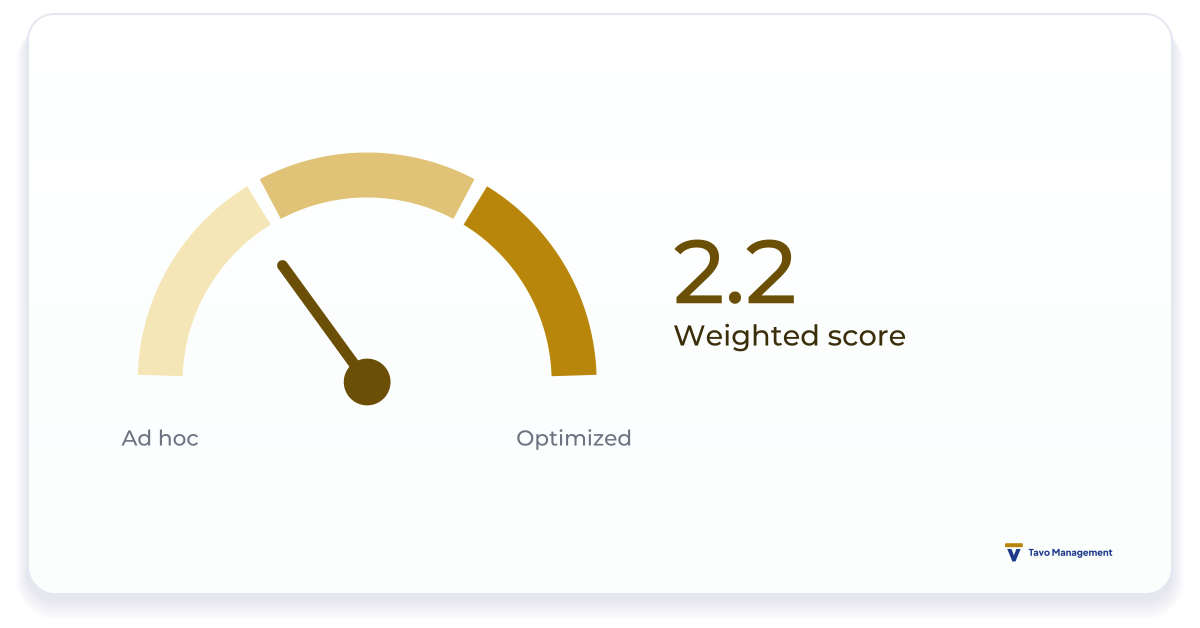
In this example, the weighted score is (2x4 + 3x5 + 2x3 + 2x5 + 3x3 + 1x3 + 2x2) divided by 25, which is 2.2 out of 5. The biggest gap is security and risk at 10, followed by vendors and finance at 6. Those two blocks become the first projects, and the team skips change management for now because it already meets its target.
Build Your Own Version in Four Passes
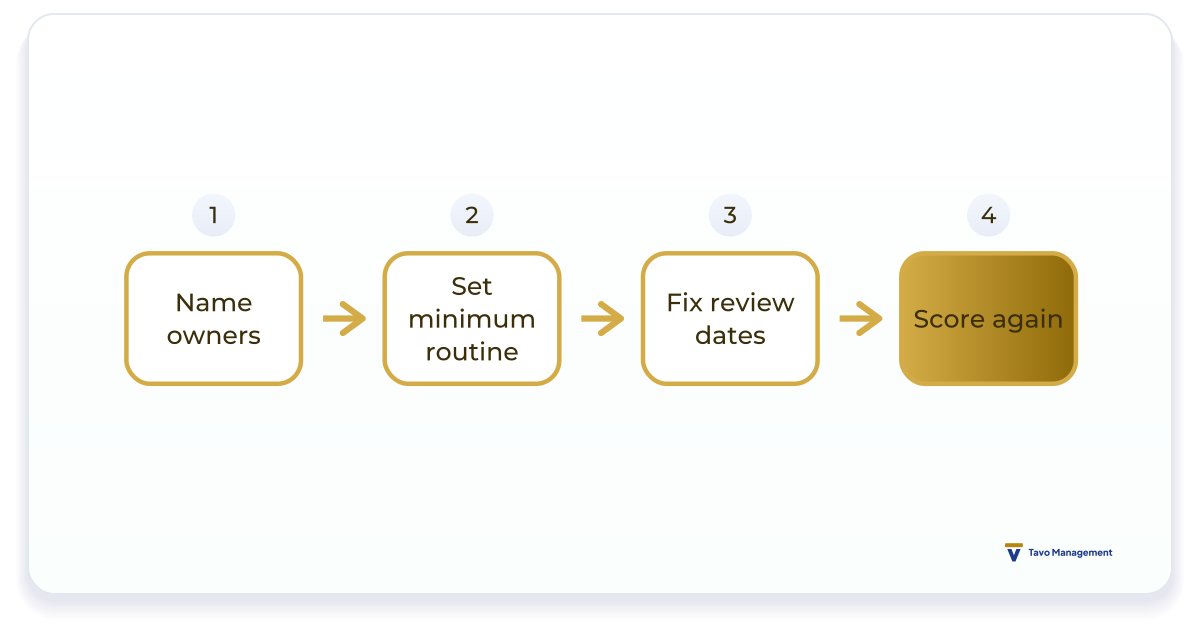
You do not need to document everything. Work in four passes and stop when the framework fits on a few pages.
First, name owners. Assign one person per building block, and write the names on one page. Second, define the minimum routine for each block: one process, one measure and one meeting. For service delivery that might be one queue, response time and a weekly ticket review. Third, set review dates and put them in the calendar. Fourth, run the formula again after a quarter, and check which gaps closed.
How the framework connects to budget and priorities is a strategy question, and I cover that in my IT management strategy playbook. Strategy decides what to improve, and the framework keeps daily work steady while you do it.
Who Plays Which Role
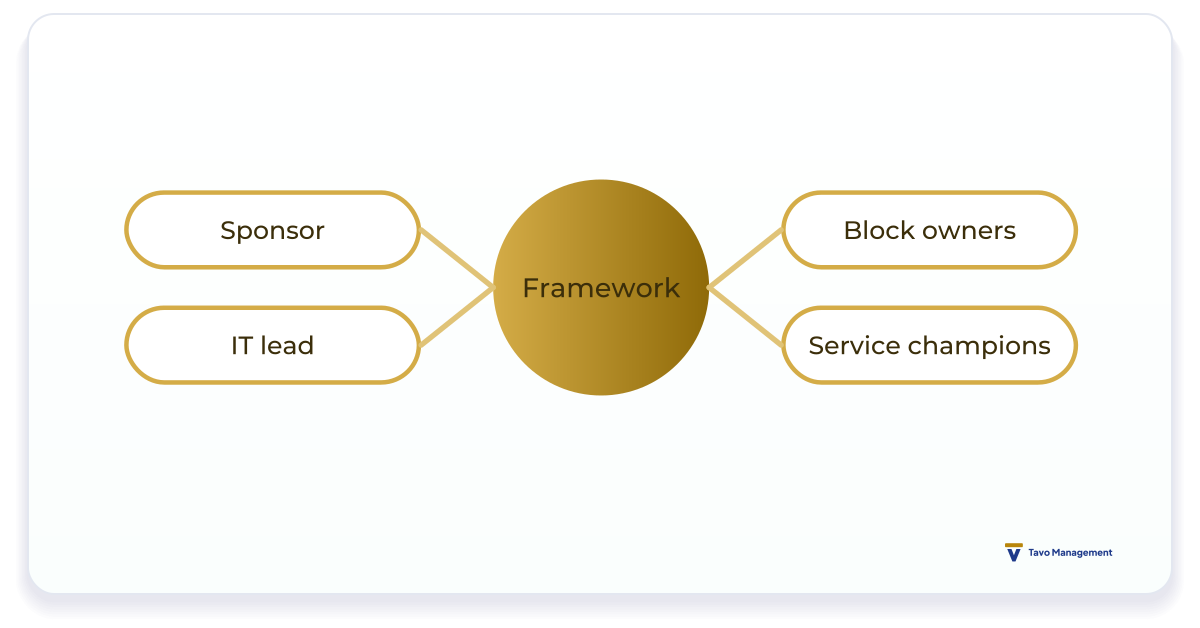
A framework without named roles is a diagram. You need four roles, and in a small company one person may hold several of them. The sponsor is a leader who owns the budget and settles disputes between IT and other departments. The IT lead runs the framework day to day and reports on it. Block owners answer for one building block each, such as security or vendors. Finally, a few service champions in the business pass on feedback and help colleagues adopt new routines.
Write the roles on one page with a short description of what each person decides alone and what needs approval. In my experience, disagreements over who may approve a purchase or a change cause more friction than any technical question, and a page that settles them removes a surprising amount of noise. Review the page whenever someone joins or leaves.
Meetings are the second half of governance. A monthly 45-minute review of the building blocks is enough for most mid-sized companies. Go through the measures, the open risks and the next changes, and write down three decisions. If a meeting ends with no decisions, shorten it or change the agenda.
Mistakes That Sink Framework Projects
The first mistake is starting with the model instead of the problem. A team announces it will adopt ITIL, spends months mapping processes and loses interest before anything improves. Start from the pain, for example late incident responses, and take only the practice that addresses it.
The second is writing documents nobody reads. A 60-page process manual feels rigorous, but people ignore it, and it goes out of date within a quarter. Keep each procedure to a page and put it where the work happens.
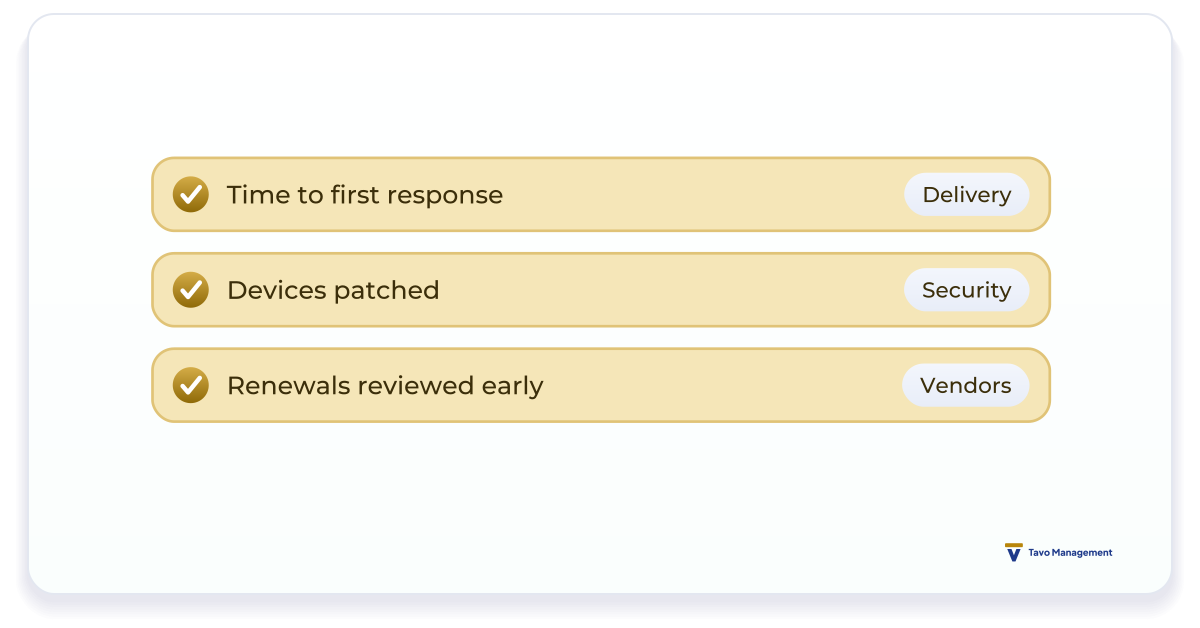
The third is skipping measurement. Without a number for each block, the framework is an opinion. Choose one measure per block, such as time to first response, share of devices patched or renewals reviewed 90 days ahead, and report them monthly.
The fourth is forgetting the people side. New routines feel like extra work until they save someone an afternoon. Explain what each change removes, start with a pilot team and let the pilot group tell the rest what it was like.
- Pick the problem first and the model second.
- Keep every procedure to a page.
- Attach one measure to every building block.
- Pilot with one team before rolling out.
One last point on scoring: repeat it with a second person, ideally from outside IT. Two people rarely score the same block alike, and the differences show where the picture is blurry. Settle them with a concrete example, such as how the last major incident was actually handled, and record the agreed score with the reason.
Adjusting the Framework to Your Size
A ten-person company can run all seven blocks on a single page, with the owner holding most of them. A 200-person company needs separate owners, regular meetings and some tooling. A multi-site manufacturer or a healthcare group adds formal risk registers and evidence for audits. The blocks stay the same, and the depth changes.
For small teams, my piece on IT management for small business shows the cut-down version. Larger teams tend to hit the human problems first, such as unclear roles and competing priorities, which I describe in the article on IT management challenges.
Questions About IT Management Frameworks
What Is an IT Management Framework?
It is a structured way of deciding who is responsible for IT, which processes you run and how you measure them. It can be a published model such as ITIL or COBIT, or a short internal version built from the parts of those models that fit your company. The point is a shared language and clear ownership.
Which IT Management Framework Should I Choose?
Choose by problem. ITIL suits service delivery and support, COBIT suits governance and board-level control, ISO/IEC 20000 suits organizations that want certification of service management and the NIST Cybersecurity Framework suits security programs. Most companies borrow from two and keep the result small.
Do I Need Certification to Use a Framework?
No. You can use the ideas without any certification. Certification matters when a customer or regulator asks for it, or when you want an independent check. For most small and mid-sized teams, the practical value comes from the habits, not the certificate.
How Long Does It Take to Build an IT Management Framework?
A lightweight version for a mid-sized company can take six to twelve weeks, including interviews, a maturity check and the first documented processes. Embedding the habits takes longer, usually a year of regular reviews. Starting with two or three building blocks gets you moving sooner.
What Is the Difference Between a Framework and a Strategy?
A framework describes how IT is run: the roles, processes and controls. A strategy describes where IT should go and which investments come first. You need both. The framework keeps daily work stable, and the strategy decides what to change.
How Do I Score IT Maturity?
Rate each building block from 1 (ad hoc) to 5 (measured and improving), weight the blocks by importance to your business and calculate a weighted average. The formula and a worked example are in this article. Use the result to rank where to invest, not as a grade.
Can a Small Company Use ITIL or COBIT?
Yes, selectively. A small company does not need every practice in those models. Take the core ideas, such as one request queue, change control for risky work, an asset record and a regular review, and leave out the rest until you grow.
Sources
General information only: this is not legal, financial or tax advice. Examples and numbers reflect typical projects; check the specifics with your advisers before deciding.
Did you find this helpful?
Thank you for your feedback.
Delaney Brisco
Delaney leads the Tavo editorial team and works with our consultants to turn real client projects into practical guides on project delivery, process design and organizational change. Before joining Tavo, she spent 12 years in operations and program management roles. She has since edited more than 300 articles on management practice and reviewed PMO setups and process redesigns from over 100 client projects. She is based in Minneapolis, Minnesota.