Summary
- A strategy starts from the business goals, not from technology wishes.
- Score every initiative on value, risk reduction, effort and urgency, then fund from the top of the list.
- Know your run versus change spending before you plan new projects.
- Review quarterly, and write down what you decided not to do.
Most IT strategies fail the same way: they are written once, filed and forgotten, while real decisions get made by whoever shouts loudest. In the engagements I have seen go well, the strategy was short, and leadership could name the top three priorities from memory. The six phases below are the order I use in IT management consulting projects.
You can run them yourself. The only hard part is agreeing on priorities, and I will show you a scoring method that takes some of the politics out of it.
Six Phases, Summarized
| Phase | Purpose | Output | Typical time |
|---|---|---|---|
| 1. Baseline | Know where you are | An inventory, a cost view and a maturity score | Two to three weeks |
| 2. Business goals | Know where the business is going | A short list of goals IT must support | One to two weeks |
| 3. Priorities | Decide what comes first | A ranked list of initiatives with scores | Two weeks |
| 4. Budget | Fund it honestly | A split between run and change spending | One to two weeks |
| 5. Roadmap | Sequence the work | Quarterly plan with owners and dependencies | One week |
| 6. Review | Keep it alive | Monthly measures and a quarterly review | Ongoing |
Phase 1: Establish the Baseline
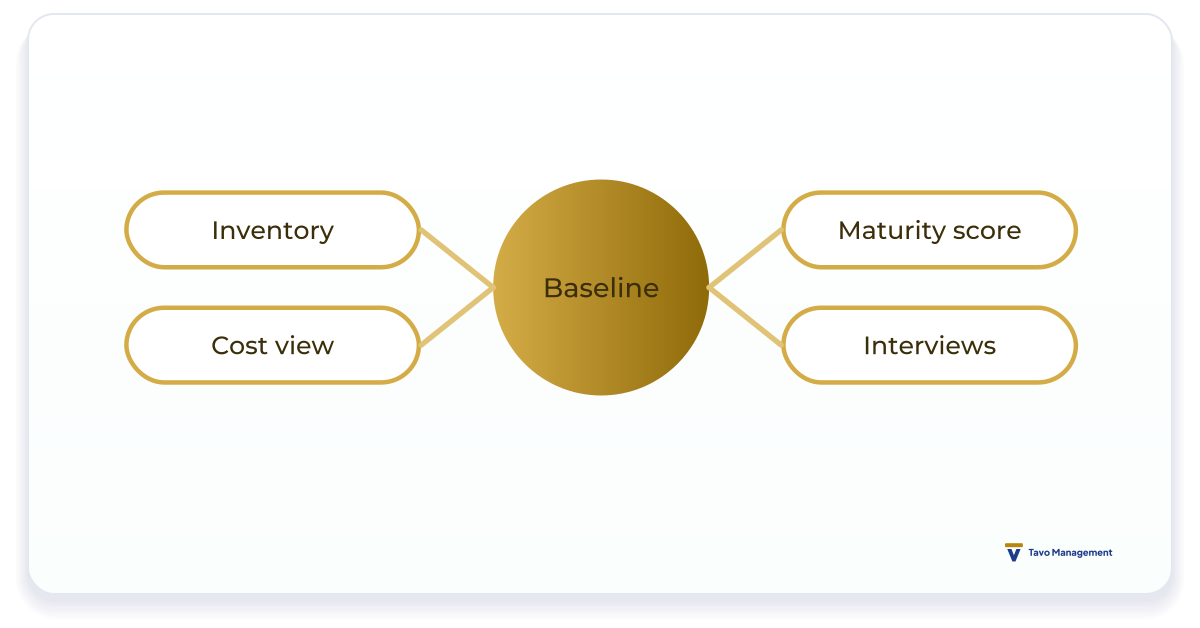
You cannot choose a direction without knowing your starting point. Collect four things: a list of systems and owners, your IT spend by category, the current service levels and a maturity score for the main building blocks. The scoring method is in my article on the IT management framework.
Add one more input that people skip: interviews. Ask five or six department heads what IT stops them from doing. The answers are often more useful than any dashboard, and they build support for the plan.
Phase 2: Tie IT to the Business Goals
Take the three to five goals leadership already has, such as opening a second site, cutting order errors or meeting a customer security requirement, and ask what each one needs from IT. Write them as outcomes. “Open site two with working systems on day one” beats “Upgrade the network.”
Put every proposed project against a goal. Anything that links to no goal is either maintenance, which belongs in the run budget, or a candidate to drop. This single step usually removes a third of the wish list.
Phase 3: Rank Initiatives With a Score
Now the hard part. Give each initiative a score from 1 to 5 for business value, risk reduction and urgency, and a score from 1 to 5 for effort, where 5 means very large.
Priority score = (value + risk reduction + urgency) / effort
Divide by effort so cheap, useful work rises to the top. A quick fix with value 3, risk 4 and urgency 3 and effort 1 scores 10. A big platform migration with value 5, risk 3, urgency 2 and effort 5 scores 2. The migration may still matter, and the score tells you to break it into smaller steps rather than start with it.
| Initiative | Value | Risk | Urgency | Effort | Score |
|---|---|---|---|---|---|
| Multi-factor authentication for all staff | 3 | 5 | 4 | 1 | 12.0 |
| Restore test and offsite backup | 3 | 5 | 3 | 2 | 5.5 |
| Single ticket queue | 4 | 2 | 3 | 2 | 4.5 |
| Replace aging laptops | 3 | 3 | 2 | 3 | 2.7 |
| ERP platform migration | 5 | 3 | 2 | 5 | 2.0 |
Scores are a conversation starter. Let the leadership group adjust them, but require a reason for every change. Disagreements about a score reveal different assumptions, and that is where the real discussion belongs.
Phase 4: Fund the Plan Honestly
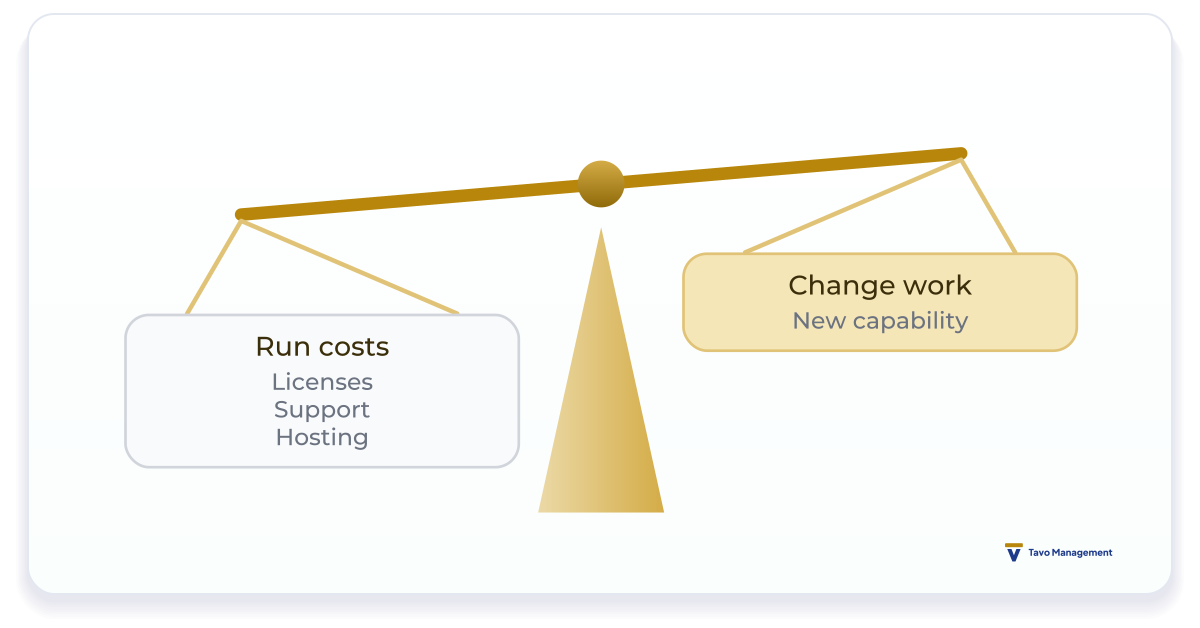
Split your IT spend into run and change. Run covers licenses, support, hosting and replacements that keep things going. Change covers new capability. Many teams find that run costs absorb nearly everything, and then wonder why nothing improves. If that is you, your first initiative is to reduce run costs, through license cleanup, contract renegotiation and retiring unused systems.
Hunt for savings in the places teams forget: unused software seats, duplicate tools and auto-renewed contracts. The IT management software ranking shows several tools that surface these, and many of them pay back in months. Keep a contingency for the unplanned, around ten percent in my experience, because something always breaks.
Phase 5: Turn Priorities Into a Roadmap
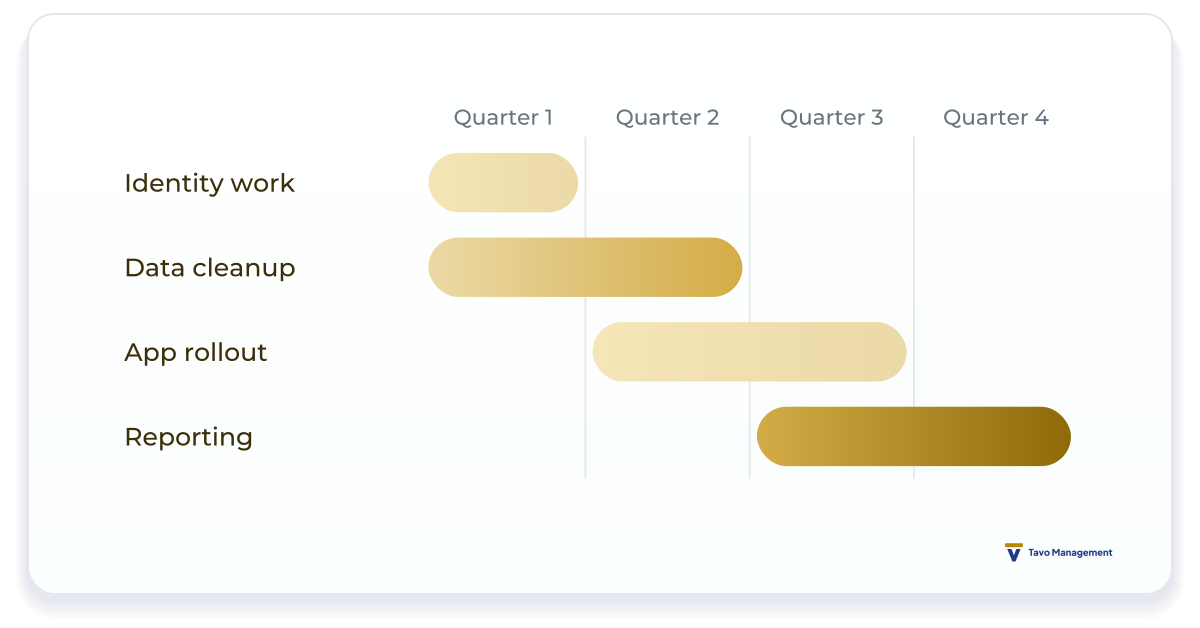
Place the ranked initiatives on a calendar by quarter, considering dependencies and capacity. Identity work comes before application rollouts. Data cleanup comes before reporting. Be strict about capacity: a team of four cannot run six projects and support tickets, however well they are scored.
Give each initiative an owner, a target date, a budget and one success measure. Publish the roadmap, and also publish the not-now list. Saying no in writing protects you from the same request arriving again next month.
Phase 6: Keep It Alive With a Rhythm
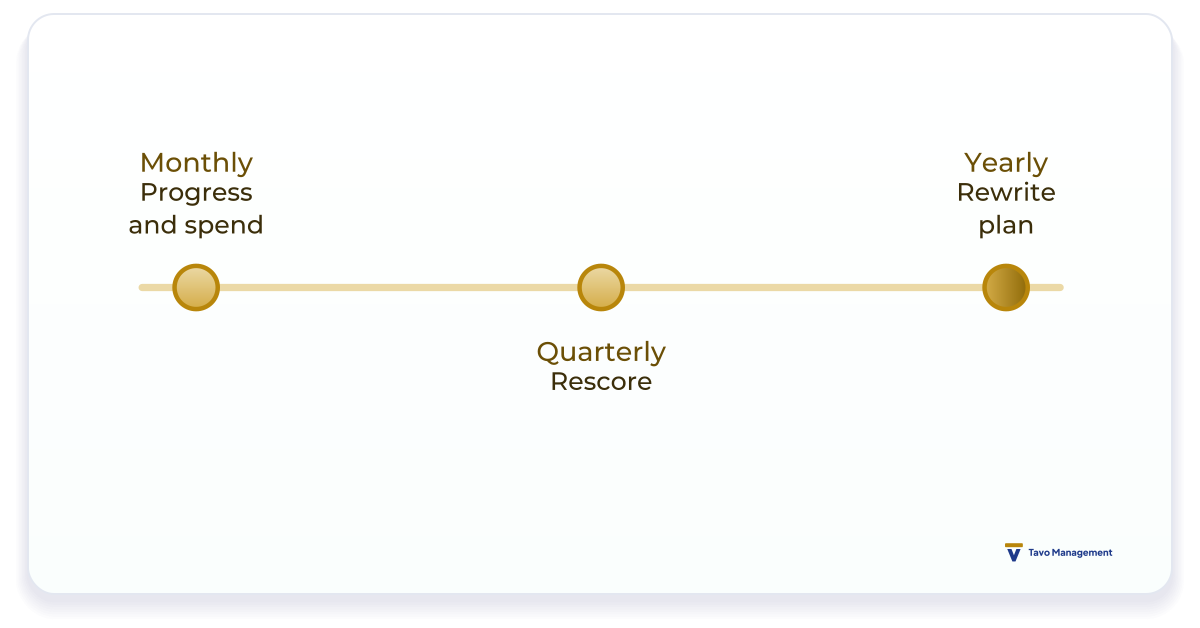
A monthly 30-minute check covers progress, spend and risks. A quarterly review revisits the scores, because the business changes. Once a year you rewrite the strategy. Between those, the best habits are the ones in my list of IT management best practices, which keep daily operations steady while projects move.
Track a small set of measures: roadmap items delivered on time, spend against budget, service level hit rate and a few business outcomes. Report them in plain language. When a measure goes red, say what you will do about it. The patterns that derail plans are described in my guide to IT management challenges.
What a Finished Strategy Looks Like
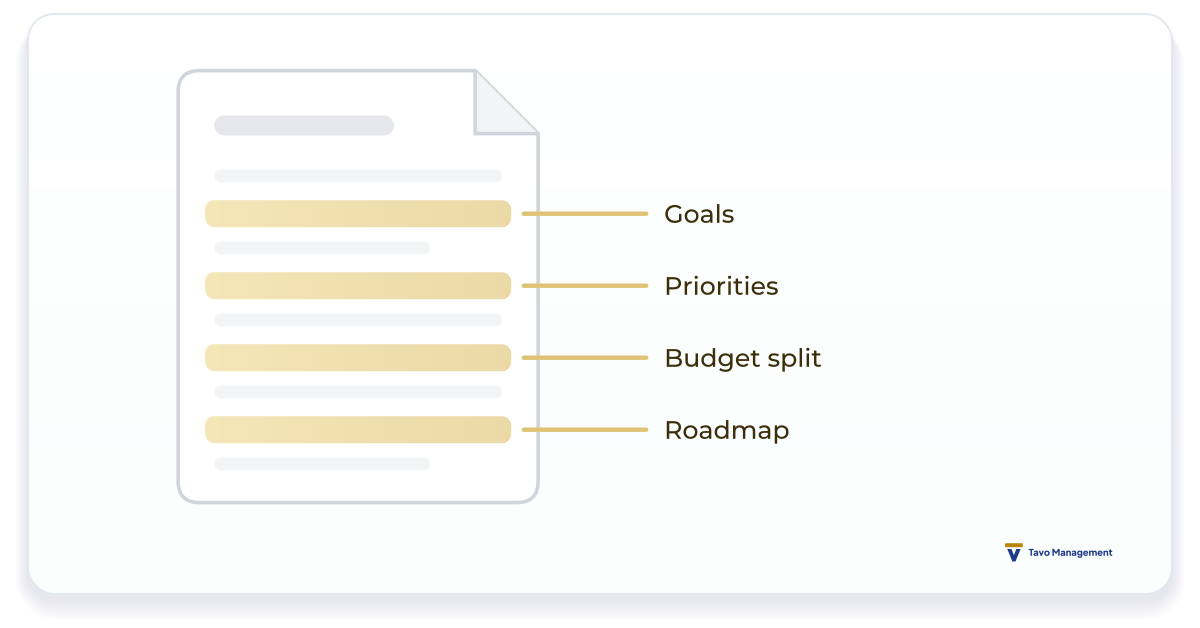
A good strategy document is short. I aim for five pages at most, and the first page alone should let a busy executive follow the plan. It holds the business goals, the three to five priorities, the total budget split between run and change and the key risks. The pages after that hold detail for the people who deliver.
| Section | What it says | Length |
|---|---|---|
| Business goals | The three to five outcomes IT must support | Half a page |
| Current state | Maturity score, spend, main risks | One page |
| Priorities | Ranked initiatives with scores and owners | One page |
| Budget | Run versus change, contingency | Half a page |
| Roadmap | Quarterly plan and the not-now list | One page |
| Measures | Four to six numbers and the review rhythm | Half a page |
The not-now list deserves a comment. Writing down what you will not do this year feels uncomfortable, and it is one of the most useful parts. When a department head asks for a new tool in March, you can point to the list and the reason it ranked lower, and the conversation becomes about trade-offs rather than about whether IT is cooperative.
Common Strategy Pitfalls
Strategies go wrong in predictable ways. The first is a wish list: thirty initiatives, none funded, all labeled high priority. A scoring method forces choices. The second is a plan written by IT alone, which optimizes for technology and surprises the business. Involve department heads in phases two and three, and ask them to sign off on the goals.
The third pitfall is ignoring capacity. A roadmap that fills every week of a four-person team leaves no room for support, sickness or the incident that always arrives in month two. Plan to about 70 percent of available time and keep the rest as buffer.
The fourth is treating the strategy as finished. Business goals shift, a key person leaves or a vendor changes its pricing. The quarterly review is your chance to adjust deliberately instead of drifting. Record each change and the reason, so next year’s plan benefits from it.
The fifth is a missing owner for the strategy itself. Someone has to run the monthly check, update the scores and chase the dates. In smaller companies that is the IT lead or the operations manager. Name the person in the document, and give them the time to do it.
What Usually Slips, and How to Cope
Even a good plan meets reality. Projects run late because an incident eats a week, a vendor delays a delivery or a key person falls ill. Build slack into every quarter, and decide in advance which initiatives move when something has to give. Writing that rule down prevents a debate during the crunch.
Dependencies cause the second kind of slip. A reporting project waits for data cleanup, which waits for an ownership decision that nobody has made. Look at your roadmap for chains like this early, and start the slowest link first, even if it scores lower on its own.
Finally, keep a short decision log. Each time you change a priority, write the date, the decision and the reason in one line. After a year, the log shows how the plan evolved and which assumptions turned out wrong, which makes the next strategy sharper and the next budget talk easier.
Adjusting the Playbook for a Small Company
If you are small, compress the six phases into a one-page plan: your goals, the top three risks, the top five initiatives with scores, the budget and the owners. Do it in a half-day workshop, and repeat every quarter. The starting actions are in my guide to IT management for small business.
Questions About IT Management Strategy
What Is an IT Management Strategy?
It is a short, written plan that connects what IT does to what the business needs over the next one to three years. It states your priorities, the projects you will fund, the ones you will say no to, who owns each and how you will measure progress. A good one fits on a few pages.
How Is an IT Strategy Different from an IT Roadmap?
The strategy explains why: goals, principles and priorities. The roadmap shows when: the sequence of projects over time. You need the strategy first, because a roadmap without priorities becomes a wish list.
How Long Should an IT Strategy Take to Write?
For a mid-sized company, four to eight weeks is realistic, including interviews with department heads and a baseline of your current setup. The writing is quick. Gathering honest input and agreeing priorities takes most of the time.
Who Should Be Involved in Creating It?
Leadership, department heads and the people who run IT. The business side decides what matters, and IT decides what is feasible and at what cost. A strategy written by IT alone tends to optimize technology, and one written without IT tends to promise the impossible.
How Often Should I Update My IT Strategy?
Review it every quarter and rewrite it once a year. A quarterly check takes an hour and keeps the plan honest. Major events such as an acquisition, a new product line or a serious incident justify an earlier update.
How Much of the IT Budget Should Go to New Projects?
It varies by company and stage. Many mid-sized teams find that most of the budget goes to running existing systems, with a smaller share left for change. Know your own split first. If almost nothing is left for improvement, your strategy has to begin with reducing run costs.
Do Small Businesses Need an IT Strategy?
Yes, but a small one. One page listing your goals, your three biggest IT risks, planned purchases and owners is enough. Without it, spending follows whatever broke last week.
General information only: this is not legal, financial or tax advice. Examples and numbers reflect typical projects; check the specifics with your advisers before deciding.
Did you find this helpful?
Thank you for your feedback.
Delaney Brisco
Delaney leads the Tavo editorial team and works with our consultants to turn real client projects into practical guides on project delivery, process design and organizational change. Before joining Tavo, she spent 12 years in operations and program management roles. She has since edited more than 300 articles on management practice and reviewed PMO setups and process redesigns from over 100 client projects. She is based in Minneapolis, Minnesota.