Summary
- Score six dimensions from 1 to 5: governance, portfolio, standards, reporting, capacity, and risk and learning.
- Your total places you in one of four stages, but the shape of the profile matters more than the sum.
- Back the score with evidence and five short interviews, then fix the two lowest dimensions first.
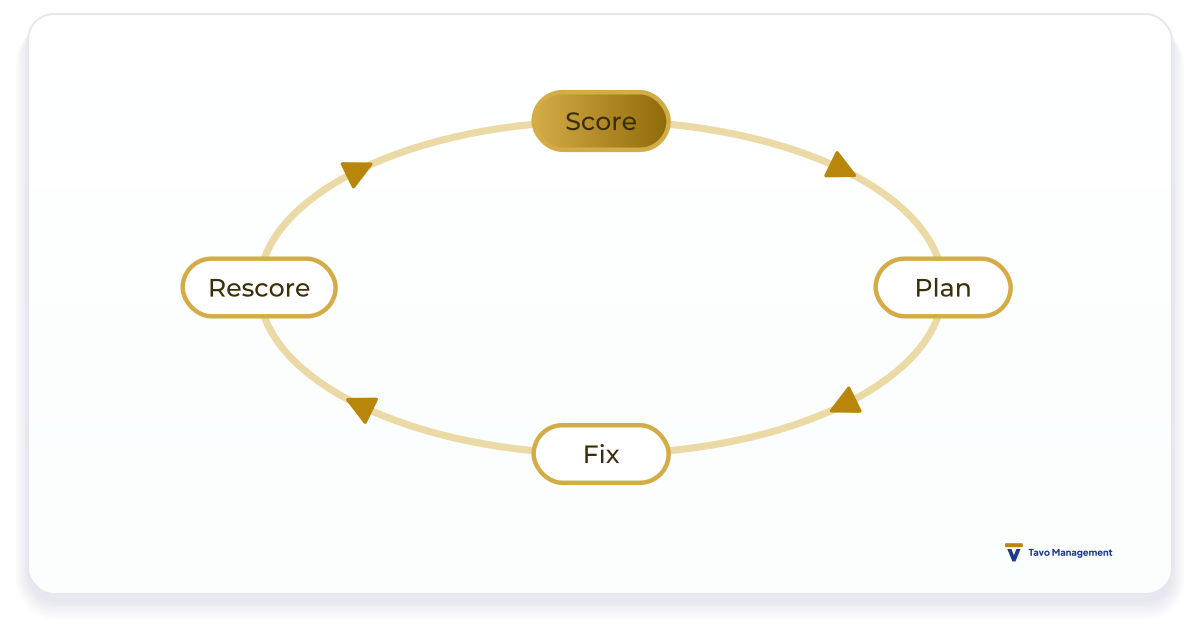
- Repeat the assessment every six to twelve months and track on-time delivery alongside it.
You cannot fix a PMO until you know where it stands. A PMO assessment gives you that picture in a few hours: a score for each dimension, a clear view of your strongest and weakest areas and a short list of what to fix first. It is the first step in any PMO consulting project I run, and you can do a first version yourself with this guide.
Score yourself on six dimensions from 1 to 5, add up the result and read the matching band. Be honest, and ask two colleagues to score separately, because the gap between your score and theirs is often the most useful part.
The Six Dimensions You Score
Each dimension has a question and three reference points. Score 1 if the left description sounds like you, 3 for the middle one and 5 for the right. Use 2 and 4 when you sit between.
| Dimension | Question to raise | Score 1 | Score 3 | Score 5 |
|---|---|---|---|---|
| 1. Governance and Sponsorship | Is there a signed charter, a named sponsor and written decision rights? | No charter, decisions made ad hoc | Charter exists but is not used | Charter, sponsor and decision rights in place and followed |
| 2. Portfolio and Prioritization | Can leaders see every project and the criteria for approving them? | No single list | List exists but is not ranked | Ranked list reviewed monthly with stopped projects |
| 3. Delivery Standards | Do projects use common templates and a shared status format? | Every manager uses own format | Templates exist, used by some | Short templates used by all teams, tiered by size |
| 4. Reporting and Data | How is status collected and how much time does it take? | Manual decks, hours per week | Shared sheet, partly manual | One dashboard fed from project tools |
| 5. Resources and Capacity | Do you know who is overloaded and which projects compete for them? | No view of capacity | Rough view for some roles | Capacity tracked for scarce roles and used in approval |
| 6. Risk and Learning | Are risks reviewed regularly and lessons reused? | Risks found late, no lessons log | Risk register, rarely reviewed | Weekly top-risk review, lessons change templates |
Add Up Your Score and Read the Result
Add your six scores for a total between 6 and 30. The bands below show what each range usually means and the move I would make first.
| Total score | Stage | What it usually means | First move |
|---|---|---|---|
| 6 to 12 | Ad hoc | Projects run on individual habits; leaders lack a shared view | Write a charter and build one portfolio list |
| 13 to 18 | Emerging | Some standards exist, but use is uneven | Cut templates to the essentials and define status colors |
| 19 to 24 | Established | Most teams follow shared rules; reporting is partly automated | Add capacity tracking and risk reviews |
| 25 to 30 | Optimized | The PMO supports strategy and learns from results | Measure value and prune what is unused |
Most organizations I work with land in the emerging band, and the shape of the profile matters more than the total. A 5 in reporting and a 1 in governance means you have a dashboard nobody acts on. The reverse, strong governance and weak reporting, means decisions get made on old data.
Collect Evidence So the Score Holds Up
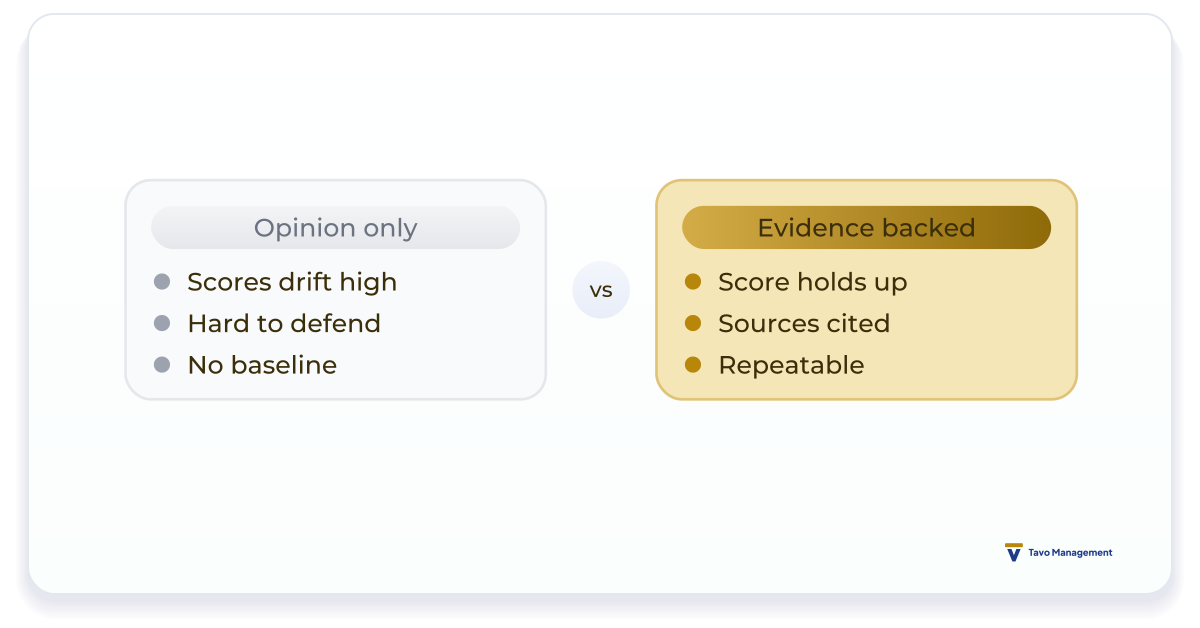
A self-score is only an opinion until you check it against evidence. For each dimension, pull one or two facts:
- Governance: the charter, the steering group's minutes and the last three decisions made.
- Portfolio: the current list, and the date of the last project you stopped.
- Standards: the templates in use and how many projects used them last quarter.
- Reporting: hours your project managers spent on status last month.
- Capacity: the number of people assigned to more than 100% of their time.
- Risk and learning: the last lessons log update and any changes it caused.
The 2026 Wellingtone State of Project Management 2026 reports that 72% of project professionals spend half a day or more each month compiling reports, and 44% are somewhat or very dissatisfied with their PMO's reporting. If your reporting hours are in that range, expect a low score in dimension four and a quick win from automation. The older PMI Pulse of the Profession, The Impact of PMOs on Strategy Implementation study (2013) found that only 33% of respondents said their PMO had fully realized its potential to contribute business value, which shows how common a gap is.
Add Voices With Five Short Interviews
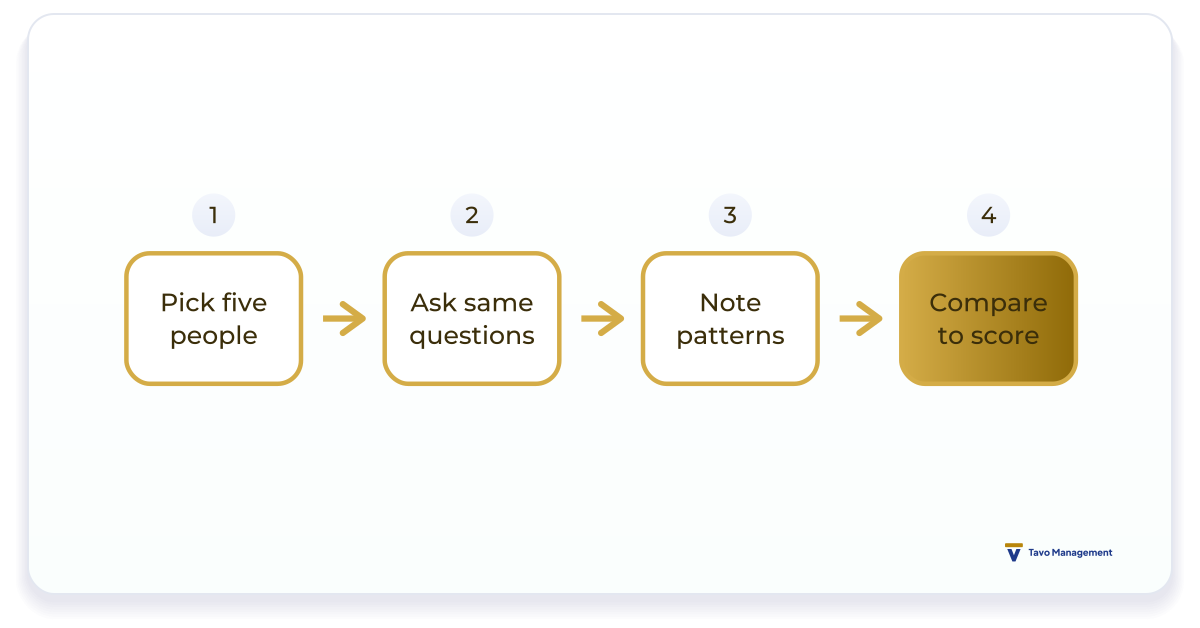
Numbers explain what is happening. Interviews explain why. Talk to the sponsor, two project managers, a department head and someone who receives PMO reports. Ask the same four questions of each: what does the PMO do well, what slows you down, which report do you read and what would you change first.
Look for patterns instead of single complaints. If three of five people say status reports are rebuilt by hand, that is a finding. If one person dislikes a template, it is a note. Quotes help when you present the results, as long as you do not attach names.
What a First Assessment Often Reveals
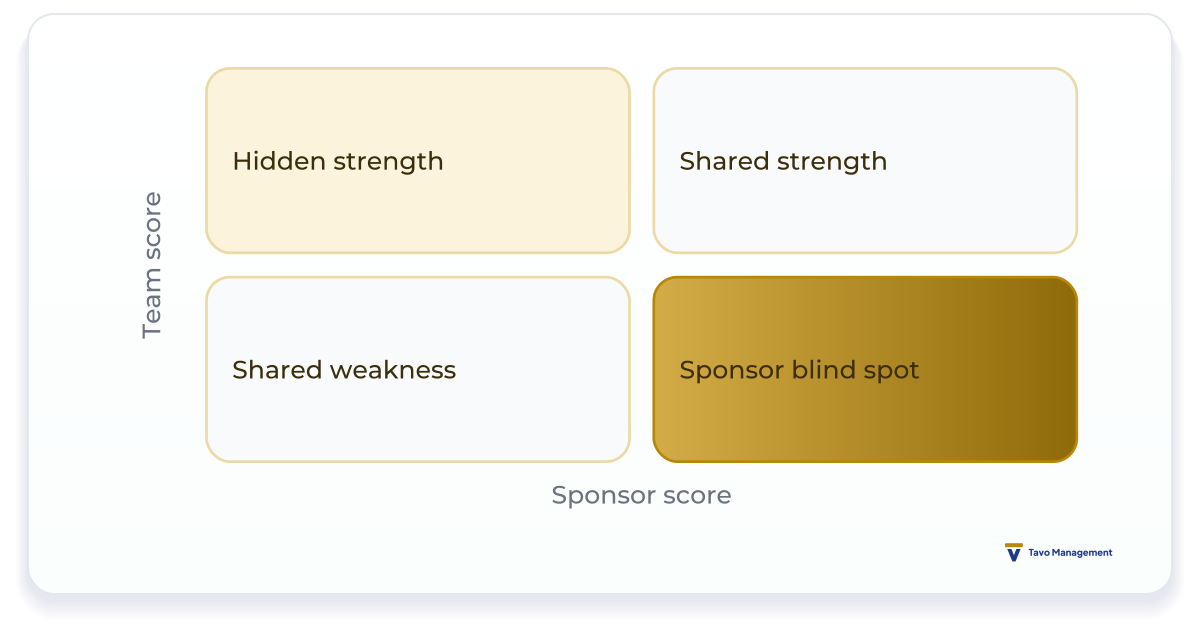
Across the operational assessments in my client work, the first scorecard rarely shows what leaders expect. Sponsors usually rate governance higher than project managers do, because the sponsor remembers the charter and the project managers remember the last decision that took six weeks. Reporting is where scores are lowest and where fixes are quickest, since a first dashboard can be live within weeks.
The second pattern is uneven adoption. One department follows the templates closely, while another has never seen them. That spread tells you where to pilot a change and where to ask for help from a well-run team. Treat the best team as a resource: ask them what they would keep if the PMO disappeared tomorrow, and what they would remove.
The third pattern is the missing baseline. Many organizations cannot say how many projects finished on time last year, because nobody recorded the original date. If that sounds familiar, make it your first quick win: from today, store the first approved end date and budget of every project, and report against them. In a few months you will have a real on-time rate to track.
Running the Assessment Workshop in Half a Day
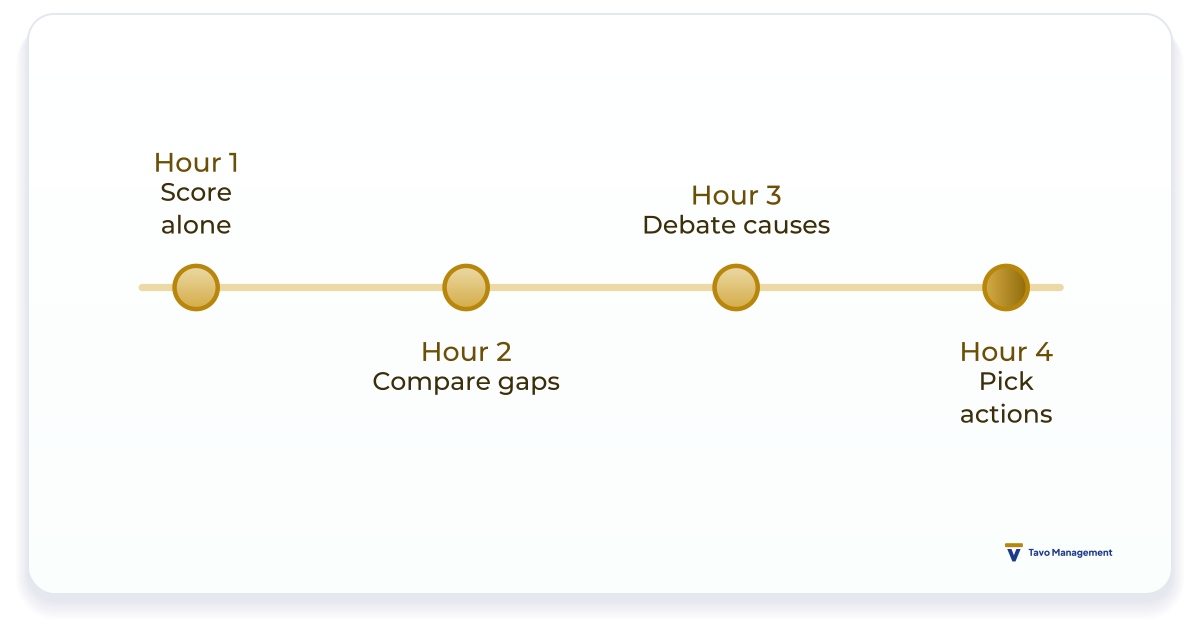
If you want more than a solo score, hold a half-day workshop with six to eight people. Spend the first hour explaining the six dimensions and the 1 to 5 scale. Then have everyone score on their own, without talking, and put the numbers on a shared sheet. Seeing the spread in one view starts the conversation faster than any presentation.
Discuss only the dimensions where scores differ by two points or more. Ask the highest scorer and the lowest scorer to describe a recent project that supports their number. In my experience, these stories reveal the real process, including workarounds that never appear in a handbook. Close the session by agreeing the two lowest dimensions and one quick win, and write down an owner and a date for each before anyone leaves the room.
Send a one-page summary within two days: the scores, the main patterns and the three actions. Speed matters, because momentum fades quickly after a workshop. Schedule the follow-up review in the same message, so the plan has a date from the start.
Keep the scorecard itself on one page, and store each version with its date. When you repeat the assessment next year, the earlier sheet shows which fixes worked and which did not move the score. It also protects you from the common habit of forgetting how bad things were, which makes real progress feel smaller than it is.
Turn the Score Into a Short Action Plan
Pick the two lowest dimensions and one quick win. A quick win is something visible within a month, such as a first ranked portfolio list or an automated weekly report. Write each action with an owner, a date and a measure, and review them monthly. The structure behind these fixes is described in my PMO framework article, and the order of work is in the PMO implementation guide.
| Lowest dimension | Typical fix | Time to first result |
|---|---|---|
| Governance | Charter and decision-rights table | 2 to 3 weeks |
| Portfolio | One ranked list with three criteria | 3 to 4 weeks |
| Standards | Shorter templates, tiered by size | 4 to 6 weeks |
| Reporting | Single dashboard from existing tools | 4 to 8 weeks |
| Capacity | Allocation view for scarce roles | 3 to 6 weeks |
| Risk and learning | Weekly top-ten risk review | 2 weeks |
Repeat the assessment every six to twelve months. A rising score is good, though the more important number is your on-time delivery rate, because a high score that does not change delivery means you are measuring the wrong things. The habits that keep scores rising are in my list of PMO best practices, and if tools are your weak spot, compare options in my guide to PMO software.
How to Choose Between a Self-Score and an External Assessment
A self-score is fast and free, and it is enough when your PMO is young and your team is open. An external assessment adds independence. People tell an outsider things they will not say to their boss, and the comparison with other organizations shows whether your gaps are normal. Choose external help if politics make honest scoring hard, if a sponsor needs a neutral report or if a previous PMO attempt failed.
Questions About PMO Assessments
What Is a PMO Assessment?
It is a structured review of how your PMO and your project delivery work today. It scores areas such as governance, portfolio management, standards, reporting, capacity and learning, and ends with a short list of priorities.
How Long Does a PMO Assessment Take?
A self-score takes a few hours, plus a few days to gather evidence and run five interviews. An external assessment of a mid-sized organization usually takes two to four weeks, depending on the number of teams.
Who Should Take Part in the Assessment?
The sponsor, the PMO lead, several project managers, a department head and someone who receives PMO reports. Include people who are skeptical of the PMO, because their view shows what to fix.
What Is a Good PMO Assessment Score?
On the scale in this guide, 19 to 24 is established and 25 to 30 is optimized. A high total matters less than a balanced profile, so look at the lowest dimension before you celebrate.
How Often Should I Reassess My PMO?
Every six to twelve months. Reassess sooner after a major change, such as a merger, a new tool or a change of sponsor. Use the same questions each time, so scores are comparable.
Can I Assess My Own PMO Objectively?
Partly. Use evidence, ask colleagues to score separately and compare results. If the PMO lead is the only scorer, the result tends to be optimistic, so an independent view helps when stakes are high.
What Do I Do If My Score Is Low?
Do not try to fix everything. Pick the two lowest dimensions and one quick win, assign owners and dates, and review monthly. A low score is a starting point, and many organizations begin in the ad hoc or emerging stage.
General information only: this is not legal, financial or tax advice. Examples and numbers reflect typical projects; check the specifics with your advisers before deciding.
Did you find this helpful?
Thank you for your feedback.
Delaney Brisco
Delaney leads the Tavo editorial team and works with our consultants to turn real client projects into practical guides on project delivery, process design and organizational change. Before joining Tavo, she spent 12 years in operations and program management roles. She has since edited more than 300 articles on management practice and reviewed PMO setups and process redesigns from over 100 client projects. She is based in Minneapolis, Minnesota.