Summary
- A one-page charter and a ranked portfolio are the two practices to settle first.
- Cut status reports to a few fields with defined colors, and let the dashboard compile them.
- Match governance to project size, and track capacity for your scarcest roles.
- Pick tools after the process, and review the PMO against a baseline every quarter.
A PMO earns its place when leaders can see the portfolio, teams can follow a few clear rules and projects stop surprising people. Plenty of PMOs miss that, usually because they pile up process before they have earned trust. If you are planning or repairing one, these eight practices come from the work I see repeating across organizations. The PMO consulting projects behind them range from small teams to large multi-department portfolios.
Each practice has a short "do this" and "avoid this", so you can test your own PMO against it in a few minutes. The first four set the foundation, and the last four keep the PMO useful as it grows.
The Eight Practices in One Table
| Practice | What it fixes | First step |
|---|---|---|
| 1. Charter | Unclear purpose and authority | Write one page and get the sponsor's signature |
| 2. Ranked portfolio | Too many projects, no priorities | List every project and score it on three criteria |
| 3. Lean status | Reports nobody trusts | Cut status to five fields with defined colors |
| 4. Tiered governance | Bureaucracy on small projects | Define three tiers with thresholds |
| 5. Capacity limits | Overloaded key people | Track time for the five scarcest roles |
| 6. Risk and decision reviews | Late surprises | Hold a weekly 30-minute review of the top ten risks |
| 7. Process before tools | Software that fits nobody | Write five must-haves before any demo |
| 8. Quarterly measures | A PMO that cannot show value | Record a baseline now |
1. Write a One-Page Charter Before Anything Else
Every PMO I have helped start that stalled had the same early gap: nobody could say in two sentences what the PMO was for. A charter fixes that. It states why the PMO exists, what it owns, what it does not own, who it reports to and how success will be judged after twelve months.
Keeping it to one page forces real choices. If the sponsor wants the PMO to both police compliance and coach teams, the charter is where you find that conflict, long before a project manager feels it. Pair the charter with the type of PMO you chose, which I describe in my PMO framework guide, and have the sponsor sign it.
Do this: Name the sponsor, three responsibilities, three exclusions and two measures of success. Review the charter again after six months.
Avoid this: Write a long mission statement full of words like alignment and excellence that nobody can test.
2. Build One Portfolio List and Rank Everything on It
The first useful thing a PMO produces is a single list of every active project and every request in the queue. Most organizations are surprised by it. In my client work, the first complete list often shows far more running initiatives than leaders believed, and the same few people named on many of them.
Once the list exists, score each item for value, cost, risk and required people. The scoring model can be simple, three criteria with a 1 to 5 scale is enough. What matters is that the same questions are asked of every request, so approval stops depending on who is loudest in the meeting.
Do this: Review the ranked list monthly and stop at least one low-ranked project each quarter to free capacity.
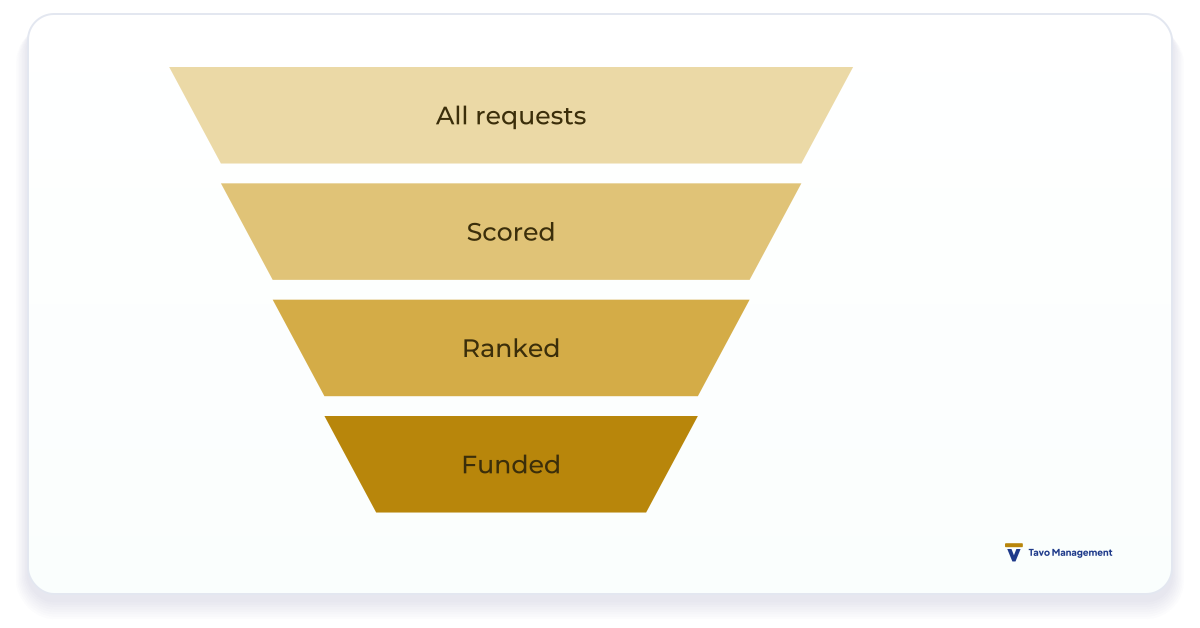
Avoid this: Add every request to the list without ever removing anything. A list that only grows is a backlog, not a portfolio.
3. Use Fewer Status Fields and Make Each One Mean Something
Status reports fail when they ask for too much. A form with twenty fields gets filled in with copy and paste. Five fields that feed a decision get answered honestly: schedule, budget, scope, top risk and the help you need from leadership.
Define what red, amber and green mean in writing, with numbers. For example, amber means the forecast end date has moved by more than two weeks or spend is more than 10% over plan. The Wellingtone State of Project Management 2026 reports that 72% of project professionals spend half a day or more each month compiling reports, and 44% are somewhat or very dissatisfied with their PMO's reporting. Both numbers point at the same fix: less reporting, and better.
Do this: Collect status weekly in the tool, from the people who do the work, and have the dashboard compile it.
Avoid this: Ask project managers to rebuild the same numbers in a slide deck every month.
4. Match Governance to Project Size
A single approval path for every project is the fastest way to make teams hate the PMO. A small internal change should not face the same gates as a multi-million program. Most PMOs I set up end up with three tiers, sometimes called small, standard and strategic, each with its own required documents and reviewers.
Small projects get a one-page brief and a manager's approval. Standard projects add a business case and a steering check at the midpoint. Strategic projects get full stage gates and executive sponsors. Write down the thresholds, such as budget, duration or number of departments affected, so nobody has to argue about the tier.
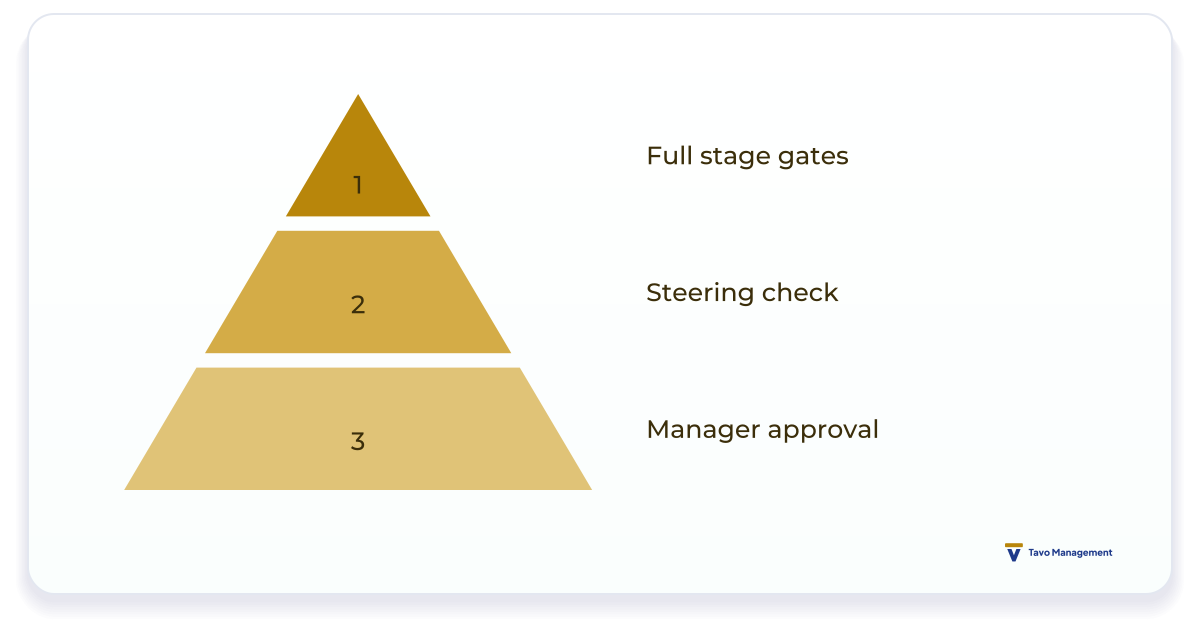
Do this: Publish the tiers and the thresholds on one page, and let project managers move a project up a tier if risk justifies it.
Avoid this: Apply full stage gates to every initiative because one expensive failure scared the leadership team.
5. Treat Resource Capacity as a Hard Limit
Projects rarely fail because the plan was bad. They fail because the same six people were assigned to nine projects. A PMO that only tracks tasks and dates misses the real constraint.
Start with the scarce roles, perhaps data engineers, clinical leads or plant engineers, and track their time against projects at a rough level. You do not need timesheets for everyone. A monthly allocation by percentage is enough to see overloads. When the numbers exceed 100%, a project has to wait, and the PMO's job is to make that trade-off visible to the people who can decide it.
Do this: Show capacity next to the ranked portfolio, so approving a project means choosing what to delay.
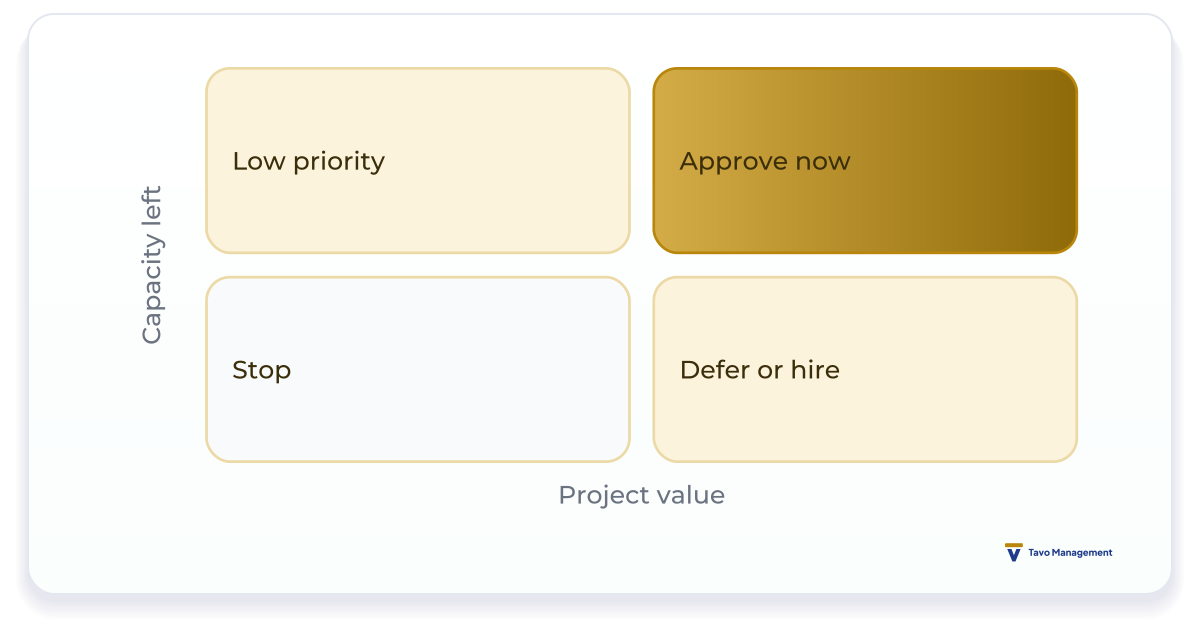
Avoid this: Approve new projects without checking who will do the work.
6. Run Weekly Risk and Decision Reviews, Not Just Status Meetings
A status meeting repeats what the report already says. A risk and decision review asks what could go wrong next and what needs a decision this week. It is shorter, more useful and harder to hide in.
Keep a shared risk register with an owner, a date and a next step for each risk. Review only the top ten across the portfolio, and send the rest to project managers. Record decisions in the same place, with who made them and when. A decision log saves a lot of time six months later when someone asks why a scope change was approved.
Do this: Limit the meeting to 30 minutes, and require a named owner for every action.
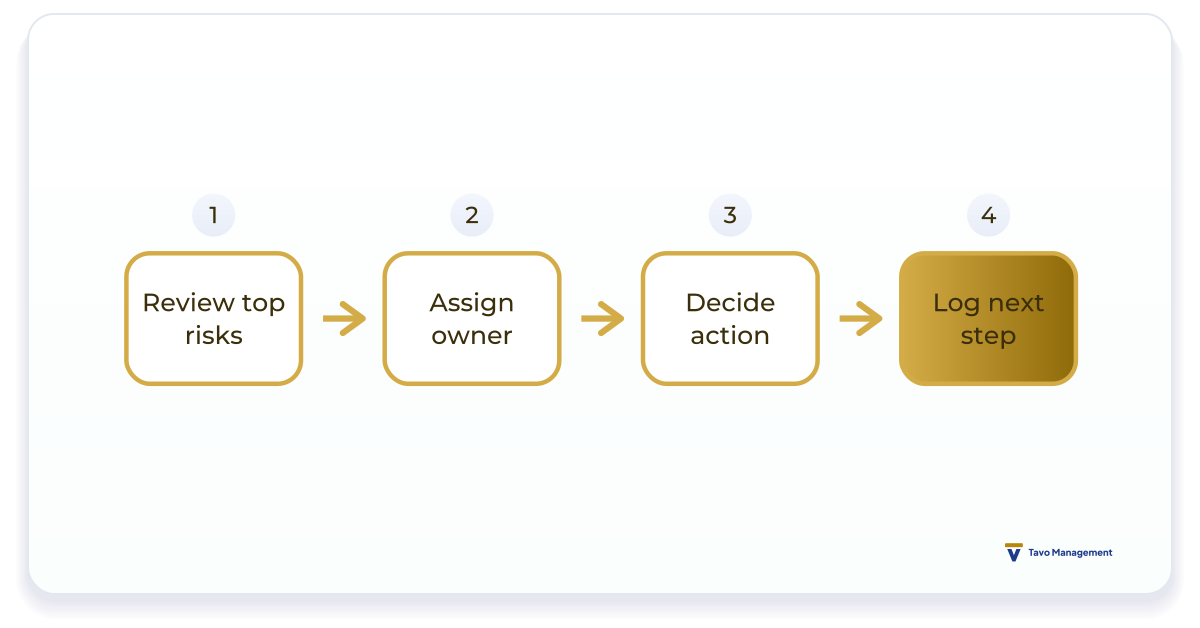
Avoid this: Let the meeting turn into a long status round-table where every manager reads out their slides.
7. Pick Tools After Process, and Start With What You Own
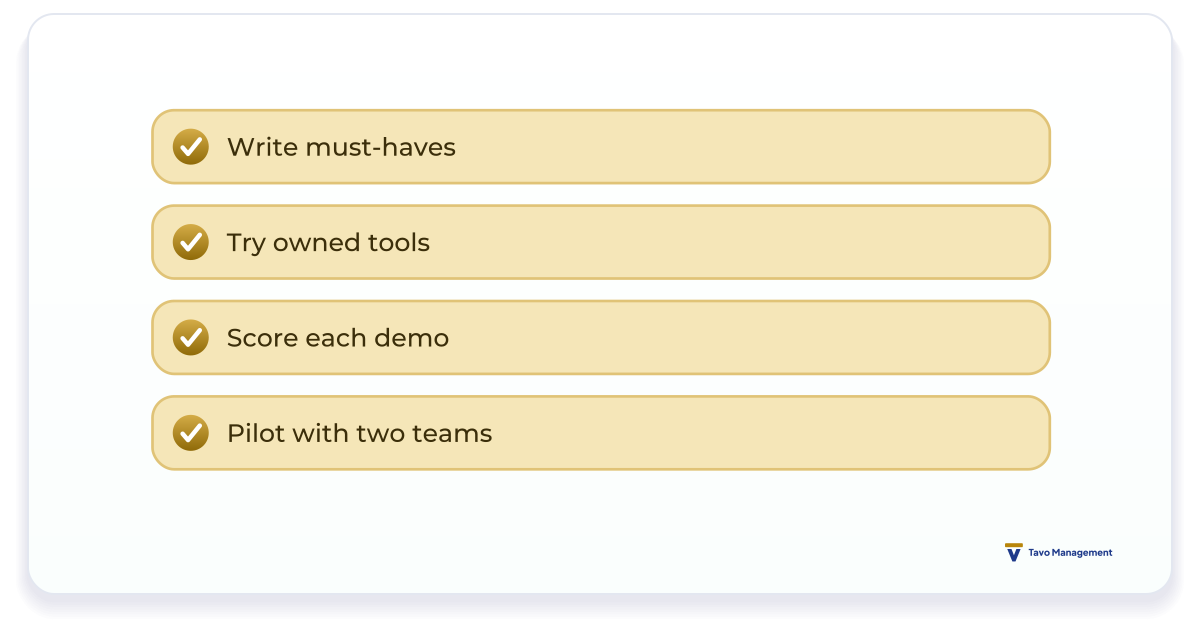
Buying PMO software before you have settled your intake rules and reporting standards is the most expensive mistake I see. The tool then forces a process nobody designed. Settle the process on paper first, then choose the tool that supports it.
Many PMOs run well on a platform the organization already pays for. If you do need something new, compare options on your real requirements, as I do in my ranking of PMO software. Pilot with two or three projects, and keep the templates identical across teams from day one so the dashboard stays comparable.
Do this: Write five must-have requirements before you see a demo, and score every vendor against them.
Avoid this: Choose the tool with the longest feature list and then ask teams to adapt.
8. Measure the PMO and Review It Every Quarter
A PMO that cannot show its value is the first thing to be cut in a budget round. Pick a few measures at the start and collect a baseline before you change anything.
Good starting measures are the share of projects delivered on time and on budget, the time spent on reporting, the number of active projects per project manager and sponsor satisfaction. The PMI Pulse of the Profession, The Impact of PMOs on Strategy Implementation (2013) found that high-performing PMOs, those where 80% or more of projects meet schedule, budget and goals, were more likely to evaluate delivery against the original schedule (86% versus 68%) and the original budget (74% versus 58%). It is an older study, but the habit of tracking against the original plan still separates strong PMOs from weak ones. A regular PMO assessment gives you a broader score once a year.
Do this: Review the measures with the sponsor every quarter and drop any that nobody uses.
Avoid this: Report vanity numbers, such as the count of templates produced or meetings held.
What Better Reporting Is Worth to You
Most of the early savings from a PMO come from the hours spent compiling status. Move the sliders to match your team, and use the result as a rough guide for a tool decision rather than a promise.
Will It Pay for Itself?
Adjust the sliders to your workload and the plan you are looking at.
Where to Start When You Cannot Do Everything
You do not need all eight at once. The sequence below is the one I use when a PMO is new or stuck. It works because each step creates the information the next step needs, and each is small enough to show a result within a quarter.
| Order | Practice | Effort | Typical visible result |
|---|---|---|---|
| First | Charter and ranked portfolio | Low | Leaders see one list and agree on priorities |
| Second | Lean status and tiered governance | Medium | Reporting time falls, small projects move faster |
| Third | Capacity limits and risk reviews | Medium | Overloads and risks show up earlier |
| Fourth | Tools and quarterly measures | Higher | One dashboard and a record of progress |
If you want the sequencing laid out with owners and dates, my PMO implementation guide walks through it in phases. For the structure that holds these practices together, read the PMO framework article, and compare your current state with the scoring in the PMO assessment post.
How to Choose Which Practice to Fix First
Look at your biggest pain and match it to one practice. If leaders disagree about priorities, start with the ranked portfolio. If project managers complain about paperwork, cut status fields and introduce tiers. If projects keep slipping for the same reasons, start with capacity and risk reviews. Ask three people from different levels to name the main problem, because the PMO's own view is often different from the project managers'.
- Can a leader name your top five projects without opening a spreadsheet?
- Do project managers spend less than an hour a week on reporting?
- Do you know which three people are overloaded right now?
- Can you show last quarter's on-time rate?
If you answered no to two or more, begin there. If you would rather have someone outside look at the whole picture, an outside review can save months of trial and error.
Questions About PMO Best Practices
What Is the Most Important PMO Best Practice?
A clear charter with a named sponsor. Without it, every other practice depends on personal goodwill. The charter tells people what the PMO owns and what it does not, which prevents most early conflicts.
How Many Projects Should One PMO Manage?
There is no fixed number. It depends on the size of the projects and the PMO type. A supportive PMO can serve dozens of small projects, while a PMO that runs projects directly will handle far fewer. Start by counting what is active today.
How Often Should a PMO Report to Leadership?
Weekly or biweekly for the dashboard, monthly for the portfolio review and quarterly for PMO performance. Keep each report short. Leaders who get a one-page view tend to read it, while long decks go unread.
Should a PMO Be Agile or Traditional?
It should support both. The PMO sets common standards for risks, decisions and reporting, and teams choose the delivery method that suits their work. Forcing one method across all projects is a frequent reason PMOs lose support.
How Do I Show the Value of a PMO?
Record a baseline before you start, then track on-time and on-budget delivery, reporting hours, and sponsor satisfaction every quarter. Share the results with the sponsor in plain numbers, including the areas that have not improved yet.
What Is the Biggest Mistake New PMOs Make?
Adding process before earning trust. New PMOs often roll out templates, gates and reports all at once. Teams respond by complying on paper and working around the PMO. Start with one useful output, usually the portfolio view, and add structure gradually.
Do Small Companies Need a PMO?
They need the practices, but often not a separate team. One person can run intake, a ranked list and a weekly review part-time. When the number of projects or the cost of failures grows, you can formalize it.
General information only: this is not legal, financial or tax advice. Examples and numbers reflect typical projects; check the specifics with your advisers before deciding.
Did you find this helpful?
Thank you for your feedback.
Delaney Brisco
Delaney leads the Tavo editorial team and works with our consultants to turn real client projects into practical guides on project delivery, process design and organizational change. Before joining Tavo, she spent 12 years in operations and program management roles. She has since edited more than 300 articles on management practice and reviewed PMO setups and process redesigns from over 100 client projects. She is based in Minneapolis, Minnesota.