Summary
- A PMO framework has five layers: governance, portfolio, delivery standards, capacity and tools, and learning.
- Pick the lightest PMO type that solves your biggest problem: supportive, controlling or directive.
- Keep governance, templates and gates short, and tier them by project size.
- Choose tools after the other layers are settled, and test the framework on two or three projects first.
A PMO framework is the structure that decides what your PMO owns, how it makes decisions and how it connects to the projects around it. Most frameworks fail for a simple reason: they copy a model from a book without asking how much control the organization will accept. If you are building one, start with the PMO consulting view that structure should follow your problems, not the other way around.
Below I describe the five layers I use, the three common PMO types and a way to size the framework to your organization. The model is deliberately plain, so you can draw it on one page and explain it in five minutes.
The Five Layers at a Glance
| Layer | What it tells you | Typical outputs | Owner |
|---|---|---|---|
| 1. Governance | Who decides what, and when? | Charter, decision rights, stage gates | Sponsor and steering group |
| 2. Portfolio | Which projects should we run? | Ranked list, intake form, scoring model | PMO lead |
| 3. Delivery standards | How do projects run and report? | Templates, status format, risk register | PMO and project managers |
| 4. Capacity and tools | Do we have the people and systems? | Resource view, dashboard, tool setup | PMO and department heads |
| 5. Learning | What do we do better next time? | Lessons log, quarterly review, coaching | PMO lead |
Choosing the Type of PMO Your Framework Supports
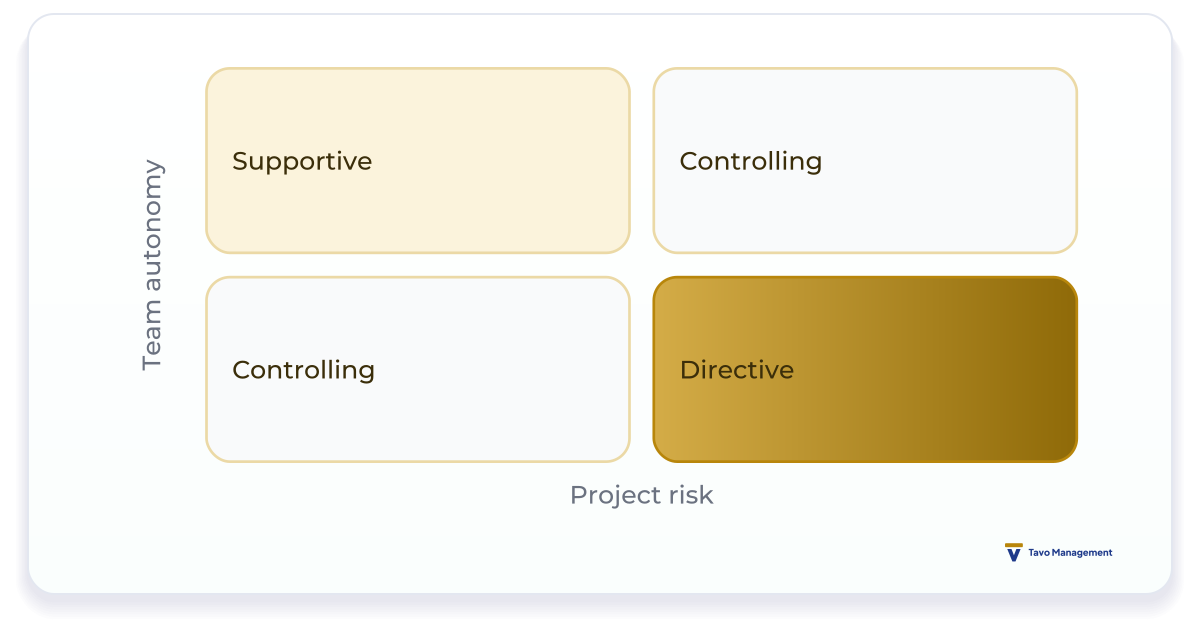
The PMBOK Guide describes three PMO types that differ in how much control they take: supportive, controlling and directive. The type decides which layers carry the most weight, so settle it before you design anything else. In my experience, the right choice depends less on size than on trust. A culture of autonomous teams will reject a directive PMO, however well designed.
| Type | Control level | What it does | Fits when |
|---|---|---|---|
| Supportive | Low | Offers templates, coaching and lessons learned | Teams are experienced and autonomous |
| Controlling | Medium | Sets standards and checks compliance | You need consistency across many teams |
| Directive | High | Runs projects directly with PMO-employed managers | Projects are few, large or highly regulated |
Many PMOs start supportive and become controlling as the portfolio grows. The PMO assessment score tells you which type your current state can carry. A low score in governance and delivery usually means you need more control, while a high score means light support is enough.
Layer 1: Governance That Fits on One Page
Governance is the layer people overbuild. It needs a sponsor, a steering group, written decision rights and a small set of stage gates. A decision-rights table that shows who approves, who is consulted and who is informed for ten typical decisions is often the most valuable single document a PMO produces.
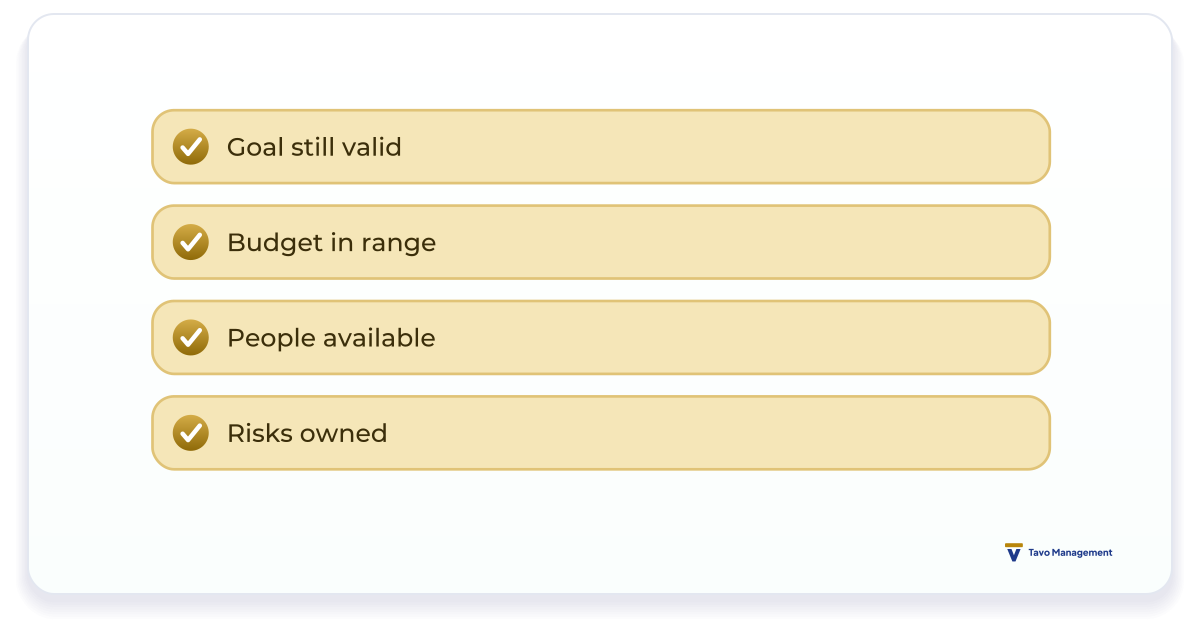
Keep gates short. Each one should ask three or four questions: is the business case still valid, is the plan realistic, are the risks understood and is the team available. If a gate takes more than an hour to pass for a standard project, it is too heavy.
Layer 2: A Portfolio View Leaders Open Every Week
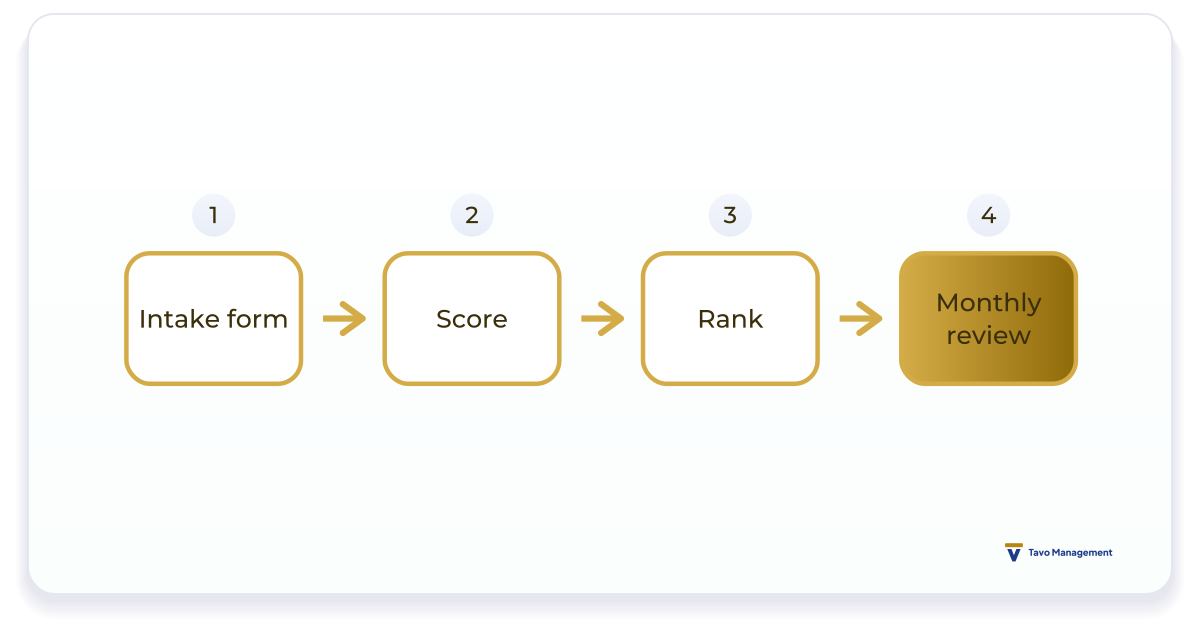
Intake, scoring and a single ranked list belong here. Score on value, cost, risk and people required, using a simple scale. The point of scoring is a fair conversation, not a precise answer. When two projects tie, leaders decide, and the PMO records the reason.
Link the portfolio to the strategy. The PMI Pulse of the Profession, The Impact of PMOs on Strategy Implementation (2013) found that PMOs frequently involved in aligning projects to strategic objectives were nearly twice as likely to be high performers (21% versus 12%). The study is older, but the logic holds today: the closer the PMO sits to strategy, the more its work counts.
Layer 3: Delivery Standards Without the Bureaucracy
Standards cover how projects are planned, tracked and closed. Limit them to a project brief, a plan, a risk register, a status report and a closing review. Each template should fit on one or two pages. Provide different versions for small, standard and strategic projects.
Allow different delivery methods. Agile teams can report progress through sprint results, while waterfall teams report milestones, as long as both feed the same five status fields. The best practices I recommend for status and reporting are in my guide to PMO best practices.
Layer 4: Capacity and Tools
The tool layer comes last on purpose. Once layers one to three are settled, you know what the software has to do. Track capacity for the scarce roles, and connect the project tools you already use into one dashboard. If you need a new platform, my ranking of PMO software compares eleven options with real prices.
Layer 5: Learning That Actually Changes Behavior
Lessons learned reviews often produce a document nobody reads. Make them useful by asking each project to record two things: what we would do differently and what we should keep. Review the log every quarter, and turn repeated lessons into a change in a template or a rule. Coaching new project managers on the most common mistakes closes the loop.
Track a small set of PMO measures here too: on-time delivery, budget accuracy, reporting hours and stakeholder satisfaction. The 2026 Wellingtone State of Project Management 2026 found that only 36% of organizations complete projects on time mostly or always, which is a useful reference point when you set your own targets.
Sizing the Framework to Your Organization
The same five layers look different in a company of 150 people and in a hospital group. Use the table below as a rough guide, and adjust it after your assessment.
| Organization | Active projects | Suggested PMO | Priority layers |
|---|---|---|---|
| Small, one site | Under 15 | Part-time lead, supportive type | Portfolio, standards |
| Mid-sized, several teams | 15 to 60 | One to three people, controlling type | Governance, portfolio, capacity |
| Large, multi-department | 60 or more | Central PMO plus local PMOs | All five, with tiered governance |
| Regulated or capital-heavy | Few but large | Directive or controlling type | Governance, risk, learning |
Whatever the size, I suggest you keep the number of roles small at first. A PMO lead, a part-time analyst who builds the dashboard and a sponsor is enough for most mid-sized portfolios. Add roles only when a task has clearly outgrown the existing people, and write down what the new role will stop being done by someone else.
Where PMO Frameworks Go Wrong
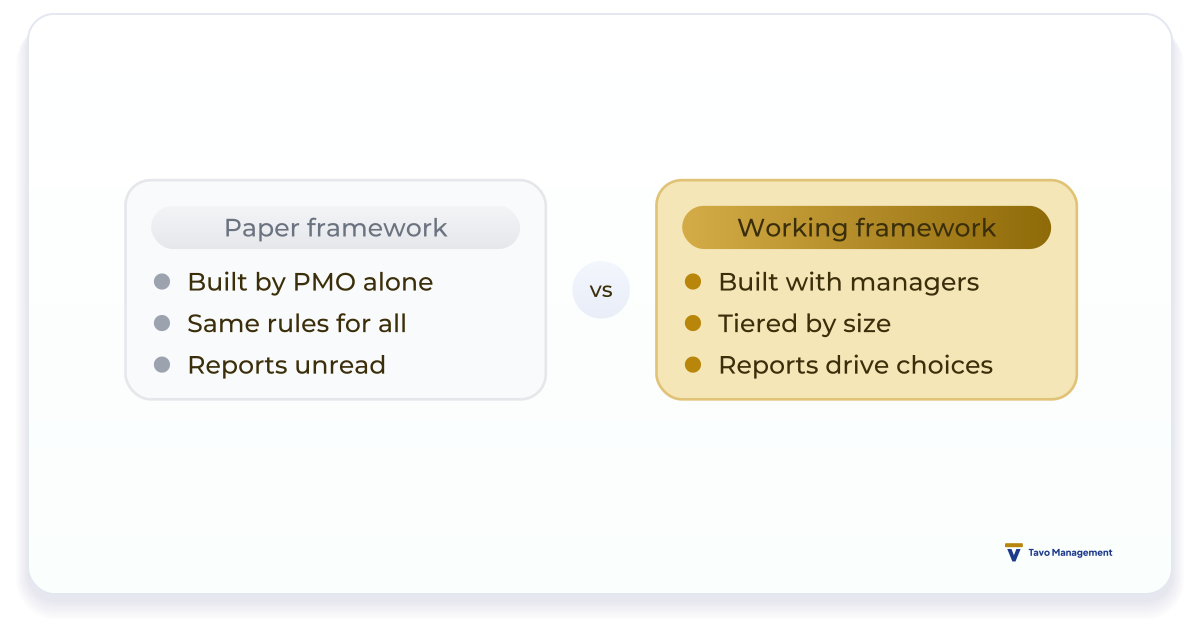
Frameworks rarely fail on paper. They fail in the third month, when the first deadline pressure hits and teams quietly stop using the templates. In my client work, the same four patterns explain most of these failures, and each one is visible early if you look for it.
The first is a framework that ignores the real decision makers. If the people who approve budgets are not in the steering group, the PMO produces reports for an audience that cannot act on them. The second is control without value: teams must fill in forms but get nothing back, such as faster approvals or help with resources. The third is copying a large company's model into a small one, which creates roles and gates nobody has time for. The fourth is a framework with no owner after launch, so templates drift and the dashboard fills with stale data.
A simple test catches most of them. Ask each project manager what the PMO does for them this month. If the answer is a list of requirements, the framework controls without helping. If you hear about faster decisions, fewer status meetings or help finding people, it is working.
How the Five Layers Depend on Each Other
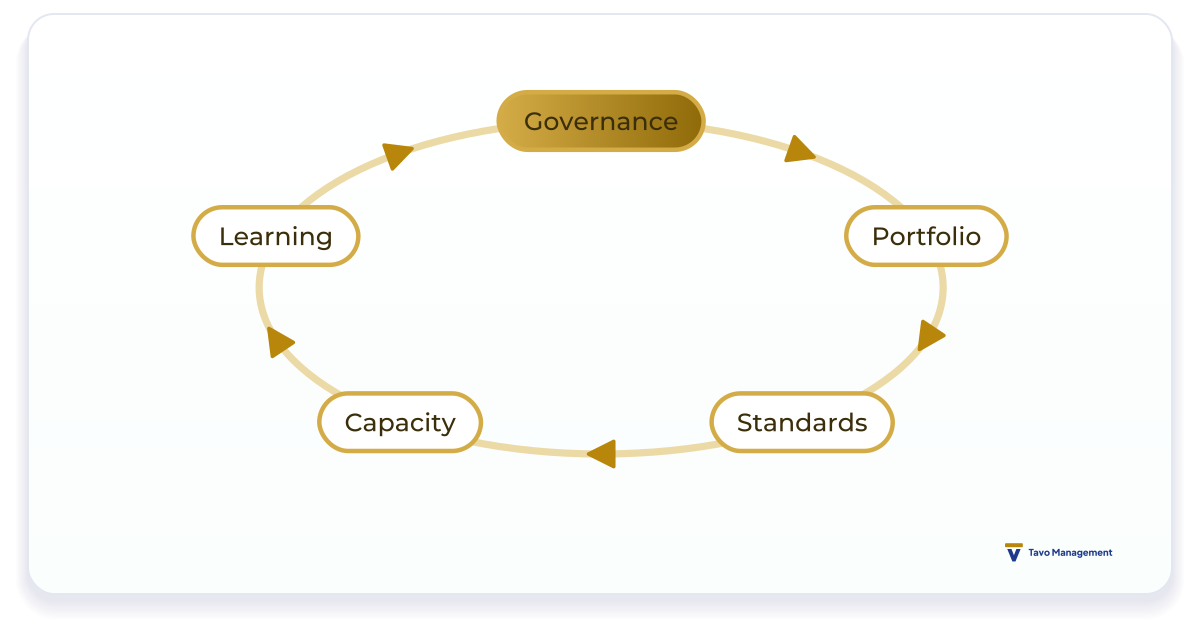
The layers are not independent boxes. Governance sets the rules that the portfolio layer applies, and the portfolio list tells delivery standards which projects need which tier. Capacity data feeds back into portfolio decisions, because approving a project without knowing who will do it is only a wish. Learning completes the loop by changing the rules in layer one and the templates in layer three.
This is why I suggest you build the layers in a rough order but review them together. A change in one place usually has a consequence in another. Adding a new gate in governance means new fields in the status report and a few more hours of reviewer time, and the framework should show that cost before anyone approves the gate. When you change a rule, write down which layers it touches and who needs to hear about it.
A one-page map helps. Draw the five layers as a loop, name an owner for each and write the single most important output beside it. When someone proposes an addition, ask which layer it belongs to and which existing item it replaces. That question alone has kept several of my clients from turning a clean framework into a thick manual.
How to Choose and Test Your Framework
Draw your five layers on a single page, and ask a project manager, a sponsor and a department head to explain what they see. If they describe three different things, the framework is not clear yet. Then pilot it on two or three projects for a quarter before extending it. When you are ready to turn the model into a plan with dates and owners, follow the phases in my PMO implementation guide.
- The PMO type is chosen and written in the charter.
- Decision rights are documented for ten common decisions.
- Standards fit on one page per template.
- Capacity is tracked for the scarce roles.
- A quarterly review is scheduled with the sponsor.
Questions About the PMO Framework
What Is a PMO Framework?
It is the structure that defines what a PMO owns, how it makes decisions and how it supports projects. A good framework covers governance, portfolio management, delivery standards, capacity and tools, and learning, and it is short enough to explain on one page.
What Are the Three Types of PMO?
The PMBOK Guide describes supportive, controlling and directive PMOs. Supportive PMOs offer templates and coaching, controlling PMOs set standards and check compliance, and directive PMOs run projects directly. Pick the type that fits your culture and your biggest problem.
How Is a PMO Framework Different from a Project Methodology?
A methodology describes how a single project is delivered, such as agile or waterfall. A PMO framework sits above it and defines how the organization chooses, governs and reports on all its projects, whatever method each team uses.
How Long Does It Take to Design a PMO Framework?
A first version usually takes four to six weeks including an assessment, interviews and a draft. Testing it on pilot projects adds a quarter. Resist the urge to polish before piloting, because real projects reveal gaps faster than workshops.
Can a Framework Work for Agile Teams?
Yes. Set common standards for risks, decisions and status fields, and let teams deliver in sprints. Agile teams can feed the same dashboard through sprint outcomes and a short monthly summary.
Who Should Own the PMO Framework?
The PMO lead owns it day to day, and the sponsor owns it in the sense of approving changes. Department heads should be consulted, because they supply the people and feel the effects of any new rule.
When Should I Revise My PMO Framework?
Review it every quarter against your measures, and revise it when the portfolio changes size, when leadership changes priorities or when teams routinely work around a rule. A rule that is regularly bypassed needs fixing, not enforcing.
General information only: this is not legal, financial or tax advice. Examples and numbers reflect typical projects; check the specifics with your advisers before deciding.
Did you find this helpful?
Thank you for your feedback.
Delaney Brisco
Delaney leads the Tavo editorial team and works with our consultants to turn real client projects into practical guides on project delivery, process design and organizational change. Before joining Tavo, she spent 12 years in operations and program management roles. She has since edited more than 300 articles on management practice and reviewed PMO setups and process redesigns from over 100 client projects. She is based in Minneapolis, Minnesota.