Summary
- A framework is a short set of principles, phases and roles that your team can remember and follow.
- Five phases cover most programs: define, structure, prepare, deliver and embed.
- Governance has three layers: sponsor, steering group and project leads, each with a clear job.
- Scale the framework to your size and add detail only where the program hurts.
Frameworks have a reputation for thick manuals that nobody opens. A good one does the opposite: it fits on a page and settles arguments before they start. If you want it set up for your organization, program management consulting can tailor the structure to your size and industry.
Below is the five-phase version I use with clients. It borrows from established standards and cuts everything a mid-sized organization rarely needs. Start with the overview table, then read the phases that matter most to you.
The Five Phases at a Glance
| Phase | Purpose | Main output | Owner |
|---|---|---|---|
| Phase 1: Define | Agree the goal, benefits, scope and sponsor | A program charter and a benefits table | Sponsor, program manager |
| Phase 2: Structure | Set governance, roadmap, budget and risk views | Governance note, dependency map and one status view | Program manager, steering group |
| Phase 3: Prepare | Plan people, communication and resources | Resource table and stakeholder plan | Program manager, business leaders |
| Phase 4: Deliver | Run projects in waves and review at gates | Stage-gate decisions and monthly reports | Project leads, steering group |
| Phase 5: Embed | Hand over, confirm benefits and close | Handover plan and benefit review | Benefit owners, program manager |
The Principles Behind the Framework
Two public standards shape most program frameworks. The PMI Standard for Program Management describes five performance domains: strategy alignment, benefits management, stakeholder engagement, governance and life cycle management, across three phases of definition, benefits delivery and closure. MSP, the Managing Successful Programmes guidance, builds on principles, governance themes and a flow of transformation. Both agree on what matters: the program exists to deliver benefits, and governance keeps the work honest. Check the current edition of each before you rely on the details.
I keep four principles from them. Every project serves a benefit. Decisions belong to people with authority. Risks are managed where they sit, including between projects. Benefits are measured after delivery, not assumed. The best practices in my guide to program management best practices grow from those same four.
Phase by Phase: What Happens and Who Decides
Phase 1: Define
The program starts with a written goal, a baseline, a benefit owner and a sponsor who commits time. The output is a short charter, usually two pages. It lists the benefits, the projects expected to deliver them, the budget range and the main assumptions. The decision to go forward is made by the sponsor and the funding body. If the benefits table is weak, stop here. Nothing later fixes a goal nobody can measure.
Phase 2: Structure
Now you build the machine. The steering group is formed, decision rights are written down and the integrated roadmap shows dependencies between projects. You set one budget view, one risk register and one status format. This phase is also where you decide what tooling you need. My ranking of program management software helps once your requirements are clear.
Phase 3: Prepare
Preparation covers people. You book scarce roles, plan communication to every affected team and decide how training will work. It is the phase most programs skip, and it is why many fail after a technically successful go-live. The output is a resource table and a stakeholder plan with dates. The program management checklist gives you eleven proofs to confirm you are ready to move on.
Phase 4: Deliver
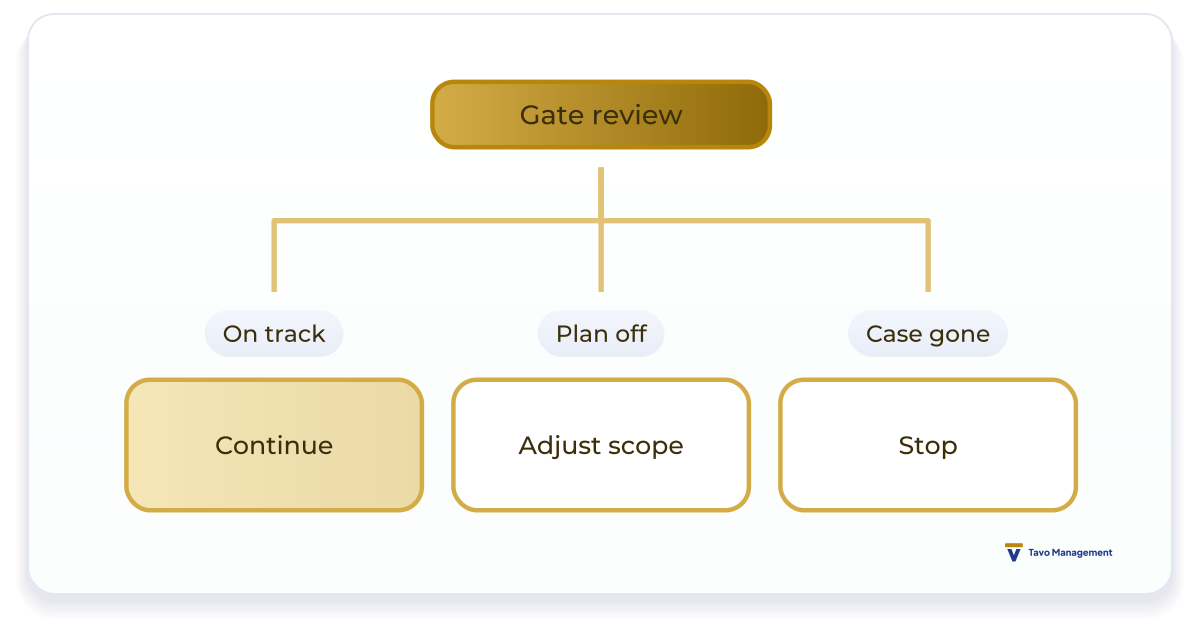
Projects run in waves. At the end of each wave, the steering group holds a gate: are benefits on track, are risks within tolerance, should the next wave start as planned? Monthly reports show progress and benefits together. Strong programs use gates to stop or change course, and not just to rubber-stamp. You will see this pattern in the program management examples for rollouts across clinics, stores and sites.
Phase 5: Embed
The last phase moves ownership to the business. The handover plan names the operational owner, the training needed and the metrics that will show whether the benefit holds. A benefit review three months and six months after closure completes the loop. The program closes when the benefit is secure, not when the last milestone passes.
Scaling the Framework Up or Down
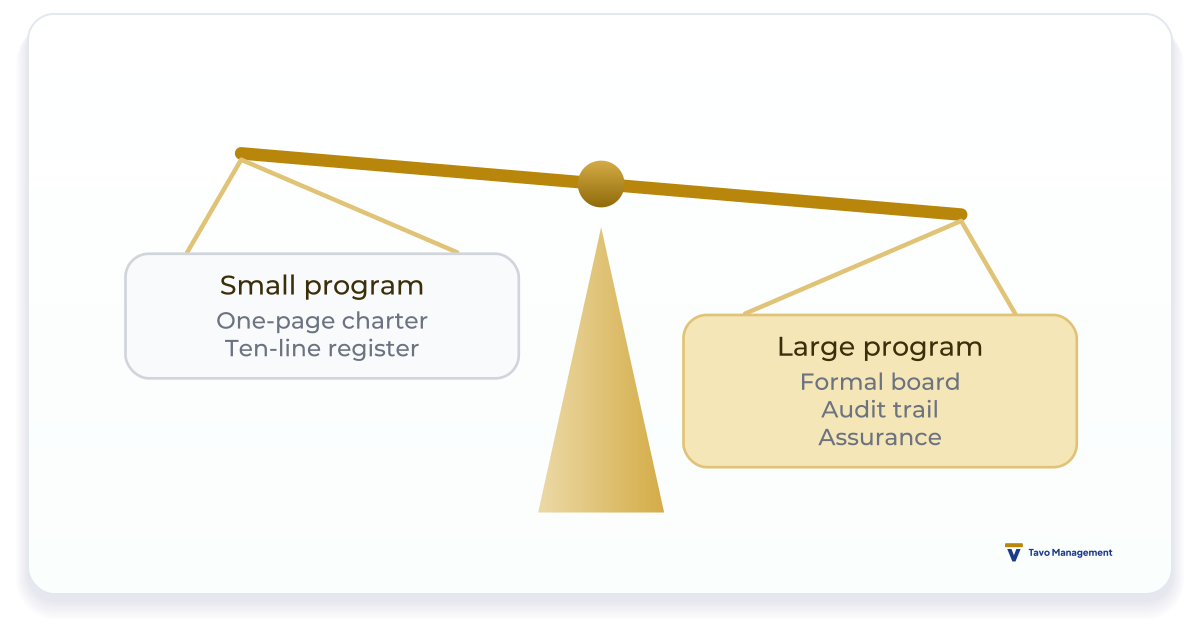
The same five phases fit very different programs. What changes is the amount of paper and the number of people in the room. The table shows the weight I normally recommend.
| Element | Small program (3 to 5 projects) | Mid-sized program (6 to 12) | Large or regulated program |
|---|---|---|---|
| Charter | One page | Two to three pages with benefits table | Full charter with formal approval and audit trail |
| Steering group | Sponsor plus two leaders, monthly | Five to seven people, monthly with weekly check | Formal board with delegated sub-groups |
| Risk register | Ten lines in a shared sheet | Fifteen to twenty rated entries | Integrated with enterprise risk reporting |
| Reporting | One page, monthly | One dashboard, refreshed weekly | Dashboard plus gate reports and independent assurance |
| Handover | Meeting and short guide | Training plan and benefit review | Formal acceptance and post-implementation review |
Start in the left column even if your program is large, and add weight when something goes wrong. It is easier to add a gate than to remove one that people have learned to dread.
Where Frameworks Break Down
Most framework failures are not design failures. They are adoption failures, and they follow a few patterns.
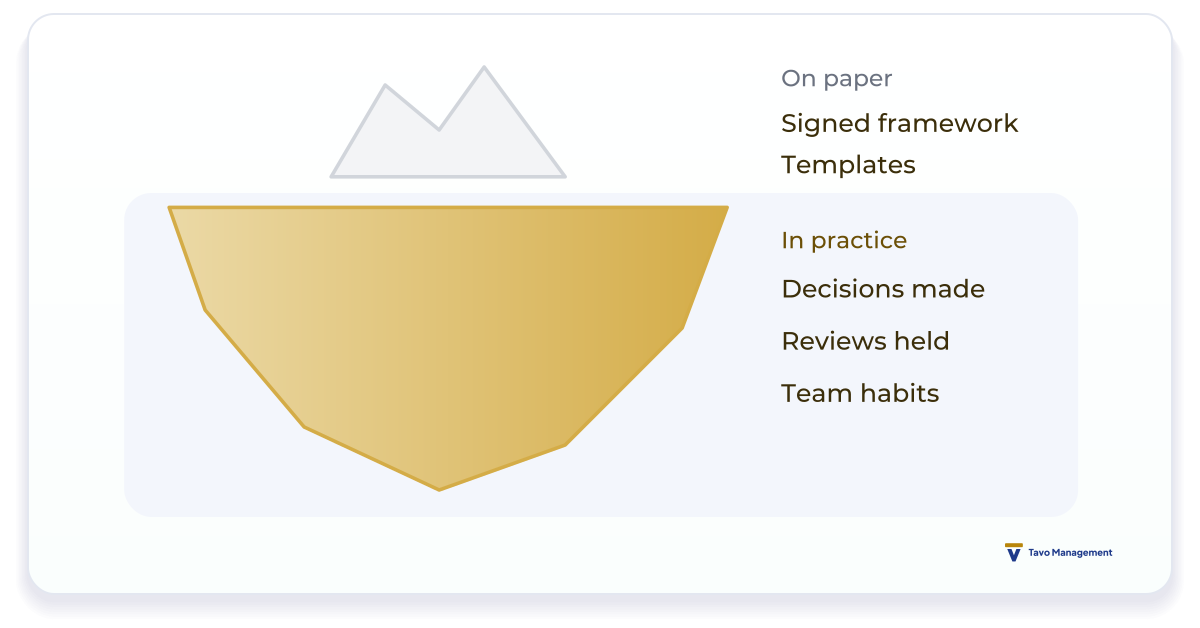
The first is the framework that lives in a document. People sign it off and never open it again. The fix is to build the framework into the meeting agendas, the report templates and the budget release rules, so following it is easier than ignoring it.
The second is gates that never say no. If no program has ever been stopped or changed at a gate, the gate is theater. I advise sponsors to ask at every gate one uncomfortable question: if this were a new proposal today, would we fund it? That question has stopped more weak projects than any scoring model I know.
The third is a framework that ignores people. Training, communication and handover are not extras. In the programs I review, the technical delivery is usually fine, and the benefit still fails because the team that has to use the result never changed its routine. That is why Phase 3 exists, and why it comes before delivery.
The fourth is copying a large organization's framework into a small one. A twelve-document gate pack makes sense for a bank under audit. It crushes a ten-person operations team.
The Three Governance Layers
Frameworks work when roles are clear. I use three layers, each with a different time horizon.
| Layer | Who | Focus | Rhythm |
|---|---|---|---|
| Sponsor | Senior executive accountable for the result | Goal, funding, major trade-offs | Monthly or at gates |
| Steering group | Sponsor, benefit owners, program manager, finance | Decisions, risks, benefits, scope changes | Monthly, shorter weekly check |
| Delivery | Program manager and project leads | Plans, dependencies, issues, reporting | Weekly |
The numbers that these layers review come from your program management KPIs. Pick a handful and keep the same set from launch to closure, so trends mean something.
Your First 30 Days With the Framework
A framework only helps once it is running. In the first week, write the one-page charter and get the sponsor to commit meeting time. Do not wait for the perfect version, because a rough charter that is signed beats a polished one that is still in review.
In week two, hold the dependency mapping session with every project lead and agree who owns each handoff. This is also the moment to list the five scarcest roles and check their load. Expect to find at least one clash, and treat it as proof that the exercise was worth the time.
In week three, set the steering rhythm and the report format. Run one dry-run meeting with real data, even if the numbers are rough. People learn the agenda by using it. Fix the template based on what confused them.
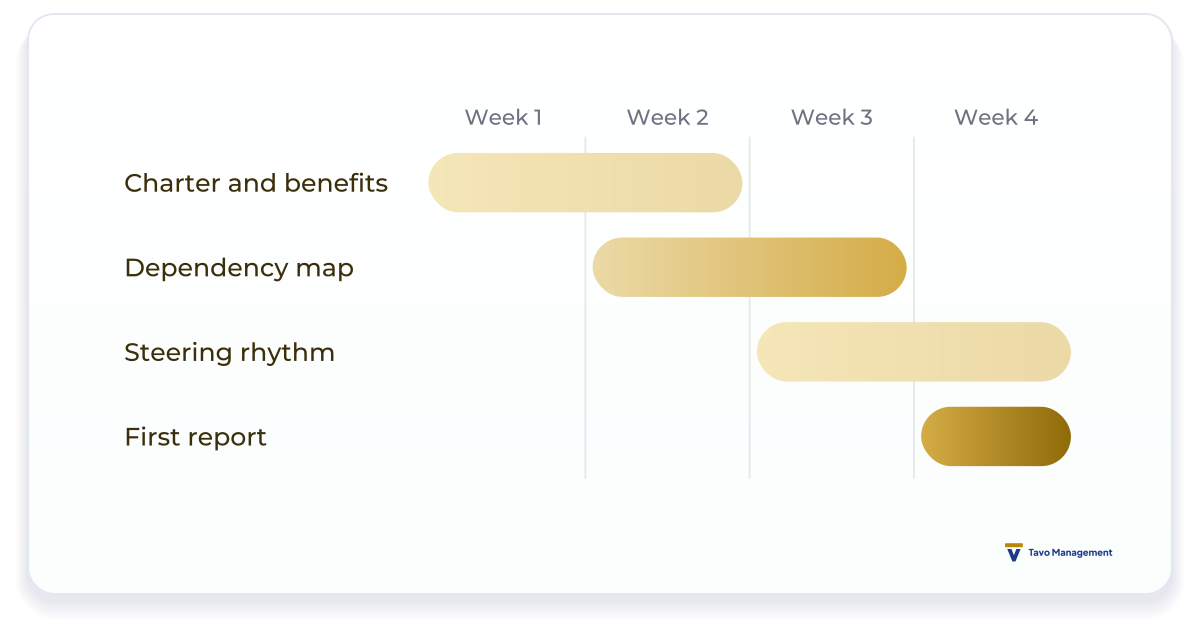
In week four, run the first full reporting cycle and ask each steering member one question: what decision did this meeting help you make? If the answers are vague, shorten the pack and sharpen the agenda. By the end of the month you have a working structure, a first list of risks with owners and a clear view of which phase needs the most attention next.
Keep a short log of what you changed in the framework and why. After a few months, that log becomes your own lessons-learned record, and it helps the next program start with a better version instead of a blank page. Share it with the PMO, if you have one, so improvements spread beyond a single program.
How to Choose the Right Weight for Your Framework
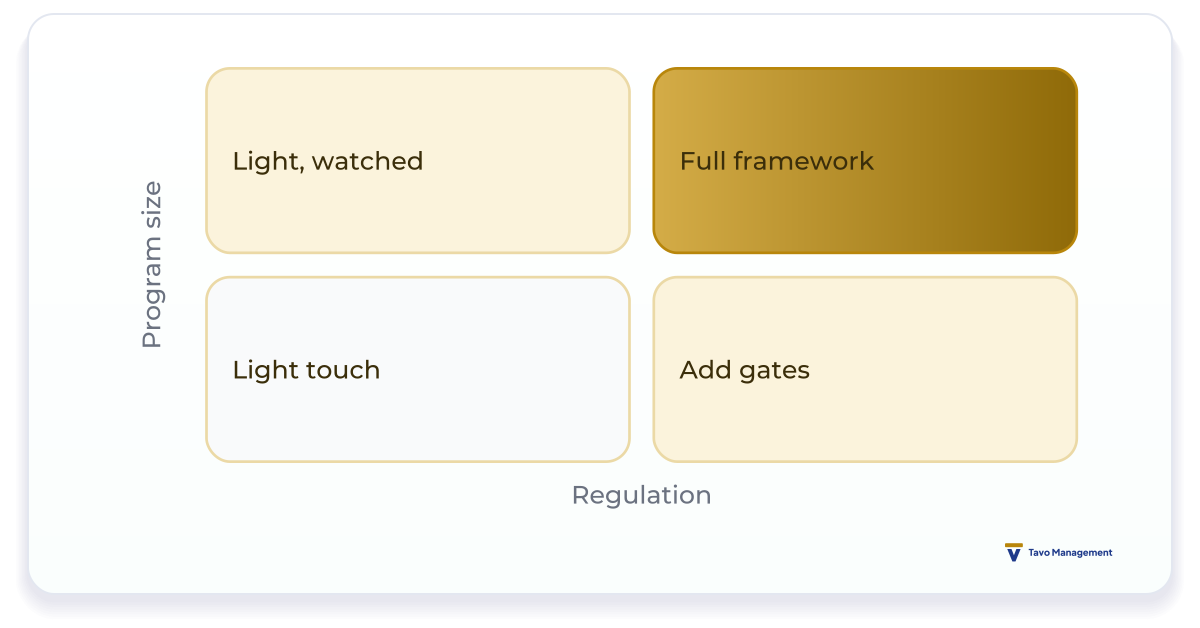
Match the framework to your program, not to a certification syllabus. Ask these questions:
- How many projects run in the program, and how tightly do they depend on each other?
- How much money and risk is involved if the program fails?
- Do regulators, auditors or partners expect a named standard?
- How experienced is your program team with formal governance?
Small programs can run all five phases on a handful of pages. Large, regulated programs need more documents at each gate. Add weight only where you find a real gap.
Questions About Program Management Frameworks
What Is a Program Management Framework?
It is a set of principles, phases and roles that tells you how a program is defined, governed, delivered and closed. It does not prescribe tools. A good framework is short enough that your team can remember it and flexible enough to scale to a small or large program.
Which Program Management Framework Should I Use?
Start from what your sector and your people already know. The PMI Standard for Program Management is widely used, and MSP (Managing Successful Programmes) is common in the UK and in government work. For most mid-sized organizations, a simplified framework built on their principles works better than full certification-level detail.
How Is a Framework Different from a Methodology?
A framework gives structure and principles and leaves details open. A methodology prescribes specific steps, documents and templates. Many organizations use a framework for governance and borrow methods, such as agile for software work, inside individual projects.
Can I Mix Agile and Traditional Approaches in One Program?
Yes, and most programs do. Governance, funding and benefits are usually planned in stages, while individual projects run in whichever style suits them. The program layer only needs consistent reporting, so progress from different styles can be compared.
How Many Phases Should a Framework Have?
Three to five is typical. PMI describes three life cycle phases: definition, benefits delivery and closure. I split definition into two and add a preparation phase, because that is where many programs lose time. Use fewer phases if your program is small.
How Long Does It Take to Put a Framework in Place?
A light version, with a charter, a governance note and a roadmap, can be ready in a few weeks. A fuller version with training and templates takes longer. The deciding factor is how fast your sponsors can agree on goals and decision rights.
Do I Need Certification to Use a Framework?
No. Certifications such as PgMP or MSP help individuals and may be required in some tenders, but you can apply the principles without them. What matters is that your team follows the same rules consistently.
Sources
Umbrex, PMI Standard for Program Management overview
General information only: this is not legal, financial or tax advice. Examples and numbers reflect typical projects; check the specifics with your advisers before deciding.
Did you find this helpful?
Thank you for your feedback.
Delaney Brisco
Delaney leads the Tavo editorial team and works with our consultants to turn real client projects into practical guides on project delivery, process design and organizational change. Before joining Tavo, she spent 12 years in operations and program management roles. She has since edited more than 300 articles on management practice and reviewed PMO setups and process redesigns from over 100 client projects. She is based in Minneapolis, Minnesota.